
Description
Key Technical Specifications
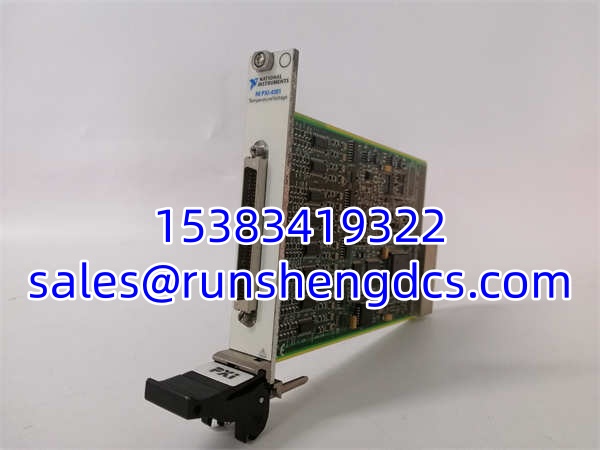
- Product Model: PXI-4351 185450D-01
- Manufacturer: National Instruments (NI)
- Product Type: Precision Temperature & Voltage Digitizer
- Input Channels: 16 Differential Analog Inputs
- ADC Resolution: 24-bit Analog-to-Digital Converter
- Thermocouple Accuracy: ±0.42 °C (J-type)
- RTD Accuracy: ±0.12 °C
- Thermistor Accuracy: ±0.03 °C
- Max Sample Rate: Up to 60 readings/s per channel
- Digital I/O: 8 TTL Lines
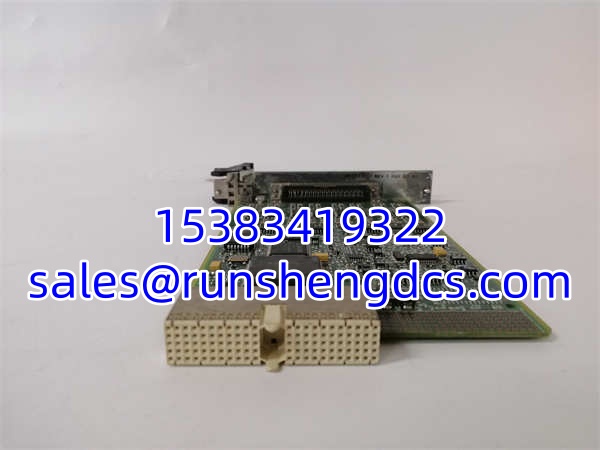
- Bus Interface: PXI / CompactPCI
Product Introduction
Debugging noisy thermocouple signals in an electrically loud plant is a nightmare. The NI PXI-4351 185450D-01 was built specifically to solve this by integrating 24-bit resolution with hardware-level power line noise rejection. It acts as a high-precision digitizer that bridges the gap between raw analog sensors and your computer, handling everything from J-type thermocouples to 4-wire RTDs without requiring external signal conditioning.
Engineers value the PXI-4351 185450D-01 because it replaces bulky, standalone temperature meters with a flexible, computer-based data-logging system. With 16 differential inputs and built-in cold-junction compensation, it guarantees that your thermal profiling data is accurate to within fractions of a degree. Bottom line — if you need to log temperatures reliably in a PXI chassis without fighting ground loops, this board is the workhorse you want.
QA/QC Transparency SOP
Analog measurement boards are unforgiving of physical defects. We validate every PXI-4351 185450D-01 with strict electrical testing:
- Intake & Origin Verification: We inspect the PXI connector for bent pins and check the PCB for thermal damage or leaking electrolytic capacitors.
- Live Functional Testing: The module is seated in a PXI chassis to verify backplane communication and successful enumeration in Measurement & Automation Explorer (MAX).
- Electrical Parameter Tests: Using precision signal generators, we inject known voltages and thermocouple offsets to verify the 24-bit ADC accuracy and cold-junction compensation.
- Firmware/Config Verification: We verify the EEPROM calibration constants are intact and the module responds to the NI-435x instrument driver.
- Final QC & Anti-Static Packaging: After passing, the module is cleared of test configurations, sealed in an ESD-safe bag, and shipped with a test certificate.
Field Engineer Gotchas
- Driver Compatibility Hell: The PXI-4351 is an older board. It does not work with modern NI-DAQmx. You must install the legacy “Traditional NI-DAQ” and “NI-435x” drivers. War story: I’ve seen engineers waste an entire weekend trying to make this board work on Windows 10 64-bit with modern drivers. Stick to Windows XP/2000 or verify driver support first.
- Cold-Junction Compensation (CJC) Errors: If your thermocouple readings are drifting by 2-3 °C, check the CJC sensor on the board. If the module was stored in a freezing warehouse and brought into a warm lab, give it 30 minutes to thermally stabilize before trusting the data.
- Differential Wiring: Do not ground the negative terminal of a differential thermocouple input. Ground loops will destroy your accuracy. Always use the board’s isolated ground reference.
- ESD Risk: The front-end analog circuitry is highly sensitive. Never plug or unplug thermocouple wires while the PXI chassis is powered on.
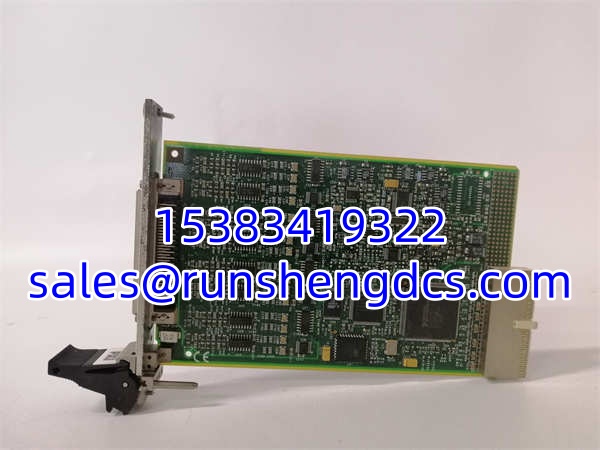
NI PXI-4351 185450D-01
Application Scenarios
- Thermal Profiling in Ovens: Monitors multiple zones simultaneously to validate temperature uniformity in semiconductor curing ovens.
- Battery Testing: Logs cell temperatures during charge/discharge cycles to detect thermal runaway conditions with ±0.12 °C precision.
- Environmental Chambers: Provides closed-loop feedback for climate testing, ensuring strict compliance with MIL-STD or ISO thermal specifications.
Real-World Case Study: A battery manufacturer was experiencing intermittent test failures because their old DAQ was picking up EMI from nearby robotic arms. The noise was causing false thermal shutdowns. We swapped in a PXI-4351 185450D-01 and utilized its differential inputs and built-in noise rejection filters. The ground loop issues vanished, and test yield improved by 4% within the first week.
FAQ
Will this work with my modern NI-DAQmx software?
No. The requires the legacy “Traditional NI-DAQ” driver and the specific “NI-435x” instrument driver. Modern DAQmx does not support this hardware.
Can I mix thermocouples and RTDs on the same board?
Yes, but you must configure each channel individually in software. The board supports 16 voltage/thermocouple channels, but RTD excitation requires specific wiring configurations. Check the manual for channel mapping.
What is the max sample rate?
It depends on the mode. In single-channel mode, you can get up to 60 readings/s. In multi-channel mode, the rate is divided across active channels. It is not designed for high-speed vibration analysis.
Do I need external signal conditioning?
For thermocouples and RTDs, no. The has built-in amplification, filtering, and cold-junction compensation. For standard voltage signals, it also includes precision attenuation.
Is this module hot-swappable?
No. PXI analog input modules should only be inserted or removed when the chassis is powered off to prevent backplane damage and data corruption.
Why are my readings noisy?
Check your wiring first. Ensure you are using shielded twisted-pair wire and that the shield is grounded at the chassis side only. Also, verify that your power line frequency filter (50Hz/60Hz) is configured correctly in software.