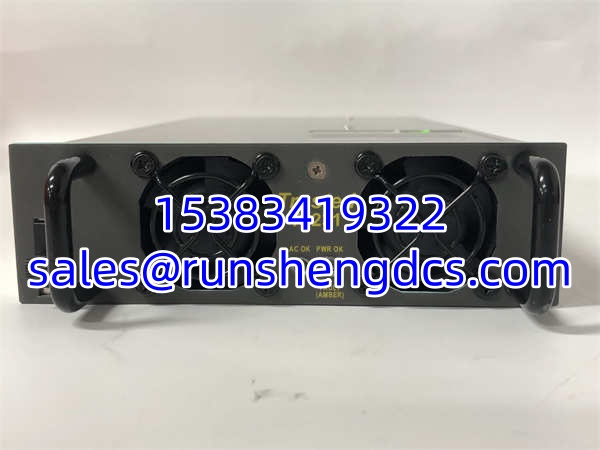

Description
Key Technical Specifications
| Parameter | Detail |
|---|---|
| Part Number | T8231 |
| Product Family | ICS Triplex Trusted TMR System |
| Module Type | Power Pack (System 24VDC) |
| Input Voltage | 85–264 VAC |
| Output Voltage | 24 VDC |
| Output Power | 750W per module |
| Chassis Compatibility | T8240 Power Shelf (up to 3 modules per shelf) |
| Redundancy | TMR — typically 2 modules active, 1 standby (or 2-of-3 voting) |
| Operating Temp | -20°C to +60°C (verify with OEM datasheet for exact range) |
| Protection | Overload, short circuit, overvoltage |
| Mounting | Backplane-mounted in T8240 power rack |
| Production Status | Legacy / Discontinued — surplus market only |
Product Introduction
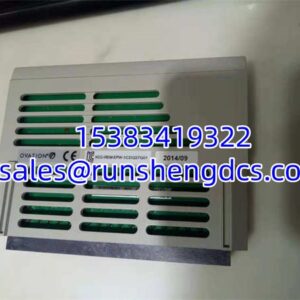
When a Trusted TMR controller rack loses a power supply module, the entire safety system’s redundancy posture drops immediately. The T8231 is the 24VDC system power pack that sits inside the T8240 power shelf — it converts 85–264 VAC mains into the clean 24VDC rail that feeds the processor modules, I/O cards, and communication interfaces across the Trusted chassis.
A typical Trusted installation runs two T8231 modules in a T8240 shelf (with the remaining slots filled by T8235 blanking plates). The TMR architecture means the system can tolerate the loss of one power module without dropping the 24VDC bus — the remaining module(s) carry the load. At 750W per module, a two-module configuration gives you enough headroom for a full processor rack plus expansion I/O. Bottom line — it’s not a fancy module. It’s a power supply. But in a SIL-rated safety system, a failed power supply with no spare means the entire safety controller goes dark. That’s why these show up on surplus lists at premium prices.
QA/QC Transparency SOP
For surplus or pulled T8231 units, a defensible test cycle:
- Intake & Origin Verification — Confirm the full part number on the module label (T8231, T8231C, or other revision). Photograph all markings, date codes, and any Rockwell/ICS Triplex branding. Log against source documentation.
- Live Functional Testing — Seat the module in a compatible T8240 power shelf. Apply AC input within the 85–264 VAC range. Verify the module powers up, the output rail reaches 24VDC (±5% tolerance), and the shelf’s status indicators show the module as healthy.
- Electrical Parameter Tests — Use a calibrated DMM to measure output voltage under no-load and loaded conditions. Verify current capacity approaches the 750W rating (approximately 31A at 24VDC). Check for excessive ripple on the DC output with an oscilloscope if available. Megger test input-to-output isolation.
- Protection Circuit Verification — Confirm overload protection trips at rated threshold and resets cleanly. Verify short-circuit protection responds without damaging the module. Check overvoltage protection on the output rail.
- Final QC & Anti-Static Packaging — Visual inspection for bulging capacitors, burnt traces, corroded connectors, or damaged backplane pins. Package in ESD-safe materials with foam inserts. Ship with a test certificate documenting output voltage, current capacity, and protection function results.
Field Engineer Gotchas
Gotcha #1: T8231 vs. T8232 — Don’t Mix System and Field Power
- Risk: The outputs 24VDC for the system (controller and logic). The T8232 outputs 28VDC for field power. They look physically similar and fit the same T8240 shelf. Installing a T8232 where a belongs will feed the wrong voltage to the controller backplane.
- Solution: Read the label carefully. = system power (24VDC). T8232 = field power (28VDC). Never assume they’re interchangeable.
- Blunt warning: Wrong voltage on the backplane can destroy processor modules. That’s a 15K mistake from a 500 power supply mix-up.
Gotcha #2: Running One Module When Two Are Required
- Risk: Some Trusted installations are configured for two modules in the shelf. If one fails and you’re running on a single module, you’ve lost redundancy. If that remaining module develops a fault, the entire safety system loses power.
- Solution: Treat a single-module condition as a critical alarm. Source a replacement immediately. Don’t let it sit in degraded mode for weeks.
- War story: A gas processing plant lost one in their ESD rack. Maintenance logged it as a “pending repair” for three months. The second module developed a capacitor fault during a thunderstorm. Entire safety system went dead. Forty-minute process shutdown before they got a spare installed.
Gotcha #3: AC Input Wiring Phase and Grounding
- Risk: The accepts 85–264 VAC, but the input wiring must match the site’s electrical distribution — single-phase vs. split-phase, proper grounding, and correct breaker sizing. A poorly grounded AC input can introduce noise onto the 24VDC rail, causing intermittent I/O faults.
- Solution: Verify AC source quality before connecting. Use a power quality analyzer to check for voltage sags, harmonics, and grounding issues. Size the input breaker per the module’s inrush current specification.
Gotcha #4: Thermal Derating in Enclosed Panels
- Risk: At 750W output, the generates significant heat. In a tightly packed shelf inside an enclosed panel with poor airflow, thermal derating kicks in — the module may not deliver full rated output at elevated ambient temperatures.
- Solution: Ensure the shelf has adequate ventilation. Verify the panel’s cooling system (fans, AC) is functional. Monitor module temperature via the Trusted system diagnostics if available.
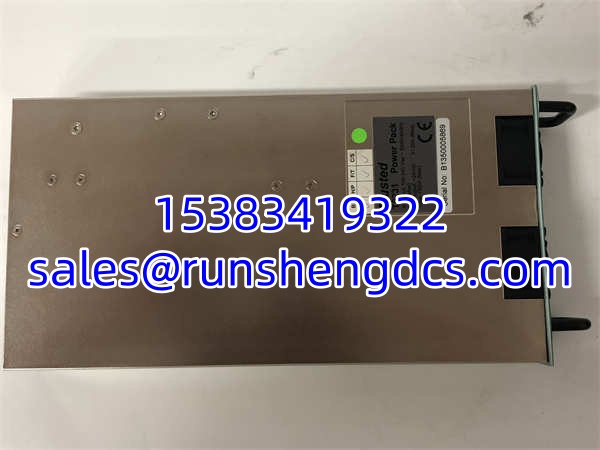
ICS TRIPLEX T8231
Application Scenarios
- Emergency Shutdown (ESD) systems in oil and gas production — the powers the Trusted TMR processor that executes safety logic for wellhead pressure, temperature, and flow trip conditions.
- Fire and Gas (F&G) detection systems in refineries — redundant power ensures that detector signals always reach the safety controller, even during a single power supply failure.
- Turbine protection in power generation — the Trusted system monitors vibration, overspeed, and lube oil pressure on gas and steam turbines; the keeps the processor alive through power disturbances.
- Burner Management Systems (BMS) in industrial boilers — SIL-rated safety logic requires uninterrupted power to the controller; dual modules provide that continuity.
FAQ
A: It’s a power supply module — specifically a 24VDC system power pack. It does not execute logic or process I/O. It provides power to the processor and I/O modules in the Trusted TMR system.
A: Typical installations use two modules in a shelf for N+1 redundancy, with the remaining slots filled by T8235 blanking plates. The shelf can physically hold up to three power modules. Verify your system’s configuration against the Trusted hardware manual for your specific application.
A: No. The outputs 24VDC for system power. The T8232 outputs 28VDC for field power. They serve different rails and are not interchangeable. Installing the wrong one can damage downstream modules.
A: No. The Trusted TMR platform is legacy/discontinued. New installations should use current-generation safety platforms. Existing Trusted systems are maintained through surplus channels and third-party service providers.
A: 750W at 24VDC, which translates to approximately 31A. In a dual-module redundant configuration, each module typically carries roughly half the total system load, so the system can tolerate the loss of one module while the remaining module picks up the full load — assuming the total load doesn’t exceed 750W.
A: One of the modules likely failed or was removed. The TMR architecture keeps the system running on the remaining module(s). Check the shelf’s diagnostic indicators to identify which slot is faulted. Replace the failed module before the remaining one also fails — you’re running without redundancy.
A: The Trusted system supports hot replacement of modules, but verify this capability for the specifically in your system’s hardware manual. Always follow the documented hot-swap procedure — improper removal can cause a transient on the DC bus that affects the running processors.