
Description
Key Technical Specifications
| Parameter | Specification |
|---|---|
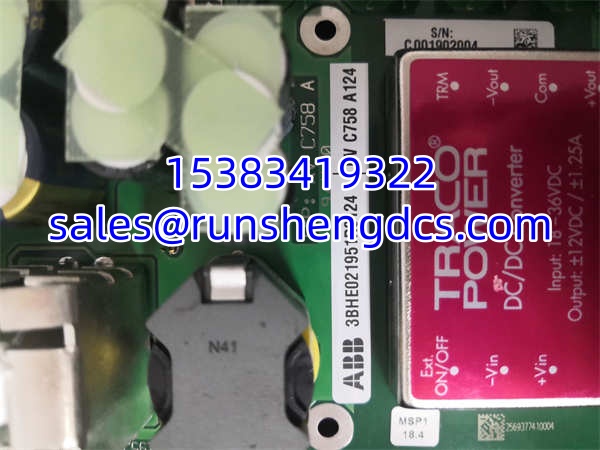
| Product Model | KVC758A124 |
| Part Number | 3BHE021951R1024 |
| Manufacturer | ABB |
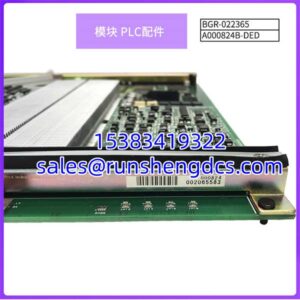
| Product Type | Drive Control Board Module (Plug-in PCB) |
| System Platform | ABB ACS800 / ACS880 Industrial Drive Systems |
| Power Supply | Powered via host drive control bus; typically 24VDC logic supply from main unit |
| Communication Interfaces | Internal ABB control bus; external fieldbus handled by host drive option modules (e.g., RPBA-01, RETA-02, RDCO-02) |
| Signal I/O | No direct field I/O; communicates via proprietary backplane connectors and internal control bus |
| Operating Temperature | 0°C to +55°C (inside ventilated control cabinet; host drive rating applies) |
| Storage Temperature | -25°C to +70°C (per general ABB drive component specs) |
| Installation Method | Plug-in board inside drive cabinet; secured with screws/stand-offs per ABB service manual |
| Form Factor | Board-level module; compact PCB designed for internal drive mounting (fits designated ABB control slot) |
| ESD Rating | Electrostatic Discharge Sensitive Device — handle with wrist strap and ESD mat |
| Certifications | CE, RoHS compliant (per ABB drive system standards) |
| Country of Origin | Finland / Global ABB manufacturing |
Product Introduction
The ABB KVC758A124 (part number 3BHE021951R1024) is a high-performance internal control board module designed for ABB’s ACS800 and ACS880 series industrial variable frequency drives. This plug-in PCB serves as a critical component within the drive’s control architecture, handling speed reference processing, torque control algorithms, and communication between the drive’s main processor and external option modules.
Unlike standalone PLC or DCS modules, the KVC758A124 is not a field-mountable device — it is a board-level component that installs directly inside the ABB drive cabinet, connecting to the host drive’s backplane via proprietary connectors. The module receives its 24VDC logic supply from the drive’s internal power distribution and communicates over ABB’s internal control bus. External fieldbus connectivity (PROFIBUS, Ethernet/IP, DDCS, etc.) is handled by separate option modules (such as RPBA-01, RETA-02, or RDCO-02) that interface with the KVC board through the drive’s option slot.
The KVC758A124 is commonly deployed in continuous-process and heavy-duty industrial environments where precise speed and torque control are critical. Typical applications include metals processing (rolling mills, cutters, coil handling), pulp & paper (winders, coaters, press sections), cement and mining (conveyors, crushers, fans), water & wastewater (blowers, high-lift pumps), and marine/offshore auxiliaries (thrusters, winches). The module’s operating temperature range of 0°C to +55°C is rated for installation inside ventilated drive cabinets, relying on the host drive’s thermal management system.
As an ESD-sensitive device, the KVC758A124 requires proper handling procedures during installation and maintenance. The board is secured inside the drive cabinet with screws and stand-offs per ABB’s service manual, and should only be handled by qualified technicians using ESD-safe tools and wrist straps.
QA/QC Transparency SOP
- Intake & Origin Verification: Confirm the model number is KVC758A124 and the part number matches 3BHE021951R1024. Verify the module came from an ABB ACS800/ACS880 drive teardown, surplus stock, or new-old-stock inventory. Check the revision label and compare against your drive’s firmware requirements — ensure compatibility with your specific drive family and software version. Inspect the physical condition: look for bent connector pins, corrosion on the backplane interface, damaged stand-off holes, or signs of overheating on components.
- Visual Inspection: Examine the PCB for swollen capacitors, burnt components, cold solder joints, or traces damaged by vibration. Check the backplane connector for secure mounting and intact locking mechanisms. Verify that all surface-mount components are properly seated and there is no evidence of moisture ingress or conformal coating degradation. Inspect the module label for legibility — the label should clearly show the model number, part number, and ESD warning markings.
- Power-Up Test (In-Drive): Install the module in a compatible ABB ACS800/ACS880 drive cabinet following the service manual’s installation procedure. Apply power to the drive and observe the drive’s status indicators. The drive should boot normally without control board fault codes. Verify that the drive’s control panel displays normal status and no KVC-related alarms are present.
- Communication Test: Connect the drive to your PLC/SCADA system via the appropriate fieldbus option module (e.g., RPBA-01 for PROFIBUS, RETA-02 for Ethernet/IP). Verify that the drive responds to speed references and torque commands from the master controller. Use ABB’s DriveWindow or DriveComposer software to confirm the KVC board is recognized and communicating properly with the drive’s main processor.
- Control Function Test: Run the drive in local mode and verify speed reference handling — command various speeds and confirm the drive responds accurately. Test torque control mode if applicable. Monitor the drive’s fault log for any intermittent control board errors. Verify that parameter sets are retained correctly after power cycles.
- Thermal Test (if applicable): For critical applications, operate the drive at rated load for an extended period (4–8 hours) while monitoring the control board’s temperature. Verify that the module operates within its 0°C to +55°C specification inside the ventilated cabinet. Check that the drive’s cooling system (fans, heatsinks) is functioning properly to maintain adequate airflow over the control board.
- Final QC & Packaging: After passing all tests, remove the module from the drive following proper ESD procedures. Inspect the connector pins for any damage from testing. Package in an ESD-safe bag with desiccant and shock-absorbing foam. Include a test report documenting power-up status, communication verification, control function test results, and thermal performance.
Field Engineer Gotchas
- vs. earlier KVC7xx revisions: If replacing an earlier KVC7xx revision board, capture the drive’s full parameter set before the swap. Parameter mappings or default values may differ between revisions, and a direct swap without parameter backup can cause unexpected drive behavior or trips.
- Not a standalone module: The is NOT a DIN-rail mount or standalone controller — it is a plug-in board that installs inside an ABB drive cabinet. Do not attempt to power it externally or mount it outside the drive. It has no direct field I/O and relies entirely on the host drive’s backplane and option modules for communication.
- ESD sensitivity: This board is marked as an Electrostatic Discharge Sensitive Device. Always use proper ESD precautions (wrist strap, ESD mat, grounded tools) when handling the module. Never touch the PCB traces or connector pins directly. ESD damage may not be immediately visible but can cause intermittent faults that are extremely difficult to diagnose.
- Drive compatibility: The is designed for specific ABB drive families (ACS800/ACS880 series). Verify compatibility with your exact drive model and firmware version before installation. Installing an incompatible control board can cause drive faults, communication errors, or even damage to the drive’s main processor.
- Option module dependencies: External fieldbus connectivity is handled by separate option modules (RPBA-01, RETA-02, RDCO-02, etc.), not by the KVC board itself. If you’re experiencing fieldbus communication issues, check the option module first — the KVC board may be functioning correctly while the fieldbus interface module is faulty.
- Parameter backup before replacement: Always download and save the drive’s complete parameter set before removing a faulty KVC board. After installing the replacement, upload the saved parameters to restore the drive to its previous configuration. This avoids time-consuming manual reconfiguration and reduces the risk of parameter errors.
- Cooling requirements: The relies on the host drive’s ventilation system for cooling. Ensure the drive cabinet’s cooling fans are operational and air filters are clean. Overheating is a common cause of control board failures in drive applications — a clogged filter or failed fan can push the board beyond its 55°C operating limit.
- Firmware matching: When replacing a KVC board, verify that the drive’s firmware version is compatible with the replacement board’s revision. Mismatched firmware can cause control instability or communication errors. Use DriveWindow/DriveComposer to check firmware versions and update if necessary.
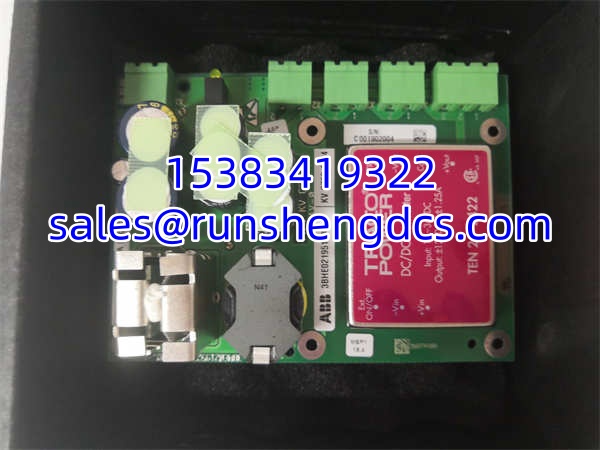
ABB KVC758A124 3BHE021951R1024
Application Scenarios
- Metals rolling mill drive control: In a steel rolling mill, an ACS880 drive equipped with a control board manages the main roll drive motor. The board processes speed references from the mill’s PLC via a PROFIBUS DP option module (RPBA-01), executing tight torque control algorithms to maintain consistent strip tension during rolling. When the original KVC board developed intermittent speed reference handling issues causing weekly production trips, replacing it with a verified restored stable operation, reducing downtime from hours to minutes per week.
- Pulp & paper winder section: At a paper mill, multiple ACS800 drives with boards control the drum winder section. The boards handle complex speed synchronization between the front and rear drum motors, ensuring uniform paper winding tension. The internal control bus communication between the KVC board and encoder feedback option modules provides real-time speed and position data for precise tension control. The module’s reliable operation inside the ventilated drive cabinet ensures continuous production in the mill’s humid environment.
- Cement plant conveyor drive: In a cement processing facility, an drive with a board controls a long-distance raw material conveyor. The board processes torque commands from the plant’s DCS system via an Ethernet/IP option module (RETA-02), managing soft-start sequences and overload protection for the conveyor motor. The drive’s control board handles the demanding duty cycle of continuous material transport in a dusty environment, relying on the drive cabinet’s sealed ventilation system to maintain the board within its operating temperature range.
FAQ
Q: What drives is the compatible with?
A: The is designed for ABB and series industrial drives. Verify compatibility with your specific drive model and firmware version before installation. Consult the ABB drive service manual or your drive’s nameplate data for the correct control board part number.
Q: Can I power the externally?
A: No. The is a plug-in board that receives its 24VDC logic supply from the host drive’s internal power distribution via the backplane connector. It cannot be powered externally or operated as a standalone module.
Q: Does the have fieldbus communication ports?
A: No. The communicates over ABB’s internal control bus. External fieldbus connectivity (PROFIBUS, Ethernet/IP, DDCS, etc.) is handled by separate option modules (RPBA-01, RETA-02, RDCO-02, etc.) that plug into the drive’s option slot and interface with the KVC board.
Q: How do I configure the ?
A: The is configured through the host drive’s parameter set, using ABB’s DriveWindow (for ) or DriveComposer (for ) software. There is no separate configuration tool for the KVC board itself — all control parameters are managed through the drive’s standard parameter interface.
Q: Is this module ESD-sensitive?
A: Yes. The is marked as an Electrostatic Discharge Sensitive Device. Always use proper ESD precautions (wrist strap, ESD mat, grounded tools) when handling the module. ESD damage may cause intermittent faults that are extremely difficult to diagnose.
Q: Can I hot-swap this board?
A: No. The is an internal drive component and cannot be hot-swapped. The drive must be powered down and locked out/tagged out before removing or installing the control board. Follow proper LOTO procedures and the ABB drive service manual for safe replacement.
Q: What’s the difference between and earlier KVC7xx revisions?
A: The is a specific revision in ABB’s KVC7xx control board family. Earlier revisions may have different component layouts, firmware requirements, or parameter mappings. Always verify the exact part number (3BHE021951R1024) matches your drive’s requirements, and back up parameters before swapping revisions.
Q: Is this board still available new?
A: The is a component for ABB’s / drive platforms. Availability depends on your region and the specific drive family. New and surplus units are available from ABB authorized distributors and independent suppliers. For critical drive applications, I’d recommend keeping a verified spare on-site — control board failures can cause significant unplanned downtime, and lead times for new units may be extended.