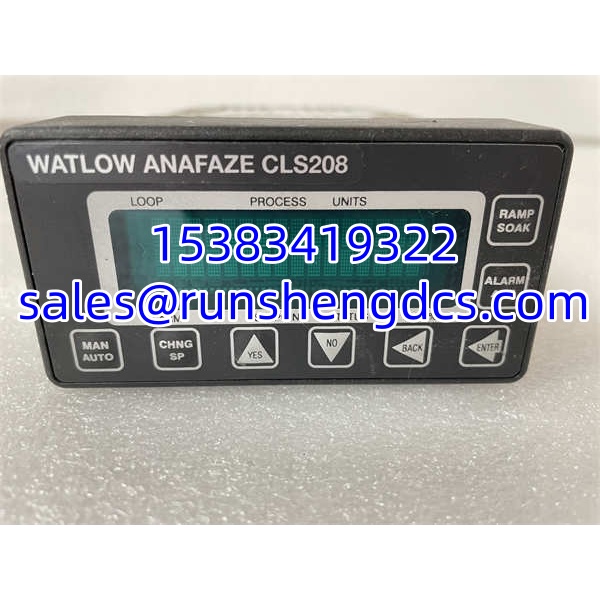

Description
Key Technical Specifications
| Parameter | Detail |
|---|---|
| Product model | CLS208 (ANAFAZE CLS200 series) |
| Manufacturer | Watlow Electric Manufacturing Company |
| Product type | 8-loop multi-loop PID process/temperature controller |
| Control loops | 8 independent loops |
| Input types | Thermocouple (J, K, T, E, R, S, B, N), RTD (PT100, 3-wire, 0.00385), 4-20 mA, 0-10 V, pulse/frequency |
| Output types | Relay, SSR drive, analog 4-20 mA / 0-10 V; configuration varies by option |
| Control algorithms | On/off, P, PI, PID with auto-tune |
| Programming | Ramp/soak profiles; multiple job storage |
| Communication | RS-232 standard; RS-485 / Modbus RTU option |
| Display | Dual-line display (character/numeric, model-dependent) |
| Power supply | Model-dependent: 90-250 VAC or 15-24 VDC variants |
| Sampling / scan | ~100 ms typical for CLS200 family |
| Accuracy | ±0.25% of span typical (verify per input type) |
| Operating temperature | 0°C to 50/55°C typical |
| Mounting | Panel-mount enclosure |
| Certifications | UL, cULus, CE typical |
Product Introduction
Replacing an old multi-loop controller without rewriting the entire heating strategy is a common brownfield headache. The CLS208 sits in that gap: an 8-loop ANAFAZE controller that handles thermocouples, RTDs, 4-20 mA, and 0-10 V inputs without needing a separate PLC for basic temperature regulation.
It is part of the Watlow ANAFAZE CLS200 family, designed for standalone multi-zone heating control. Each loop can run independent PID, on/off, or dual heating/cooling control, and the ramp/soak function handles batch profiles without external sequencers. RS-232/RS-485 serial communication allows integration with HMIs, PLCs, or data loggers, with Modbus RTU available depending on configuration. For plants still running CLS200 hardware, the CLS208 is a practical spare or replacement — but verify the option code, because input/output and power configurations are not universal across all CLS208 units.
QA/QC Transparency SOP
- Intake & Origin Verification: Confirm model CLS208, option/PN code (e.g., 208-1100110), serial number, and physical condition. Reject units with damaged terminal blocks, burnt components, or missing option labels.
- Live Functional Testing: Power up on a test bench. Verify display, keypad response, and loop recognition. Inject known TC/RTD/4-20 mA signals and confirm PV tracking and output response.
- Electrical Parameter Tests: Check power supply voltage, fuse continuity, output relay/SSR drive operation, and analog output scaling. Measure insulation resistance on power and I/O terminals where applicable.
- Firmware/Config Verification: Read software revision, loop configuration, communication settings, and ramp/soak programs. Back up parameters before clearing or reconfiguring.
- Final QC & Anti-Static Packaging: Perform final loop checkout, seal in ESD packaging with desiccant, and include test summary, option code, and photos.
Field Engineer Gotchas
- Option code mismatch: CLS208 units ship with different input/output/power options. A unit that looks identical on the front may have different analog outputs or communication ports. Always match the full option code, not just “.”
- Sensor type configuration: A K-type thermocouple wired to a loop configured for J-type will read incorrectly and can cause runaway heating. Verify sensor type and CJC settings before closing the loop.
- SSR drive vs relay output: SSR drive outputs are low-voltage DC signals, not mains-rated relay contacts. Wiring an SSR drive output directly to a mechanical relay coil or mains circuit can damage the controller.
- Serial address conflicts: If multiple ANAFAZE controllers share an RS-485/Modbus network, duplicate node addresses cause communication timeouts. Document addresses before adding a replacement.
- Ramp/soak state after power loss: Some configurations hold the last state; others revert to manual or hold. Verify post-power-up behavior before leaving the controller unattended.
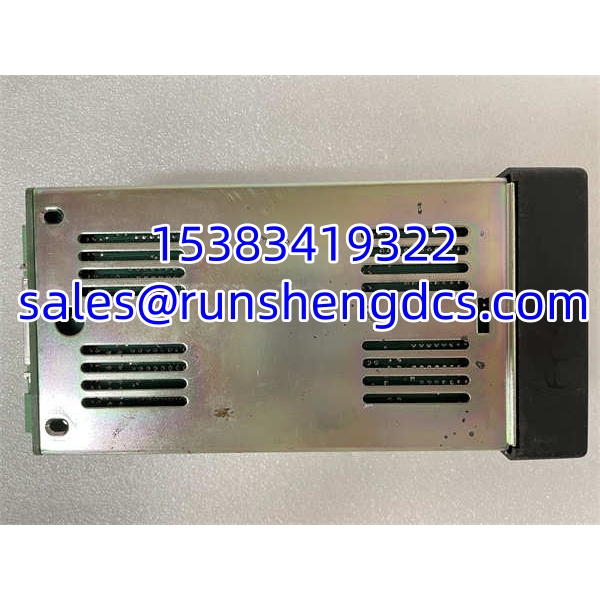
Watlow ANAFAZE CLS208
Application Scenarios
- Multi-zone plastic extrusion or injection molding: Controls barrel and die heating zones with independent PID loops and ramp/soak startup profiles.
- Batch oven and furnace profiling: Executes ramp/soak recipes for curing, drying, or heat-treating processes without external PLC sequencing.
- Packaging machine heat sealing: Maintains consistent seal bar temperature across multiple zones with fast PID response and alarm supervision.
- Semiconductor or electronics test equipment: Provides stable multi-channel temperature control for environmental test chambers and thermal fixtures.
FAQ
- Is the same as CLS204 or CLS216?
No. is the 8-loop version. CLS204 and CLS216 are 4-loop and 16-loop variants in the same CLS200 family. - Can I use for both heating and cooling?
Yes, many configurations support dual heating/cooling control per loop. Confirm the installed option supports this. - Does it support Modbus?
RS-485/Modbus RTU is available depending on configuration. Some units may have RS-232 only. Check the nameplate and communication port. - Can it replace a single-loop Watlow controller?
It can, but it is overkill for one loop. It is better suited for multi-zone applications or as a direct -family replacement. - Is still supported?
It is widely found in surplus and legacy systems. For new projects, confirm Watlow’s current recommended replacement family. - What power supply does it need?
Both 90-250 VAC and 15-24 VDC variants exist. Verify the specific unit’s power rating before installation. - Does it support auto-tune?
Yes, the family includes PID auto-tune. Use it after sensor and output configuration are confirmed correct.