
Description
Key Technical Specifications
| Parameter | Typical Value / Note |
|---|---|
| Manufacturer | UE / Precision Sensors (ECHOLINE LDP series) |
| Model | LDP1WC 250P-16 |
| Product Type | Pressure transmitter / transducer |
| Measurement Range | 0–250 psi |
| Pressure Type | Reported as absolute pressure in some sources; confirm gauge/absolute/sealed-gauge from the nameplate |
| Output Signal | 4–20 mA (2-wire analog) |
| Accuracy | ±0.5% full scale |
| Process Connection | 1/4″ NPT |
| Wetted Material | Stainless steel |
| Operating Temperature | -40°C to 85°C |
| Supply Voltage | Typically 12–36 VDC for 4–20 mA transmitters; verify from datasheet |
| Ingress Protection | Not confirmed for this specific model; verify IP/NEMA rating |
| Certifications | Not confirmed; verify UL/CE/ATEX markings on the nameplate |
| Mounting | Direct NPT thread mount; typical industrial transmitter form factor |
Product Introduction
A 4–20 mA pressure signal is the backbone of process visibility. The LDP1WC 250P-16, listed under the ECHOLINE LDP series and associated with UE/Precision Sensors, is a stainless-steel pressure transmitter designed to deliver a continuous 4–20 mA analog output across a 0–250 psi range. It plugs directly into a PLC or DCS analog input card, giving operators real-time pressure trending rather than a single trip point.
The important distinction here is that this is not a UE mechanical pressure switch like the H100 or 400 series. Those devices produce dry-contact SPDT/DPDT outputs for alarm or trip logic. The LDP1WC 250P-16 is an analog transmitter — it belongs in a measurement loop, not as a direct replacement for a mechanical trip switch. The “250P” almost certainly denotes the 250 psi range; the “-16” suffix and “LDP1WC” prefix should be confirmed against the actual device label, as this exact part number is not widely documented in UE’s mainstream catalog references.
QA/QC Transparency SOP
- Intake & Origin Verification: Record model LDP1WC 250P-16, serial number, and manufacturer label. Confirm whether the device is branded UE, Precision Sensors, or ECHOLINE. Inspect for damaged threads, cracked housings, and moisture ingress.
- Live Functional Testing: Apply a verified pressure source from 0 to 250 psi. Measure the 4–20 mA output at 0%, 25%, 50%, 75%, and 100% of span. Verify linearity within ±0.5% FS.
- Electrical Parameter Tests: Confirm loop supply voltage, loop current at zero pressure (should be ~4 mA), and absence of ground faults or shorted terminals.
- Leak and Wetted-Part Inspection: Pressurize the process connection and check for leaks at the NPT fitting and sensor diaphragm. Verify stainless steel wetted parts are free of corrosion or pitting.
- Final QC & Packaging: Seal in anti-static bag with desiccant. Label with model, serial, test date, measured accuracy, and zero/span readings.
Field Engineer Gotchas
- Transmitter vs. Switch Confusion: This is a 4–20 mA analog transmitter. It cannot directly replace a UE mechanical SPDT pressure switch in a trip circuit without re-engineering the logic in the PLC/DCS.
- Absolute vs. Gauge Pressure: Some sources list this model as absolute pressure. If your process requires gauge pressure (relative to atmosphere), an absolute-pressure transmitter will read ~14.7 psi higher at zero gauge. Verify the nameplate.
- Loop Power and Wiring: 4–20 mA transmitters require proper loop power and polarity. Wiring it like a dry-contact switch will not work. Confirm 2-wire vs. 4-wire configuration from the datasheet.
- NPT Thread Compatibility: The 1/4″ NPT connection must match the process tap. Use proper thread sealant rated for the process fluid and temperature. Over-tightening can crack the sensor housing.
- Surplus Calibration Drift: Used transmitters can drift out of calibration. Always bench-test the 4–20 mA output across the full span before installing it in a critical loop.
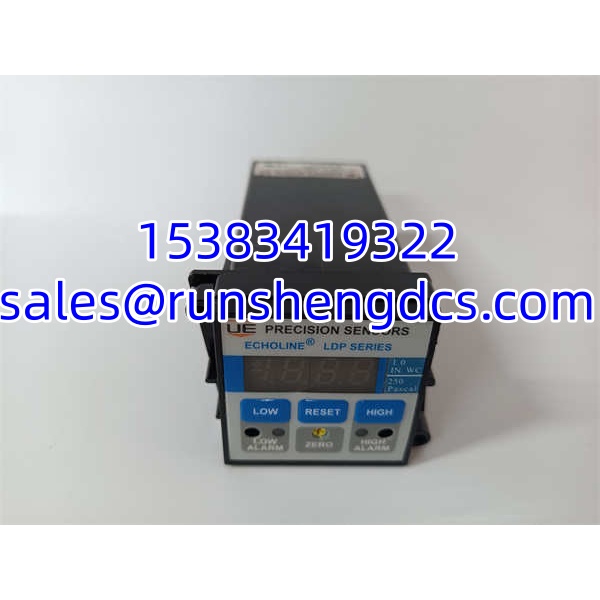
UE LDP1WC 250P-16
Application Scenarios
- Process pressure monitoring in PLC/DCS systems: Continuous 4–20 mA feedback for hydraulic, pneumatic, or process fluid lines where trending and alarm thresholds are handled in software.
- Compressor discharge monitoring: Real-time pressure tracking on air or gas compressors where operators need visibility beyond a single trip point.
- HVAC and utility systems: Monitoring chilled water, compressed air, or steam header pressure in building management or plant utility loops.
- Hydraulic system supervision: Providing analog pressure feedback to a motion controller or PLC for closed-loop pressure regulation.
FAQ
It is an analog pressure transmitter with a 4–20 mA output, not a mechanical dry-contact switch.
2. What is the pressure range?
0–250 psi.
3. What is the accuracy?
±0.5% full scale.
4. Can it replace a UE H100 or 400 series switch directly?
No. UE H100/400 series switches provide SPDT/DPDT dry contacts. The 250P-16 outputs 4–20 mA and requires an analog input card and software-based logic.
5. What process connection does it use?
1/4″ NPT.
6. Is it suitable for hazardous areas?
Not confirmed. Verify ATEX/UL/IECEx markings on the actual device nameplate before installing in classified areas.
7. What should I verify before buying a surplus unit?
Confirm the manufacturer label, output type (4–20 mA), pressure range, absolute vs. gauge designation, calibration status, and thread condition.