
Description
Key Technical Specifications
| Parameter | Specification |
|---|---|
| Part Number | 3625C1 |
| Module Type | Digital Output Module |
| Output Points | 32 points, common output |
| Nominal Voltage | 24VDC |
| Operating Voltage Range | 16–32VDC (max 36VDC) |
| Rated Current per Point | 1.7A maximum |
| Inrush Current | 7A within 10ms |
| Voltage Drop | Typically <2.8VDC @ 1.7A |
| Minimum Load Current | 10mA |
| Load Leakage | 4mA maximum |
| Point Isolation | 1500VDC |
| Module Power Dissipation | <13 watts |
| Safety Rating | SIL3 (IEC 61508), TMR architecture |
| Operating Temperature | -20°C to +50°C |
| Storage Temperature | -40°C to +70°C |
| Humidity | 5% to 95% RH, non-condensing |
| Hot-Swap | Yes — supports online replacement |
| Country of Origin | USA |
Product Introduction
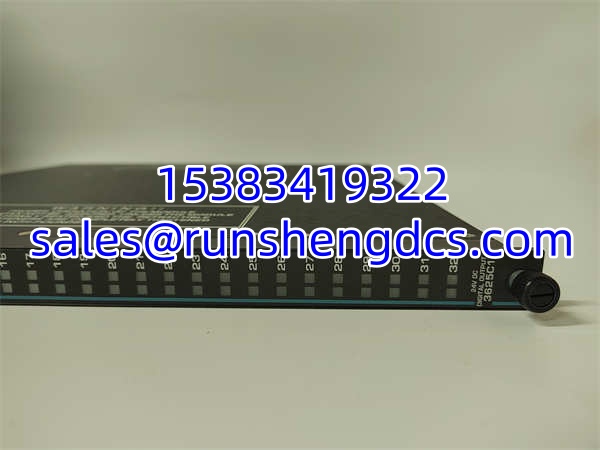
The TRICONEX 3625C1 is a 32-point, 24VDC digital output module for the Tricon safety system — the workhorse DO card that drives your ESD valves, solenoids, and relay trips. Built on Triconex’s signature Triple Modular Redundancy (TMR) architecture, each of the three independent sub-circuits executes the same output command, and a dedicated hardware voting mechanism ensures that a single-point failure in any one channel cannot produce a spurious output or, critically, a failure-to-trip. The module carries SIL3 certification per IEC 61508, making it suitable for the highest-integrity safety functions in petrochemical, power generation, and oil & gas applications.
The 3625C1 belongs to the broader 3625 series of digital I/O modules. The “-C1” suffix denotes a specific hardware revision within that family — other suffixes (such as 3625A, 3625H, 3625TCM) indicate different output configurations, terminal types, or communication capabilities. The module provides comprehensive onboard diagnostics with per-point and per-module LED indicators for output status, fault, load, and activation, and it supports hot-swap replacement so a failed card can be changed without taking the safety system offline. This is a legacy part that circulates primarily through surplus and refurbishment channels; when sourcing a replacement, the critical verification is matching the exact suffix to your installed unit, as different revisions may have different output driver types or terminal block configurations.
Troubleshooting Quick Reference
| Fault | Likely Cause | Relevancy | Quick Check | Fix |
|---|---|---|---|---|
| Single output channel not energizing | Blown field fuse, loose terminal, or failed output driver | High | Check field wiring and fuse at terminal block; measure output voltage | Replace fuse; reseat terminal; swap module if driver is failed |
| Module fault LED lit | Internal module fault detected by self-diagnostics | High | Check diagnostic LEDs and TriStation diagnostics | Replace module via hot-swap; send failed unit for repair |
| All outputs de-energized | Loss of field power or module not seated | High | Verify 24VDC field supply; check module seating and fasteners | Restore field power; reseat module and torque fasteners to 10 in-lb |
| Erratic output after replacement | Wrong revision or output type mismatch | High | Compare P/N suffix on new vs. original module | Match exact P/N (3625C1); verify output configuration in TriStation |
| Voting mismatch alarm | One sub-circuit disagreeing with the other two | Medium | Run module diagnostics in TriStation software | Identify failed sub-circuit; replace module if fault persists |
TRICONEX 3625C1
Application Scenarios & Pain Points
Emergency Shutdown (ESD) systems. The 3625C1 drives the solenoid valves that trip a process unit when dangerous conditions are detected. With 32 output points per module, a single card can handle a significant portion of an ESD valve array. When an output channel fails, that valve may not trip on demand — a dangerous failure mode that the TMR architecture is specifically designed to prevent.
Fire & Gas (F&G) systems. The module controls fire sprinkler deluge valves, gas suppression release devices, and audible/visual alarm equipment. The 1.7A per-point rating is sufficient to drive most industrial solenoids directly, eliminating the need for intermediate relay panels in many installations.
Turbine mechanical control. Steam and gas turbine control systems use the 3625C1 to drive servo valves and overspeed trip solenoids. The TMR architecture’s resistance to electromagnetic interference and mechanical vibration is critical in the electrically noisy environment near large turbine generators.