
Description
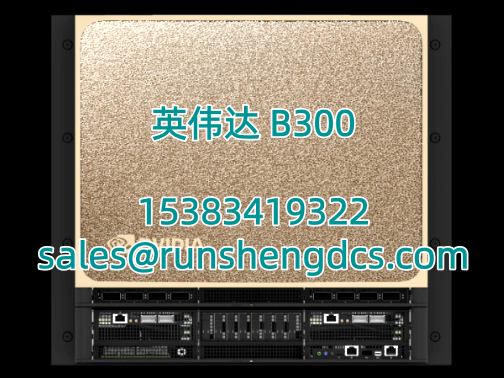
The NVIDIA B300 (officially “Blackwell Ultra”) represents NVIDIA’s most powerful single data center GPU to date, shipping from January 2026 as the pinnacle of the Blackwell architecture family. Built on the same dual-die Blackwell design as its predecessor B200, the B300 pushes performance boundaries through enhanced memory capacity, higher clock speeds, and optimized thermal design—delivering unprecedented AI inference throughput for enterprise-scale deployments.
Designed specifically for the “AI reasoning era,” the B300 addresses the critical bottleneck that has plagued large language model serving: memory capacity versus model size. With 288 GB of HBM3e memory per GPU—50% more than the B200—the B300 enables single-GPU hosting of 70B+ parameter models in FP16 precision, eliminating the complexity and latency penalties of multi-GPU tensor parallelism for mainstream enterprise workloads.
Application Scenarios
At a major European financial services firm running real-time fraud detection across 50 million daily transactions, the infrastructure team faced a critical dilemma: their Llama 70B FP16 model required sharding across two H200 GPUs, introducing 12-15ms inter-GPU communication latency that pushed end-to-end inference beyond their 20ms SLA threshold. After migrating to a single NVIDIA B300, the team eliminated cross-GPU synchronization entirely, reduced per-query latency to 8ms, and freed up the second GPU slot for concurrent batch processing—effectively doubling throughput without expanding rack footprint.
This scenario illustrates the B300’s core value proposition: memory capacity is the new compute bottleneck for AI inference. As reasoning models like OpenAI’s o-series and DeepSeek R1 generate massive KV caches during chain-of-thought processing, the 288 GB VRAM provides headroom to maintain large context windows without cache eviction, directly impacting reasoning quality and response consistency. For enterprises deploying agentic AI systems where multiple models run concurrently on shared infrastructure, the ‘s memory advantage translates to fewer GPU instances, simplified orchestration, and significantly lower total cost of ownership.
Parameter
| Main Parameters | Value / Description |
|---|---|
| Product Model | (Blackwell Ultra) |
| Manufacturer | NVIDIA |
| Product Category | Data Center AI Accelerator / GPU |
| Architecture | Blackwell Ultra (Dual-Die, SM103) |
| GPU Memory | 288 GB HBM3e (12-Hi stacks) — 50% more than B200, enables single-GPU 70B+ model hosting |
| Memory Bandwidth | 8 TB/s — Matches B200 but with 50% more capacity, improving effective bandwidth utilization |
| FP4 Dense Compute | 15,000 TFLOPS — 67% higher than B200; critical for quantized inference with minimal quality loss |
| FP8 Dense Compute | 7,000 TFLOPS — 55% improvement over B200 for mixed-precision training and inference |
| FP16 Dense Compute | 3,500 TFLOPS — Doubles effective throughput for FP16 workloads versus |
| TDP | 1,400W — Requires direct liquid cooling; 40% higher than , demanding infrastructure planning |
| Interconnect | NVLink 5 (1.8 TB/s per GPU) — Same generation as , enabling seamless multi-GPU scaling |
| Networking | ConnectX-8 (1.6T) — Doubles inter-node bandwidth versus ‘s 800G, reducing distributed training communication overhead |
| Form Factor | SXM6 (module) / PCIe (variants) |
| Software Stack | CUDA 12.x, cuDNN 9.x, TensorRT-LLM 0.15+, vLLM with FP4 support |
Technical Principles and Innovative Values
Innovation Point 1: 12-Hi HBM3e Memory Stack Architecture The transitions from the ‘s 8-Hi HBM3e stacks to 12-Hi configurations, physically increasing memory density without expanding die footprint. This engineering breakthrough maintains the 8 TB/s bandwidth while increasing capacity to 288 GB, fundamentally changing the economics of large model inference by reducing or eliminating the need for model parallelism across multiple GPUs.
Innovation Point 2: NVFP4 Native Precision with 15 PFLOPS Throughput Unlike previous generations where FP4 was an afterthought, the treats FP4 as a first-class citizen with dedicated 15,000 TFLOPS dense compute. Modern inference engines (TensorRT-LLM 0.15+, vLLM) increasingly support FP4 quantization with <1% quality degradation, effectively doubling effective throughput compared to FP8. For a 70B model serving 100+ concurrent users, this translates to 3-5× higher requests-per-second versus H200 infrastructure.
Innovation Point 3: ConnectX-8 1.6T Networking The upgrade from 800G () to 1.6T optical modules doubles inter-node bandwidth for multi-node training and distributed inference. In gradient synchronization-bound training workloads, this reduces communication overhead by up to 40%, directly improving scaling efficiency across cluster sizes.
Innovation Point 4: Thermal Design Optimization for Sustained Performance At 1,400W TDP, the leverages advanced power delivery and thermal management to maintain boost clocks under sustained AI workloads. The 40% power increase over is not merely higher consumption—it enables the clock headroom necessary to achieve the 67% FP4 performance uplift, delivering superior performance-per-watt for inference-optimized workloads.
Application Cases and Industry Value
Case Study: Autonomous Vehicle Simulation Platform at a Tier-1 Automotive Supplier
A leading German automotive supplier deployed systems to accelerate neural network training for autonomous driving perception models. Their previous H100-based cluster struggled with the memory requirements of 400M+ parameter vision transformers processing 8K multi-camera streams, forcing aggressive gradient accumulation steps that extended training epochs by 35%.
After migrating to (8× configuration), the team reported three transformative improvements: First, the 2.3 TB aggregate GPU memory allowed full-batch training of their largest vision models without gradient accumulation, cutting epoch time from 14 hours to 9 hours. Second, the FP8 training throughput enabled by Blackwell’s native support reduced mixed-precision overhead, improving convergence stability. Third, the ConnectX-8 networking halved inter-node synchronization time during distributed training across 4 DGX nodes, achieving 92% scaling efficiency versus 78% on their legacy infrastructure.
User feedback from the platform engineering lead: “The didn’t just speed up training—it changed our model development methodology. We can now experiment with architectures that were previously impossible due to memory constraints, and the 10U form factor fit our existing rack layout without structural modifications.”
Industry Value: For automotive AI development, the reduces time-to-validation for safety-critical perception models while maintaining the computational rigor required for regulatory compliance. The memory capacity advantage directly enables higher-resolution sensor fusion and longer temporal context windows—capabilities that translate to measurably safer autonomous systems.

Related Product Combination Solutions
| Related Model | Synergy with |
|---|---|
| Same Blackwell architecture family; ideal for mixed-cluster deployments where handles smaller models (7B-30B) and serves 70B+ workloads, optimizing cost-per-workload across the fleet. | |
| NVIDIA H200 | Hopper-generation alternative with 141 GB HBM3e; suitable for FP64-heavy HPC workloads or as a cost-effective inference node for models under 65B parameters where memory would be underutilized. |
| Predecessor DGX system (8× ); existing infrastructure can be seamlessly upgraded to using the same NVLink 5 and SXM6 form factor, preserving rack and cooling investments. | |
| NVIDIA GB300 NVL72 | Rack-scale system combining 72× GPUs with NVSwitch; for training 400B+ parameter models or serving massive concurrent user loads, the NVL72 extends single-node capabilities to exascale. |
| NVIDIA Grace CPU | Arm-based companion processor for in DGX Station and GB300 platforms; provides high-bandwidth coherent memory access for CPU-offloaded preprocessing and embedding operations. |
| NVIDIA BlueField-3 DPU | Data processing unit for offloading networking, storage, and security from GPUs; essential for multi-tenant cloud deployments running inference-as-a-service on infrastructure. |
| NVIDIA ConnectX-8 NIC | 1.6T networking interface matching ‘s native capability; required for building multi-node clusters that fully exploit the GPU’s distributed training potential without network bottlenecks. |
| NVIDIA Spectrum-X Ethernet | AI-optimized Ethernet switch platform for clusters; delivers consistent, predictable bandwidth for inference serving workloads where traditional InfiniBand may be over-engineered. |
Installation, Maintenance, and Full-Cycle Support
Pre-Deployment Infrastructure Requirements The at 1,400W TDP mandates direct liquid cooling (DLC) for sustained operation—air cooling is not viable for production deployments. The system requires approximately 14 kW per 10U chassis, necessitating rack power budget verification and potentially PDU upgrades. Data center operators should confirm coolant distribution infrastructure compatibility; Supermicro’s DLC-2 technology captures up to 98% of thermal load through liquid cooling, minimizing facility HVAC burden. Operating temperature range is 10°C to 35°C, with altitude derating above 900 meters.
Routine Maintenance and Operational Efficiency The shares the CUDA 12.x software ecosystem with , ensuring code portability without modification. Routine maintenance focuses on coolant loop monitoring, NVLink connector inspection, and firmware updates via NVIDIA Base Command Manager. The SXM6 module design enables hot-swappable GPU replacement in qualified HGX platforms, reducing mean-time-to-repair. For inference workloads, the ‘s higher memory capacity reduces the frequency of model reloading between different workloads, minimizing GPU idle time and improving cluster utilization rates.
Technical Support and Service Commitment NVIDIA provides comprehensive lifecycle support for through NVIDIA AI Enterprise software subscriptions, including access to optimized containers, security patches, and performance-tuned libraries. Hardware warranty spans 3-5 years with next-business-day replacement options for critical components. Enterprise customers receive dedicated technical account management, architecture review services, and migration assistance from H100/ infrastructure. For organizations requiring hands-on deployment support, NVIDIA-certified partners offer installation, rack integration, and performance benchmarking services to ensure systems achieve published throughput specifications within 48 hours of power-on.