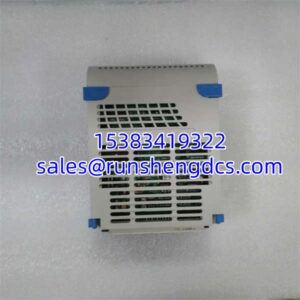

Description
Key Technical Specifications
| Parameter | Value |
|---|---|
| Product Type | VMEbus Single-Board Computer (SBC) |
| Brand / Series | GE Fanuc / Motorola / MVME2400 Series |
| Part Number | MVME2434 |
| Processor | PowerPC 7457 (G4) with AltiVec vector processing |
| Processor Speed | Model-dependent (up to ~1 GHz class; confirm from nameplate) |
| Cache | 64 KB L1 (32 KB I + 32 KB D); 512 KB on-chip L2; optional off-chip L3 |
| System Controller | Marvell Discovery II MV64360 |
| Memory | Onboard ECC SDRAM (32 MB – 512 MB range, model-dependent) |
| Non-Volatile Storage | Flash EPROM and NVRAM for firmware and configuration |
| VME Interface | VME64x, 64-bit data/address, 2eVME/2eSST capable |
| PMC Expansion | One 64-bit PMC mezzanine site |
| Ethernet | Dual 10/100 Mbps ports |
| Serial | Dual RS-232, full-duplex, up to 115.2 Kbps |
| Timers / DMA | Four 32-bit counters/timers; 8 DMA channels |
| Watchdog | Hardware watchdog with automatic reset |
| Operating Temperature | −40 °C to +85 °C (extended industrial grade) |
| Form Factor | 6U VME (233 mm × 160 mm) |
| OS Support | VxWorks (BSP provided); other RTOS support model-dependent |
Product Introduction
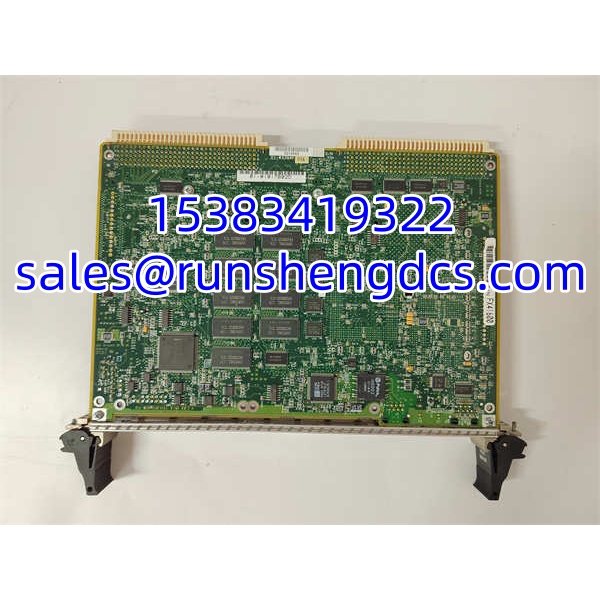
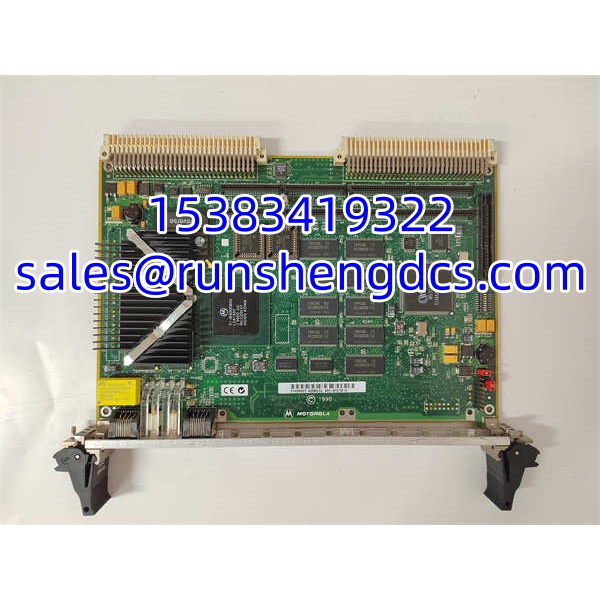
The MVME2434 is a 6U VMEbus single-board computer built around the PowerPC 7457 (G4) processor and the Marvell Discovery II MV64360 system controller. It delivers high-throughput processing for VME-based systems through a 64-bit VME64x interface, onboard ECC DRAM, and an AltiVec vector-processing engine that accelerates signal processing and data-intensive workloads. One PMC mezzanine site allows field expansion — for example, adding additional serial, fieldbus, or specialized I/O — while dual Ethernet ports and dual RS-232 serial ports provide standard network and console connectivity.
This board is found in legacy industrial control, aerospace, defense, and data-acquisition systems where VMEbus remains the installed base. Because the MVME2434 is a legacy product, replacement units are primarily available as surplus or refurbished stock. For field deployment, the critical diligence items are confirming the processor clock speed, DRAM size, firmware/BSP revision, and any installed PMC mezzanine card — mismatches in any of these can prevent the board from booting or integrating with the existing VME chassis configuration.
QA/QC Transparency SOP
- Intake & Origin Verification — Confirm branding (Motorola / GE Fanuc / Emerson), MVME2434 model, sub-model suffix, serial number, and manufacturing date. Photograph the nameplate, PMC site, and all connectors. Reject units with corrosion, cracked PCBs, or bent VME pins.
- Live Functional Testing — Install in a compatible VME64x chassis with proper power (+5 V, +3.3 V if required). Verify boot sequence, VMEbus enumeration, and OS load from Flash. Confirm both Ethernet ports link and both RS-232 ports transmit/receive.
- Memory & Storage Tests — Run a full ECC DRAM test to detect soft and hard errors. Verify Flash and NVRAM integrity. Check that the hardware watchdog triggers a reset as designed.
- PMC Site Verification — If a PMC mezzanine card is installed, verify it is recognized by the BSP and that its I/O functions correctly. Document the PMC model and firmware.
- Final QC & Anti-Static Packaging — Seal in ESD bags with desiccant. Include test summary, DRAM size, processor clock, firmware/BSP revision, Ethernet MAC addresses, and PMC configuration.
Field Engineer Gotchas
- Brand/Nameplate Confusion — The MVME2434 may carry Motorola, GE Fanuc, or Emerson branding depending on its manufacturing era and subsequent corporate transitions. These are the same hardware family. Fix: Match by model number and sub-model suffix, not brand alone.
- DRAM Size Mismatch — Different sub-models ship with different DRAM sizes. A board with less DRAM than the BSP expects may fail to boot. Fix: Read the DRAM size from the nameplate and confirm the BSP image matches. War story: A site swapped in a “compatible” that booted but crashed under load — the replacement had half the DRAM of the original, and the application image assumed the larger configuration.
- PMC Card Dependency — If the application relies on I/O provided by a PMC mezzanine card, a replacement board without the same PMC will lose critical interfaces. Fix: Inventory the PMC card model and firmware before removal. Blunt advice: The SBC without its PMC is often only half the system.
- VME64x Power Requirements — Some MVME2400 variants require +3.3 V from the backplane. An older VME chassis without +3.3 V rails may not support the board. Fix: Verify chassis power rails against the board’s requirements before installation.
- BSP/Firmware Revision — The VxWorks BSP revision must be compatible with the application image. A mismatched BSP can cause boot failures or driver incompatibilities. Fix: Archive the BSP version and application image from the live board before replacement.
GE MVME2434
Application Scenarios
- Legacy DCS controller replacement — A failed in a VME-based process control rack must be replaced during a planned outage while preserving the application image and network configuration.
- Aerospace test-stand controller — The SBC runs real-time test sequences, acquiring data via PMC-mounted I/O and reporting results over Ethernet.
- Defense data-acquisition node — The PowerPC 7457’s AltiVec engine accelerates signal processing for radar or sonar data streams routed over the VME backplane.
- Industrial retrofit platform — The serves as a migration bridge, running legacy VxWorks applications while new I/O is added via the PMC site.
FAQ
A: It was originally developed by Motorola Embedded Computing and later carried under GE Fanuc Embedded Systems and subsequent brand transitions. The hardware family is the same.
Q: What processor does it use?
A: A PowerPC 7457 (G4) with AltiVec vector processing and on-chip L2 cache.
Q: What operating system does it run?
A: Primarily VxWorks, with a BSP provided by the OEM. Other RTOS support is model-dependent.
Q: Can I add I/O expansion?
A: Yes. The board has one 64-bit PMC mezzanine site for additional serial, fieldbus, or specialized I/O.
Q: What is the memory configuration?
A: Onboard ECC SDRAM, size varying by sub-model (32 MB – 512 MB range). Confirm from the nameplate.
Q: Is it compatible with older VME chassis?
A: It is VME64x compliant and backward-compatible with VME64/VME chassis for basic operation, but some features (e.g., +3.3 V, 64-bit transfers) require a compatible backplane.
Q: Is this board still in production?
A: No. It is a legacy product available primarily as surplus or refurbished stock. Confirm processor clock, DRAM size, firmware revision, and PMC configuration before purchase.