
Description
Key Technical Specifications
| Parameter | Specification |
|---|---|
| GE Part Number | IS215UCVEH2AE |
| VME Part Number | VMIVME-7614-132350-017614-132 D |
| Manufacturer | GE (General Electric) |
| Product Series | Speedtronic Mark VIe Turbine Control |
| Product Type | UCVE VME Controller Card |
| Processor | Intel-based CPU |
| Power Supply | 5VDC |
| Operating Temperature | -20°C to +70°C |
| Storage Temperature | -40°C to +85°C |
| Front Panel Ports | 1× Ethernet, 2× COM ports, 1× LAN port |
| Expansion | Mezzanine card slot (for additional I/O or communication modules) |
| Rack Compatibility | 13-slot and 21-slot VME control racks (Mark VIe standard) |
| Mounting | Top and bottom front-panel retaining screws for secure rack installation |
| Real-Time OS Support | VxWorks, QNX |
| Redundancy | Supports RST (triple redundant) control architecture |
| System Bus | VME backplane interface for communication with I/O modules |
| Diagnostic Features | Remote diagnostics, local fault logging, maintenance interface |
| Certifications | CE compliant |
| Product Status | Legacy / Discontinued — spare/replacement only |
Product Introduction
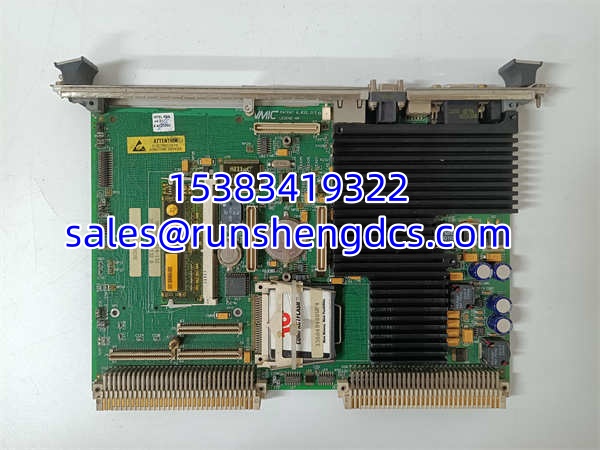
When a GE Speedtronic Mark VIe turbine control system needs a brain, the IS215UCVEH2AE (VMIVME-7614-132350-017614-132 D) is the card that does the thinking. This isn’t a generic VME processor — it’s a purpose-built UCVE (Universal Controller VME) card designed specifically for GE’s Mark VIe turbine control architecture, serving as the central processing unit that executes the real-time control logic keeping gas and steam turbines running safely and efficiently.
The IS215UCVEH2AE sits at the top of the Mark VIe control hierarchy. It runs the turbine control program — fuel scheduling, speed governing, temperature limiting, protective tripping — on an Intel-based processor using a real-time operating system (VxWorks or QNX). The card communicates with all the I/O modules in the VME rack via the VME backplane, collecting field data from analog input cards, servo valve cards, thermocouple cards, and RTD cards, processing that data through the control algorithms, and sending output commands back to the field devices. In redundant (RST) configurations, three UCVE cards run in parallel, voting on outputs to ensure that a single card failure doesn’t cause a turbine trip.
The front panel is the operator’s window into the controller. It features an Ethernet port for network communication with the HMI workstation and plant DCS, two COM ports for serial communication with peripheral devices or configuration tools, and a LAN port for additional network connectivity. The mezzanine card slot on the front panel allows for hardware expansion — adding specialized communication interfaces, additional serial ports, or custom I/O without requiring a separate VME slot. The top and bottom retaining screws secure the card firmly in the rack, preventing vibration-induced connector loosening in high-vibration turbine hall environments.
The IS215UCVEH2AE is part of the broader Mark VIe ecosystem, working alongside cards like the IS200VSVOH1B (servo valve), IS200VTURH1B (turbine control), IS200VTCCH1C (thermocouple), IS200VRTDH1D (RTD), IS200VAOCH1B (analog output), and IS215VCMIH1B/IS215VCMIH2B (communication interface). The UCVE card orchestrates all of these modules, collecting their data, executing the control logic, and coordinating their actions.
Why it matters: in a turbine control system, the UCVE controller card is the single most critical component. If it fails, the turbine loses its brain — the control logic stops executing, outputs freeze or go to safe state, and the turbine trips. In a redundant system, the other two cards can take over, but you’re now running without redundancy, which is a high-risk condition. Having a tested spare UCVE card on the shelf means you can restore full redundancy during a planned outage rather than gambling on a single-card configuration until a replacement can be sourced for a discontinued product.
QA/QC Transparency SOP
Every IS215UCVEH2AE / VMIVME-7614-132350-017614-132 D goes through a five-step verification process:
- Intake & Origin Verification: We cross-check both the GE part number label (IS215UCVEH2AE) and the VME board-level label (VMIVME-7614-132350-017614-132 D) against GE’s known production records for the Mark VIe series. We verify the serial number and revision code to confirm authenticity — counterfeit VME controller cards are a known problem in the surplus market.
- Visual & Mechanical Inspection: We inspect the PCB for burnt components, cracked solder joints, or corrosion. We verify that the front panel ports (Ethernet, COM, LAN) are intact and undamaged. We check the mezzanine card slot for bent pins and verify that the retaining screws are present and thread correctly. We inspect the VME backplane connector pins for straightness and corrosion.
- Power-Up & Boot Test: We install the card in a test VME rack and apply 5VDC power. We verify that the card boots correctly, the real-time operating system (VxWorks or QNX) loads without errors, and the card completes its self-test sequence. We verify that all front panel LEDs indicate normal operation.
- Communication & Functional Verification: We verify Ethernet communication by pinging the card from a test workstation. We verify COM port functionality by connecting a serial terminal and confirming bidirectional communication. We verify VME backplane communication by confirming the card can read from and write to test I/O modules in the rack. If a mezzanine card is installed, we verify its functionality as well.
- Final QC & Anti-Static Packaging: After passing all tests, the card is bagged in ESD-safe packaging with a printed test report. No unit ships without a signed-off QC sheet documenting power-up test, boot verification, communication tests, and visual inspection.
Field Engineer Gotchas
- Firmware Version Matching Is Critical in Redundant Systems: In an RST redundant configuration, all three UCVE cards must run the same firmware version. A mismatch can cause voting errors, communication failures between cards, or unpredictable control behavior. Always document the firmware version of the original card before removal and verify the replacement matches. War story: A combined-cycle plant in the Midwest replaced a failed UCVE card with a surplus unit that had an older firmware version. The three cards couldn’t agree on output values, causing the turbine to trip on a “voting disagreement” fault. They had to downgrade the replacement card’s firmware to match — a 2-day process requiring GE ToolboxST software and a qualified technician.
- Mezzanine Card Configuration Must Be Replicated: If your original UCVE card has a mezzanine card installed (additional communication ports, custom I/O, etc.), the replacement must have the same mezzanine card. The control program may be configured to use the mezzanine card’s resources — if it’s missing, the program will fault. Always photograph the original card’s mezzanine configuration before removal.
- Retaining Screws Are Not Optional: The top and bottom front-panel retaining screws are critical for securing the card in the VME rack. In high-vibration turbine hall environments, a loose card can work its way out of the backplane connector, causing intermittent communication failures or a complete loss of control. Always torque the retaining screws to spec during installation.
- Not Hot-Swappable in All Configurations: While the Mark VIe system supports some level of hot-swap capability for redundant cards, GE’s official guidance is to follow your plant’s specific procedures. Hot-swapping a non-redundant (single-card) UCVE will cause an immediate turbine trip. Even in redundant systems, hot-swapping can cause transient communication disruptions. Always de-energize the slot if procedures allow.
- Ethernet Port Configuration: The front-panel Ethernet port is used for communication with the HMI workstation and plant DCS. If you’re replacing a card, the IP address and network configuration must be set correctly — either through the control program download or through the card’s configuration interface. A wrong IP address can isolate the card from the network, preventing HMI communication and control program downloads.
- VME Backplane Connector Wear: After years of insertion and removal, the VME backplane connector pins on the card can wear or bend. A worn connector can cause intermittent communication with the backplane, leading to I/O read errors or control logic faults. Always inspect the connector pins carefully before installation.
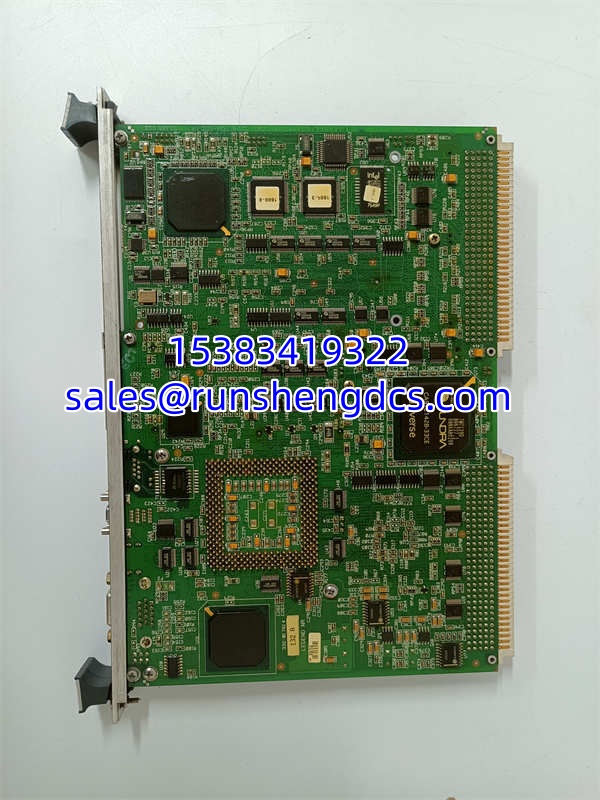
GE IS215UCVEH2AE VMIVME-7614-132350-017614-132 D
Application Scenarios
- Gas turbine control: The primary application — executing the real-time control logic for GE Frame B, E, F, and H-class gas turbines. The UCVE card processes fuel scheduling, speed governing, acceleration control, temperature limiting, and protective tripping functions. It communicates with servo valve cards (IS200VSVOH1B) for fuel control, thermocouple cards (IS200VTCCH1C) for exhaust temperature monitoring, and RTD cards (IS200VRTDH1D) for bearing temperature monitoring.
- Steam turbine control: Executing control logic for GE steam turbines in combined-cycle and standalone applications. The UCVE card processes speed governing, load control, extraction pressure control, and protective tripping. It interfaces with servo valve cards for steam control valve positioning and thermocouple/RTD cards for temperature monitoring.
- Redundant (RST) turbine control: In critical applications, three UCVE cards run in parallel in an RST (triple redundant) configuration. Each card executes the same control logic independently, and a voting system compares their outputs. If one card fails or disagrees with the other two, it’s isolated and the remaining two continue to control the turbine. This provides the highest level of reliability for base-load power generation.
- Industrial process control: Beyond turbine control, the Mark VIe platform with UCVE cards is used in other industrial process control applications where high reliability and real-time performance are required — compressor control, pump control, and general process automation.
- Spare parts for aging Mark VIe installations: Many GE Mark VIe turbine control systems are 10–20 years old. UCVE controller cards can fail due to component aging, capacitor drying, or connector wear. Since the product is legacy/discontinued, having a tested spare on the shelf is essential for minimizing unplanned outage time.
FAQ
A: They are two part numbers for the same physical card. is GE’s system-level part number used in Mark VIe documentation and spare parts catalogs. VMIVME-7614-132350-017614-132 D is the VME board-level part number (from the original VMI/GE joint venture era) printed on the PCB itself. Both refer to the same UCVE controller card.
A: The is a Mark VIe card. Mark VI systems use different controller cards (typically IS200-series VME cards like IS200UCVEH2A). While both are VME-based, they are not directly interchangeable due to differences in firmware, backplane communication protocols, and I/O module compatibility. Verify your system’s series before ordering.
A: Yes. The UCVE card can operate in a single-card (non-redundant) configuration. However, this means there is no redundancy — if the card fails, the turbine will trip. Most critical power generation applications use the RST triple-redundant configuration for maximum reliability.
A: The #1 cause is front-panel Ethernet port failure — the RJ45 connector can suffer from pin corrosion, physical damage from repeated cable insertion/removal, or internal component failure. The second most common issue is VME backplane connector wear from repeated insertion/removal, leading to intermittent communication with I/O modules. Capacitor aging on older cards is also a known failure mode.
A: Firmware updates for the Mark VIe UCVE card should only be performed by qualified GE service technicians using the ToolboxST software. If you’re replacing a failed card in a redundant system, the safest approach is to match the firmware version of the existing cards. Contact GE support for firmware update procedures.
Q: Is this product still available new from GE?
A: No, the / VMIVME-7614-132350-017614-132 D is a legacy/discontinued product. It is only available through surplus suppliers and aftermarket channels. For new installations, GE has newer turbine control platforms (Mark VIeS) that should be used instead. The is suitable for repair, reuse, and replacement of existing Mark VIe systems only.