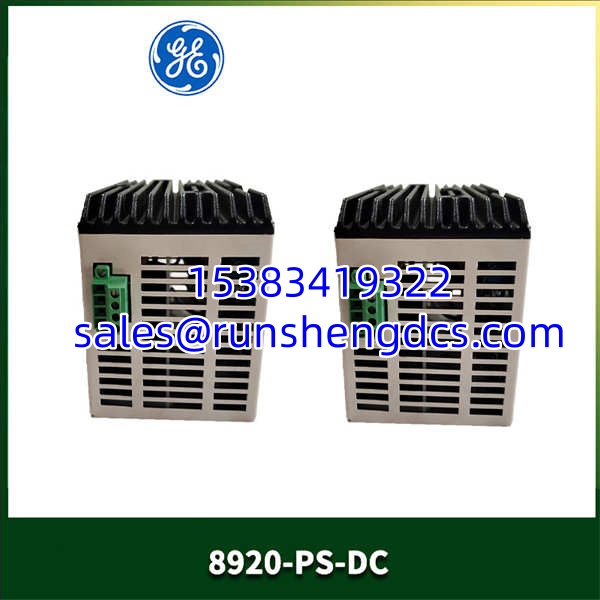

Description
Key Technical Specifications
| Parameter Name | Parameter Value |
|---|---|
| Product Model | 8920-PS-DC |
| Manufacturer | GE Fanuc Automation |
| Product Type | IS Module DC Power Supply |
| Input Voltage Range | 18.5 VDC to 36 VDC |
| Output Current | 5A DC |
| Energy Consumption | ~16 Watts (Typical) |
| Protection Features | Overload, Short-Circuit, Reverse Polarity |
| Operating Temperature | +5°C to +55°C |
| Dimensions | 53mm (W) x 263mm (H) x 317mm (D) |
| Mounting Style | DIN Rail / Panel Mount |
| Series Compatibility | GE IS Module Series |
| Input Current | ~10mA (Standby/Logic) |
Product Introduction
Power supplies in industrial control cabinets are the first thing to fail when voltage sags hit, yet they’re often the last component engineers check. The GE 8920-PS-DC was designed to handle the dirty 24VDC plant power that destroys consumer-grade adapters. With a wide input range of 18.5 to 36 VDC, it doesn’t just regulate; it survives. This module is the heartbeat for any GE IS rack, converting raw plant power into the clean, stable 5A DC rail that sensitive I/O cards demand.
Engineers specify the GE 8920-PS-DC because it integrates protection directly into the module, not just as a fuse on the input. If a field device shorts out, this supply shuts down safely instead of frying the entire backplane. The compact form factor (53mm width) allows high-density packing in crowded 90-70 or IS racks. Bottom line — it’s a workhorse that runs hot, handles transients, and keeps the logic alive when the plant power dips. Just verify your input wiring polarity; reverse polarity will kill it instantly despite the protection claims.
QA/QC Transparency SOP
We don’t just test for “output voltage.” Here is the actual process for a GE 8920-PS-DC:
- Intake & Origin Verification: We verify the GE date code and check for physical damage on the DIN clip and terminal blocks. These units often come from high-vibration environments; we inspect for cracked solder joints on the heavy inductors.
- Live Functional Testing: Module goes on a programmable DC load. We ramp the input from 18.5V to 36V and verify output regulation stays within ±5%. We also simulate a 50% load step to check transient response.
- Electrical Parameter Tests: Fluke 117 checks input current draw against the 16W spec. We verify the short-circuit protection triggers at <100ms and recovers automatically when the fault clears.
- Thermal Stress Test: We run the 8920-PS-DC at full 5A load in a 55°C chamber for 2 hours. If the output drifts more than 2% or the unit shuts down, it fails. These supplies are rated for +55°C; we verify it.
- Final QC & Anti-Static Packaging: Inspect terminal screws for stripped heads. Bagged in ESD shielding. No loose hardware. We include a test report showing the actual output voltage at full load.
Field Engineer Gotchas
- Input Voltage Sag: The 8920-PS-DC accepts 18.5V minimum. Risk: If your 24VDC plant supply sags to 17V during motor starts, this supply will dropout. Fix: Measure the voltage at the module terminals during worst-case plant conditions. Don’t trust the panel meter at the breaker.
- Overload Protection Latch: Some revisions latch off on sustained overload. War Story: Saw a tech keep resetting the breaker, thinking the supply was bad. It was a shorted field device. The 8920-PS-DC was protecting the backplane. Clear the field fault first.
- Heat Dissipation: This module dissipates significant heat at full load. Warning: If you stack these vertically with no airflow, they will thermal shutdown. Maintain 20mm clearance or use a forced-air kit. I’ve seen them cook themselves in sealed NEMA 12 enclosures.
- Wiring Torque: The terminal blocks are small. Blunt Truth: If you don’t torque to spec (usually 0.5-0.7 Nm), the connection will arc and melt the plastic housing. Use a calibrated torque screwdriver, not a pocket multi-tool.
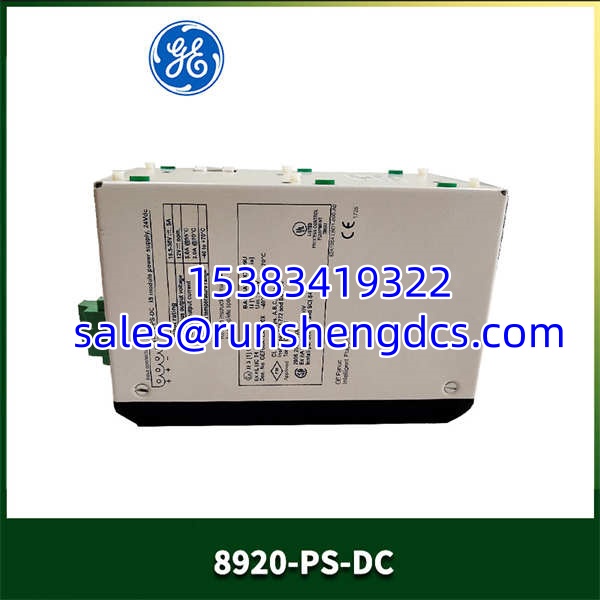
GE 8920-PS-DC
Application Scenarios
- GE IS/90-70 Retrofits: Replacing failed power supplies in 20-year-old water treatment racks. The GE 8920-PS-DC is often the only drop-in replacement that fits the existing DIN rail and wiring.
- Distributed I/O Stations: Remote skids with long 24VDC cable runs. The wide input range handles the voltage drop at the end of 200ft of #14 AWG.
- Harsh Environment Panels: Unheated outdoor cabinets. The +5°C to +55°C range covers most ambient conditions, but verify internal panel temps in summer.
FAQ
Q: Can I use a generic 24VDC DIN rail supply instead?
A: Technically yes, if it meets the 5A, 18.5-36VDC, and protection specs. But the 8920-PS-DC has specific signaling pins for the IS backplane (like “Power Good”). A generic supply might not assert this signal, causing the CPU to fault. Verify the pinout first.
Q: My supply is hot to the touch. Is this normal?
A: Yes. At 5A load, the 8920-PS-DC runs at 60-70°C case temp. If it’s too hot to touch (>80°C), check your load current and ambient temp. It might be overloaded or in a dead-air space.
Q: Does this support hot-swapping?
A: No. The 8920 series is not designed for hot-swap. Removing it under load will arc the terminals and potentially damage the backplane. Plan a shutdown window.
Q: What is the “Power Good” signal threshold?
A: Typically 4.75V DC. If the output drops below this, the 8920-PS-DC pulls the PG line low, telling the CPU to halt. This prevents the CPU from executing garbage logic during brownouts.
Q: Can I parallel two of these for more current?
A: No. The 8920-PS-DC lacks active current sharing. Paralleling will cause one unit to hog the load and fail. If you need >5A, use a higher-capacity supply or distribute the load across multiple racks.
Q: Is this compatible with the 8920-PS-AC?
A: No. The -DC is for 24VDC plant power; the -AC is for 120/240VAC. They have different internal topologies and pinouts. Don’t mix them.
Q: How do I test the overload protection?
A: Use a variable electronic load. Ramp the current to 6-7A. The 8920-PS-DC should current-limit or shutdown within 100ms. If it holds 10A indefinitely, the protection circuit is failed. Replace it.