
Description
Key Technical Specifications
| Parameter | Specification |
|---|---|
| Part Number | 163179-01 |
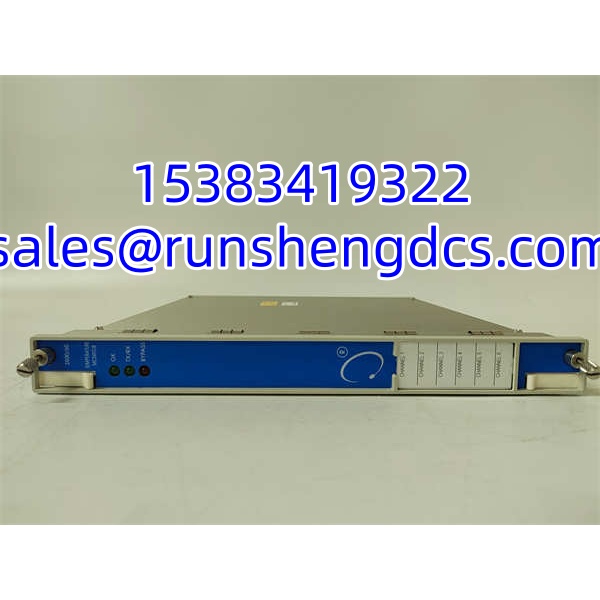
| Module Designation | 3500/60 Temperature Monitor |
| Channels | 6 independent temperature inputs |
| Sensor Types | RTD (2-/3-wire Pt100, etc.); Thermocouple (J, K, E, T, R, S, B, N) |
| Channel Isolation | Non-isolated (RTD/TC mixed); TC-isolated variant provides 250 VDC channel-to-channel isolation |
| Input Impedance | >10 MΩ per lead input |
| Alarm Levels | Programmable Alert and Danger setpoints per channel, with time delays |
| TMR Support | Yes — three modules installed adjacently for 2oo3 voting |
| Power Consumption | ~9 W typical |
| Operating Temperature | -30 °C to +65 °C (-22 °F to +150 °F) |
| Storage Temperature | -40 °C to +85 °C |
| Humidity | Up to 95% non-condensing |
| Configuration | 3500 Rack Configuration Software (P/N 3500/01) via 3500/22M TDI or RS-232 |
| Hot-Swap | Yes — replaceable while rack is powered |
| Standards Compliance | API 670 (when properly configured with required relay modules) |
Product Introduction
A turbine bearing runs 15 °C hotter than baseline and nobody notices until the Babbitt starts to wipe. The 3500/60 (163179-01) is the card that should have raised the alarm. It sits in the 3500 rack alongside vibration and displacement monitors, pulling in six RTD or thermocouple signals, conditioning them, and comparing each reading against user-defined Alert and Danger thresholds. When a setpoint is breached, it triggers the rack’s relay modules — no separate temperature transmitter or PLC logic required.
The 163179-01 is the non-isolated variant, meaning it can accept a mix of RTD and thermocouple inputs on the same card. That flexibility is useful on machines with diverse temperature monitoring needs — stator winding RTDs on a generator, bearing thermocouples on a compressor. For electrically noisy environments, the TC-isolated variant (check the dash suffix) provides 250 VDC channel-to-channel isolation. In TMR configuration, three 3500/60 modules vote 2oo3 to eliminate single-point failures. Power draw is a modest 9 W per module. Bottom line: it’s a workhorse card that’s been protecting bearings and windings for decades, but it’s no longer in active production.
QA/QC Transparency SOP
- Intake & Origin Verification — Serial number and revision code logged. Visual inspection for burnt traces, corroded terminal blocks, and bent backplane pins. Cross-reference lot code against known OEM production batches.
- Live Functional Testing — Module seated in a powered 3500 rack with a known-good 3500/22M TDI. All six channels stimulated with calibrated RTD and thermocouple simulators (Fluke 754 or equivalent). Alert and Danger setpoints verified per channel; relay output confirmed via 3500/32 relay module.
- Electrical Parameter Tests — Input impedance measured on each channel (>10 MΩ spec). Insulation resistance (megger) tested between terminal block and chassis ground. For isolated variants, 250 VDC channel-to-channel isolation verified.
- Firmware/Config Verification — Module firmware revision read via 3500 Rack Configuration Software. Configuration uploaded and compared against a known-good template. Non-volatile memory dual-region consistency check performed.
- Final QC & Anti-Static Packaging — Module removed from test rack, terminal block inspected for torque marks, sealed in ESD bag with desiccant. Test report including channel-by-channel readings and firmware revision included with shipment.
Field Engineer Gotchas
- 163179-01 vs. 163179-02 (Isolation Matters) — The -01 is the non-isolated variant. The -02 is the TC-isolated version with 250 VDC channel-to-channel isolation. Swapping a -01 for a -02 in a noisy electrical environment can introduce ground loops and false readings. Conversely, putting a -02 where a -01 was specified wastes money if isolation isn’t needed. Check the nameplate dash suffix before ordering.
- 3500/60 vs. 3500/61 — No Recorder Outputs — The 3500/60 does NOT provide 4-20 mA recorder outputs. If your DCS expects analog temperature signals from the 3500 rack, you need the 3500/61 instead. This is the single most common procurement mistake with these cards. Verify whether your system pulls temperature data via Modbus (TDI) or expects hardwired 4-20 mA.
- TMR Requires Three Adjacent Modules — You can’t run TMR with two 3500/60 modules and call it redundant. TMR requires three identical modules installed in adjacent slots, with 2oo3 voting configured in the relay module. A two-module “TMR” setup is just dual redundancy — a single module failure takes out the vote.
- Mixed RTD/TC on Non-Isolated Cards — The 163179-01 allows mixing RTD and thermocouple inputs on the same card. That’s convenient, but make sure each channel is individually configured for the correct sensor type in the 3500 Configuration Software. A thermocouple wired into an RTD-configured channel will read wildly wrong — and may not trigger a sensor-fault alarm immediately.
- Firmware Mismatch After Swap — A replacement 3500/60 with older firmware may not match the rack’s configuration revision. The module will load but may reject certain setpoint ranges or alarm delay settings. Always upload the existing configuration before removing the old card, and verify firmware compatibility after installing the replacement.
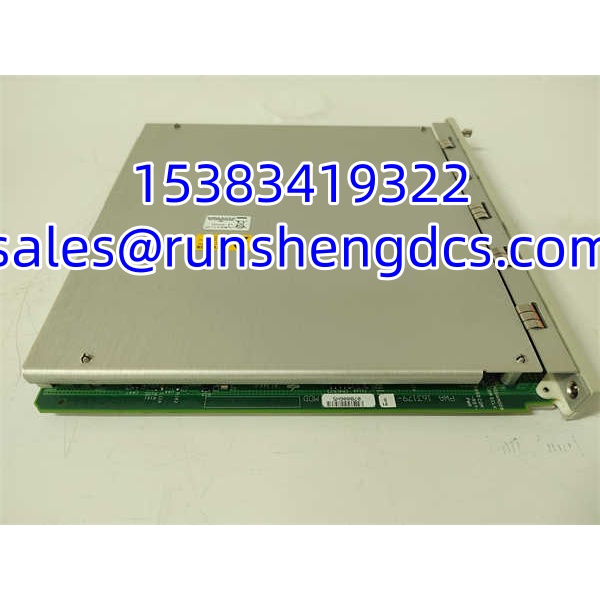
BENTLY 3500-60 163179-01
Application Scenarios
- Steam turbine bearing temperature protection — Babbitt temperature RTDs on each journal bearing feed into the 3500/60. Alert at 10 °C above baseline, Danger at trip point per API 670. The 3500/60’s sub-second update rate catches thermal runaway before mechanical damage occurs.
- Centrifugal compressor lube oil monitoring — Thermocouples on the oil header and return lines. The 3500/60 compares readings against setpoints and drives the 3500/32 relay module for low-oil-temperature pre-lube interlocks and high-oil-temperature trips.
- Generator stator winding protection — Embedded Pt100 RTDs in the stator slots. Six channels cover two phases with redundancy. In TMR configuration, a single RTD failure doesn’t cause a nuisance trip — the 2oo3 vote masks the bad channel.
FAQ
Q: Does the 3500/60 163179-01 provide 4-20 mA analog outputs?
A: No. The 3500/60 has no recorder outputs. If you need 4-20 mA analog outputs for each channel, you need the 3500/61. The 3500/60 only provides digital data to the rack backplane and relay trip outputs via the 3500/32 relay module.
Q: Can I mix RTD and thermocouple inputs on the same 163179-01 card?
A: Yes — the 163179-01 is the non-isolated variant, which supports mixed RTD and TC inputs. Each channel must be individually configured for the correct sensor type in the 3500 Rack Configuration Software.
Q: What’s the difference between 163179-01 and 163179-02?
A: Isolation. The -01 is non-isolated (mixed RTD/TC). The -02 is TC-isolated with 250 VDC channel-to-channel isolation, which helps prevent ground-loop issues in electrically noisy environments. The -02 typically supports TC inputs only.
Q: Is the 3500/60 still manufactured?
A: No. It is a legacy product. Available units are surplus or refurbished. Always request a test report and verify the firmware revision before purchase.
Q: Can I hot-swap a 3500/60 module?
A: Yes. The 3500 rack supports hot-swapping of monitor modules. The replacement module will load its configuration from non-volatile memory. However, verify that the firmware revision is compatible with the rack’s current configuration to avoid setpoint mismatches.
Q: Does this module participate in TMR voting?
A: The 3500/60 itself provides the temperature measurement. TMR voting is implemented at the relay module level (3500/32) using 2oo3 logic across three adjacent 3500/60 modules. All three modules must be identical and properly configured.
Q: What software do I need to configure this module?
A: Bently Nevada 3500 Rack Configuration Software (P/N 3500/01), connected via the 3500/22M TDI module (Ethernet) or direct RS-232. Version 3.90 or later is recommended for full feature support.