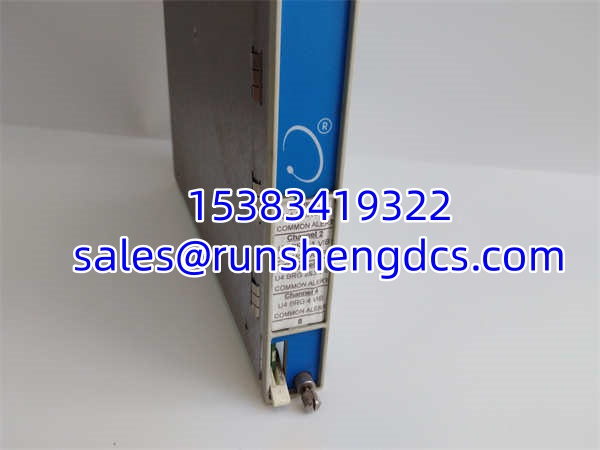

Description
Product Introduction
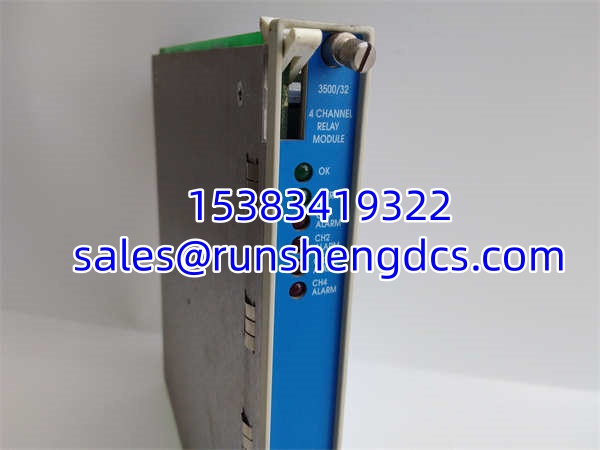
When a turbine trips unexpectedly due to a miswired relay logic fault, the downtime costs bleed fast. That’s the high-stakes environment the Bently Nevada 3500/32 was engineered for. It sits squarely in the 3500 rack as the final arbiter of machine safety, translating sensor data into physical contact closures.
This module isn’t just about switching; it’s about decision-making. Each of its four channels can be programmed with independent AND/OR voting logic—meaning you can demand two out of three sensors agree before tripping (2oo3), or use a simple high-high alarm. It handles up to 5 A loads directly, cutting out the need for external interface relays in many cases. Honestly, for critical rotating equipment where a false trip is as bad as a missed trip, this level of configurable logic is non-negotiable.
Key Technical Specifications
- Module Type: 4-Channel Relay Output (Full Height)
- Contact Form: 4 x SPDT (Single Pole Double Throw)
- Contact Rating: 5 A @ 24 VDC resistive, 5 A @ 240 VAC
- Logic Capability: Independent AND/OR voting per channel
- Input Sources: Accepts Alarm, Danger, Not-OK, or PPL signals from any channel in the rack
- Operating Temp: -30 °C to +65 °C
- Storage Temp: -40 °C to +85 °C
- Isolation: 1500 Vrms input/output/isolation barrier
- Status Indicators: LED for Normal, TX/RX, and individual Channel Alarms
- Firmware: Configured via 3500 Rack Configuration Software
Compatibility & Replacement Matrix
- 3500/32-01-00 → 3500/32: Direct Fit — No wiring changes required; check firmware revision for logic quirks.
- 3500/32-02-00 → 3500/32: Direct Fit — Backward compatible; newer hardware revisions are generally safe.
- 3500/34 (TMR) → 3500/32: Incompatible — The 3500/34 is a Triple Modular Redundant module; do not substitute with this standard relay module.
- 3500/32 → 3500/32-01-00: Direct Fit — Standard replacement path.
Quality Inspection & SOP Transparency
Here is exactly how we vet every 3500/32 before it ships. No black box testing.
- Incoming Inspection
- We verify the serial number against Bently Nevada’s public databases to flag any service advisories.
- Visual check: We look for “yellowing” of the plastic housing (a sign of heat aging) and corrosion on the gold fingers. The status LEDs are checked for physical cracks.
- Live Functional Test
- Environment: The module is slotted into a live 3500 rack (we use a test chassis with a 3500/15 CPU).
- Power-Up: We observe the boot sequence—the “TX/RX” LED should blink rapidly after the “OK” light stabilizes.
- Logic Simulation: Using the software, we force a “Danger” signal on Channel 1. The relay must pull in audibly. We verify continuity across the COM/NO terminals with a Fluke 115.
- Load Test: We connect a 24 VDC/3 A load to each SPDT contact and cycle it 10 times. The contact resistance must stay below 0.1 Ω.
- Electrical Parameter Test
- Hi-Pot Test: We apply 1500 Vrms between the logic side and the contact side. Leakage current must be < 1 mA.
- Insulation Resistance: 500 VDC applied; reading must exceed 100 MΩ.
- Firmware Verification
- We read the firmware version via the software. If it’s not the latest (e.g., v5.0+), we document whether the customer requires a specific legacy version. We never assume.
- Final QC & Packaging
- The module is placed in an anti-static bag with a humidity indicator card.
- A test report (showing pass/fail for each relay contact) is included in the box.
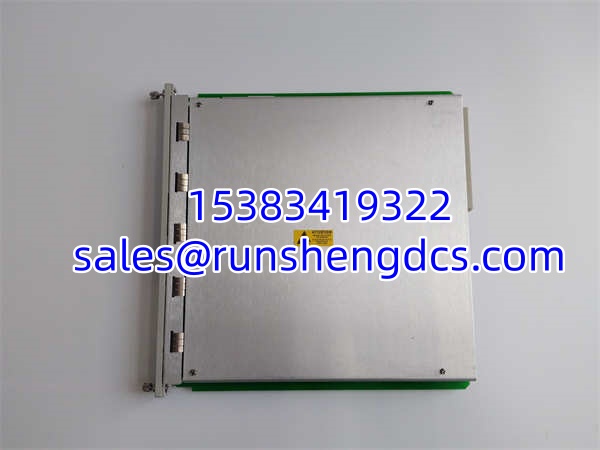
Bently Nevada 3500/32
Common Replacement Pitfalls
Swapping a relay module seems simple—plug and play, right? Not in a Bently rack. I’ve seen these mistakes cause hours of unnecessary troubleshooting.
- Firmware Revision Mismatch
The configuration file for a 3500/32 is not always backward compatible. If your rack is running firmware v4.5 and you install a module flashed with v6.0 logic, the CPU might reject it as “Unconfigured” or “Faulted.” Always check the firmware version of the old module before pulling it out. If you don’t have the old one, default to the latest revision but be prepared to re-download the config. - DIP Switch / Jumper Misconfiguration
While the 3500/32 relies heavily on software config, there are physical jumpers for contact fail-safe behavior (energize-to-trip vs. de-energize-to-trip). If the old module was wired for “Fail Safe” (contacts open on power loss) and the new one is set to “Non-Fail Safe,” you have a serious safety hazard. Take a photo of the jumper block orientation before disconnecting. - Connector / Terminal Incompatibility
Bently Nevada occasionally changes the pinout of the rear terminal strip (RTS) between major revisions. The plastic connector looks identical, but pin 1 might be in a different location. Do not assume the old wiring harness will drop in cleanly. Check the pinout diagram for revision 02 vs. 04. - Power Budget Shortfall
The 3500/32 draws power directly from the backplane. If your rack is already maxed out on current draw (e.g., 10+ high-density I/O cards), adding this relay module (which can draw ~200 mA) might overload the power supply. Calculate your total rack load with a 20% buffer. - ESD Damage
This is a microprocessor-based module, not just a chunk of iron. The internal circuitry is sensitive. Always use a grounded wrist strap. I’ve seen techs install these bare-handed in dry winter conditions only to have the module fail the next day because the ESD zapped the logic board during insertion.
FAQ
Q: Can I just swap this in directly without the Bently software?
A: You can physically insert it, but it won’t function correctly. The 3500/32 requires configuration via the 3500 Rack Configuration Software to define what each relay does (e.g., Vibration High High, Bearing Temp Alert). Without loading the config, the CPU will report a “Channel Fault.”
Q: Is the 3500/32 compatible with the 3500/34 TMR module in the same rack?
A: Yes, they can coexist in the same rack. However, you cannot replace a 3500/34 slot with a 3500/32. The TMR module requires specific slot spacing and cabling. They are siblings, not twins.
Q: My system is old (v3.5 firmware). Will a new 3500/32 work?
A: It depends. Newer hardware revisions of the 3500/32 often require a minimum firmware version (e.g., v4.0). If your rack is on v3.5, the new module might handshake but refuse to go “OK” until you upgrade the CPU firmware. Check the revision compatibility matrix first.
Q: What’s the difference between “Energize to Trip” and “De-Energize to Trip”?
A: This is critical for safety logic.
- Energize to Trip (Fail Dangerous): The relay is normally de-energized. When an alarm occurs, the relay pulls in (energizes).
- De-Energize to Trip (Fail Safe): The relay is normally energized. If power fails or an alarm occurs, the relay drops out.
Most safety shutdowns use “De-Energize to Trip” so that a dead module or cut wire causes a trip.
Q: Do you test with actual load current, or just continuity?
A: We test with an actual load. We use a resistive load bank to draw 3 A @ 24 VDC through each contact. Continuity tests only check if the switch closes; a load test checks if the contacts can handle the current without arcing or welding shut. We do both.