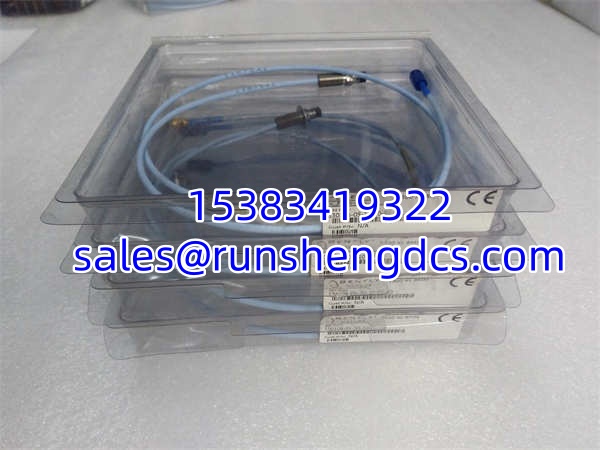
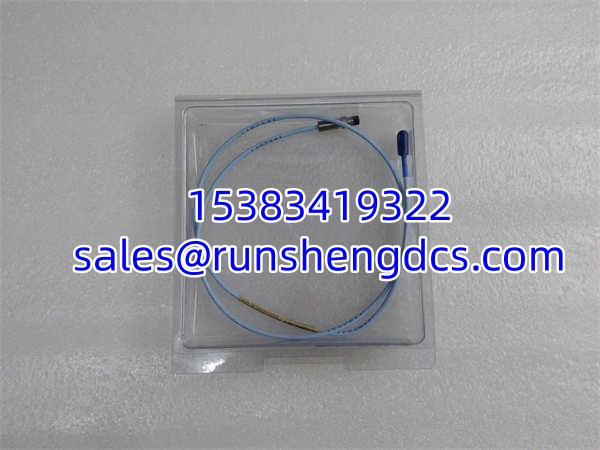

Description
Key Technical Specifications
- Product Type: 3300 XL 8mm Reverse Mount Proximity Probe
- Brand: Bently Nevada
- Probe Tip Material: Polyphenylene Sulfide (PPS)
- Probe Housing Material: AISI 303 or 304 Stainless Steel (SST)
- Thread Size: 10mm x 1.0 Metric Thread
- Cable Length: 30 cm (1.2 ft)
- Connector Type: 02 = Micro ClickLoc™ Coaxial Connector
- Agency Approvals: 00 = Standard Approvals
- System Compatibility: 3300 XL 8mm Extension Cable & Proximitor
- Application: Fluid-film Bearing Vibration & Position Measurement
Product Introduction
When a 50-megawatt turbine starts throwing vibration alarms at 2 AM, the last thing you want to find is a corroded probe tip giving false readings. The Bently Nevada 330106-05-30-10-02-00 is an 8mm eddy current proximity probe designed to survive inside harsh bearing housings. It uses high-frequency electromagnetic fields to measure the exact distance to the rotating shaft, feeding raw AC and DC signals back to your 3300 XL Proximitor. I’ve seen plants keep aging compressors running safely simply because they had a few of these exact probes sitting in a climate-controlled cabinet.
Engineers rely on this specific sensor because the 3300 XL 8mm system provides complete interchangeability without requiring individual component calibration. It features a rugged AISI 303/304 stainless steel housing and a PPS tip that resists chemical degradation in oil-laden environments. Just be warned: this is a discontinued part. The secondary market is full of pulled, abused sensors. If the ClickLoc connector looks pitted or the cable jacket is cracked, do not trust it on a critical machine.
Quality SOP & Tech Pitfalls (The Reality Check)
Before any Bently Nevada 330106-05-30-10-02-00 leaves our bench, it goes through a strict protocol. We start with a visual counterfeit check, inspecting the ClickLoc connector pins and cable integrity. Next, it goes on a live test rack to verify the gap voltage linearity and dynamic frequency response. We check insulation resistance with a Fluke 115 to ensure no internal shorts, verify the 10mm thread pitch against factory specs, and seal it in fresh anti-static packaging. I can provide the test video if you need peace of mind.
Here is the brutal reality of swapping these old probes: bad connections and improper gapping cause 80% of false trips. I once watched a tech spend three hours chasing a phantom vibration fault, only to find out the ClickLoc extension cable wasn’t pushed in until it physically clicked. Also, never assume the new probe will have the exact same gap voltage as the old one. If you don’t set the target gap voltage (usually -9V to -10V DC) correctly using a multimeter, the sensor will either clip at the top of the shaft stroke or fail to detect axial displacement.
Installation & Configuration Guide
- Pre-Installation: ⚠️ SAFETY FIRST. Bypass the safety outputs in your logic solver or put the machine in a safe state. Lock out the equipment. Take high-resolution photos of the existing probe routing and the ClickLoc connector orientation.
- Removal: Label the extension cable. Carefully unscrew the old probe from the 10mm threaded bracket. Do not yank the cable; if the threads are seized, use penetrating oil and a proper wrench on the hex flats, never on the cable body.
- Installation: Route the new 330106-05-30-10-02-00 away from sharp edges and hot surfaces. Thread the 10mm probe into the bracket and tighten securely. Push the ClickLoc connector onto the extension cable until you hear and feel a definitive click.
- Power-On & Testing: Apply power to the Proximitor. Connect a multimeter to the OUT and COM terminals. Adjust the probe depth until the DC gap voltage reads exactly in the center of the linear range (typically -9.0V DC). Verify the AC dynamic signal using an oscilloscope during machine startup.
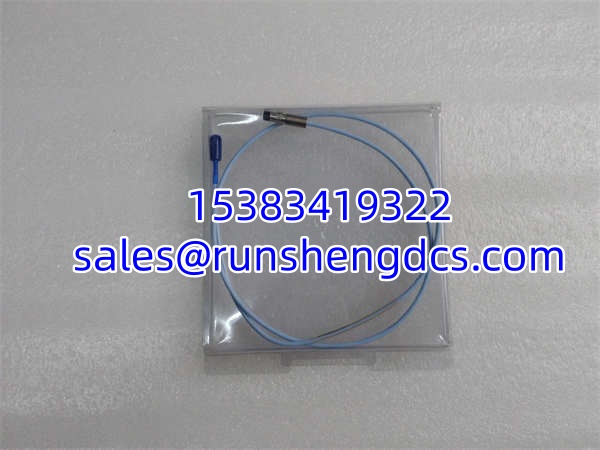
Bently Nevada 330106-05-30-10-02-00
Compatible Replacement Models
| Replacement Model | Compatibility Tier | Notes |
|---|---|---|
| Bently Nevada 330106-05-30-05-02-00 | ✅ Drop-in Replacement | Same 10mm thread and 30cm cable, but with a 5cm cable length variant. Verify routing clearance. |
| Bently Nevada 330104-00-08-10-02-00 | ⚠️ Software Compatible | Standard 3300 XL 8mm forward mount probe. May require verifying bracket thread and cable routing path. |
| Bently Nevada 3300 XL NSv Proximitor System | ⚠️ Software Compatible | Modern upgrade path. Requires new Proximitor, new extension cable, and updated DCS/PLC configuration. |
Frequently Asked Questions (FAQ)
Can I mix this 330106 probe with an older 3300 (non-XL) extension cable?
No. The 3300 XL system uses a different internal capacitance and frequency. Mixing XL probes with legacy extension cables or Proximitors will cause severe non-linearity and false alarms. Keep the entire system XL.
Why is my Proximitor showing a BAD sensor fault after installing this probe?
Check the ClickLoc connection first. If it isn’t fully seated, the signal will bounce. Also, verify that the probe isn’t shorted to the grounded bearing housing. A quick continuity check from the probe tip to the machine ground will tell you if you have a dead short.
Is the 330106-05-30-10-02-00 still manufactured by Bently Nevada?
No, this specific configuration is officially obsolete. You are buying New Surplus or refurbished stock. Lead times vary wildly depending on who has it sitting on a shelf.
Can I use a standard multimeter to test the probe?
Yes, for the DC gap voltage. But to truly verify the vibration signal integrity, you need an oscilloscope. A multimeter won’t capture the high-frequency AC dynamic component that the Proximitor actually processes for vibration data.
Does the 30cm cable length matter?
Absolutely. The 3300 XL system is designed for specific total cable lengths (usually 4m, 5m, or 9m including the probe). If your 30cm probe makes the total cable length fall outside the Proximitor’s compensation range, the calibration will be completely off. Always measure your total run before ordering.
What happens if I overtighten the 10mm thread?
You will strip the bracket threads or crack the PPS probe tip. Use a torque wrench if possible, and always use the hex flats on the probe body, never the cable, to apply leverage.