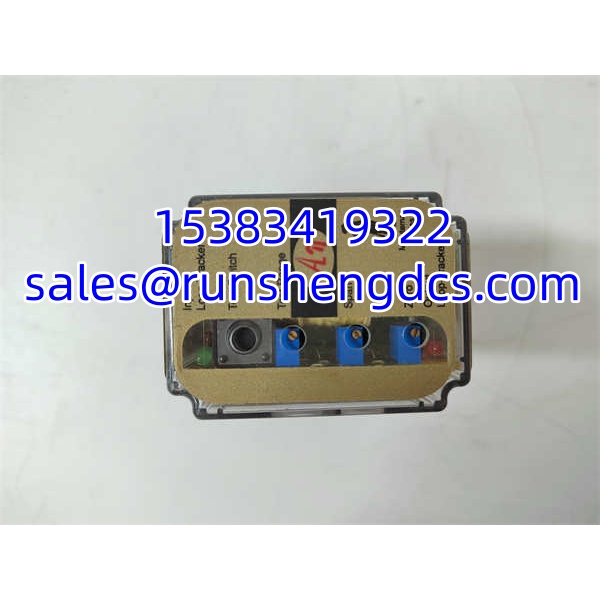

Description
Key Technical Specifications
| Parameter | Specification |
|---|---|
| Manufacturer | Absolute Process Instruments |
| Product Type | DC-DC Isolated Signal Conditioner / Transmitter |
| Model | API4380G (API 4380-G) |
| Input Signal | DC voltage or current (e.g., 0-10 VDC, 4-20 mA) |
| Output Signal | DC voltage or current, field configurable |
| Accuracy | ±0.1% typical |
| Isolation | 3-way optical isolation: input, output, power |
| Configuration | External rotary and sliding switches |
| Loop Excitation | Built-in 18 VDC unregulated supply for passive inputs |
| Dimensions | 102 x 64 x 32 mm (typical) |
| Weight | ~250 g |
| Mounting | DIN-rail or panel-mount style (verify with OEM label) |
Product Introduction
Ground loops and noisy 4-20 mA loops do not announce themselves politely. They show up as drifting readings, phantom trips, or control valve hunting that disappears when you wiggle a shield wire. The Absolute API4380G is a DC-DC isolated signal conditioner built to break those loops without re-engineering the entire instrumentation run.
It accepts a DC voltage or current input and delivers a proportional, optically isolated DC output. The input, output, and power supply are each isolated from one another, which is the part that actually matters in the field. Range selection is handled by onboard rotary and sliding switches, so you can match 4-20 mA, 0-10 VDC, or mixed configurations without a laptop. Typical accuracy is ±0.1%, and the module includes an 18 VDC unregulated loop excitation supply for passive transmitters.
QA/QC Transparency SOP
- Intake & Origin Verification: Verify model API4380G, suffix, power rating, and serial number. Inspect terminal blocks, switch positions, and housing for heat damage or corrosion.
- Live Functional Testing: Apply a known DC input (e.g., 4 mA, 12 mA, 20 mA) using a calibrated loop calibrator. Measure output with a Fluke multimeter and confirm linearity across at least three points.
- Electrical Parameter Tests: Check power supply draw, input/output continuity, and isolation resistance between input, output, and power terminals. No shorted paths should exist across isolation barriers.
- Configuration Verification: Record rotary and sliding switch settings. Confirm they match the requested range and that the internal loop excitation is enabled only when required.
- Final QC & Anti-Static Packaging: Verify terminal integrity, label legibility, and switch positions. Pack in ESD-safe material with documented test readings and configuration settings.
Field Engineer Gotchas
- Wrong power supply kills the loop: Some API4380G units are 115 VAC powered. Applying 24 VDC to an AC-powered unit — or vice versa — will not end well. Always read the power label before wiring.
- Switch settings must match the loop: The rotary/sliding switches define input and output ranges. A module set for 0-10 VDC on the output will not behave correctly in a 4-20 mA loop. Document the switch positions before removing the old unit.
- Loop excitation can mask wiring faults: The built-in 18 VDC excitation is useful for 2-wire transmitters, but it can create confusion if the loop already has its own supply. Double-supplying a loop produces offset errors that look like transmitter drift.
- Isolation is not infinite: Three-way optical isolation helps with ground loops, but it does not fix reversed polarity, broken shields, or saturated power supplies. Verify the entire loop, not just the conditioner.
- Terminal pinout varies by documentation source: One reference lists pins 1/3 as power, 5/6 as signal input, and 7/8 as signal output. Confirm against the actual module label before terminating.
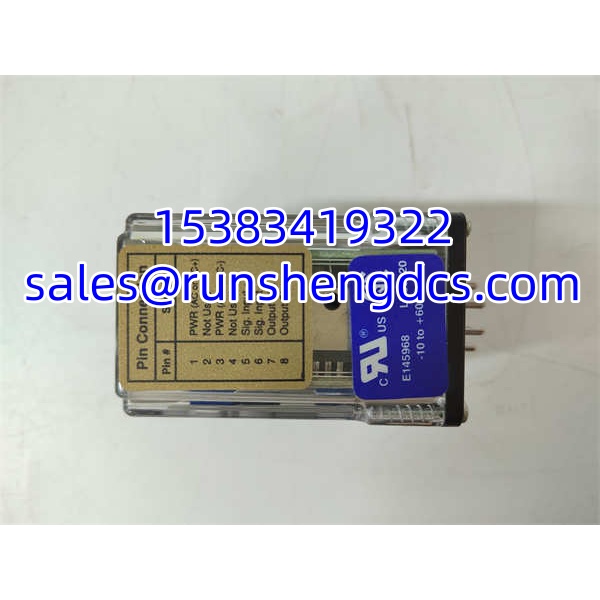
ABSOLUTE API4380G
Application Scenarios
- Retrofitting legacy 4-20 mA loops: Breaking ground loops when adding new PLC analog inputs to older field transmitters.
- Turbine exhaust temperature monitoring: Isolating thermocouple transmitter signals before they enter a control system or HMI display.
- Power plant DC monitoring: Conditioning DC voltage or current signals from battery chargers, rectifiers, or auxiliary power systems.
- Lab and test stand instrumentation: Providing clean, isolated analog outputs for data acquisition systems that share different ground references.
FAQ
Is API4380G the same as API4380-G?
Yes. The dash is a formatting variant. Both refer to the Absolute Process Instruments DC-DC isolated signal conditioner.
Can it convert 4-20 mA to 0-10 VDC?
Typically yes. The module supports field-configurable DC voltage and current ranges via onboard switches. Confirm the exact available ranges on the module label.
Does it provide loop power?
It includes a built-in 18 VDC unregulated loop excitation supply for passive input devices. Use it only when the field transmitter requires loop power.
What is the accuracy?
±0.1% typical. For critical custody transfer or safety loops, verify the actual calibration certificate or test data for the supplied unit.
Can I use it for thermocouple isolation?
Only if the thermocouple signal has already been converted to a standard DC voltage or current. The conditions DC signals; it is not a raw thermocouple isolator.
Is this module hot-swappable?
No. Treat it as a live instrumentation device. De-energize the loop or follow site safe-work procedures before changing wiring or replacing the module.
Do you supply calibration records?
Surplus units should be supplied with functional test records. Full calibration certificates depend on the vendor and should be requested before purchase.