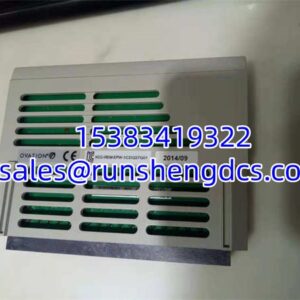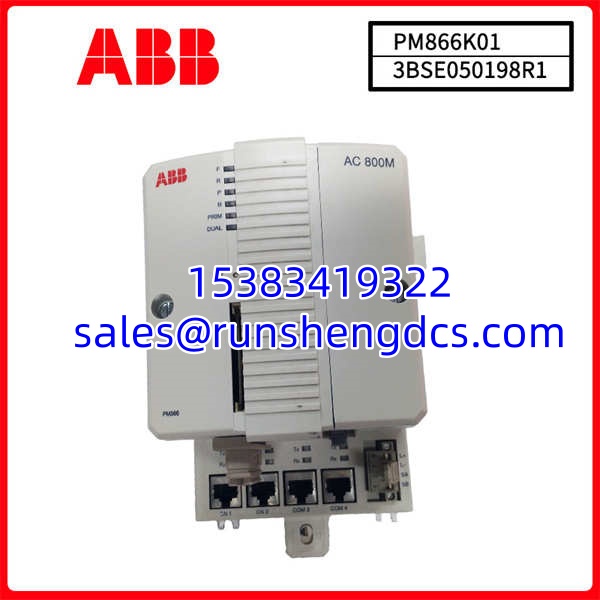
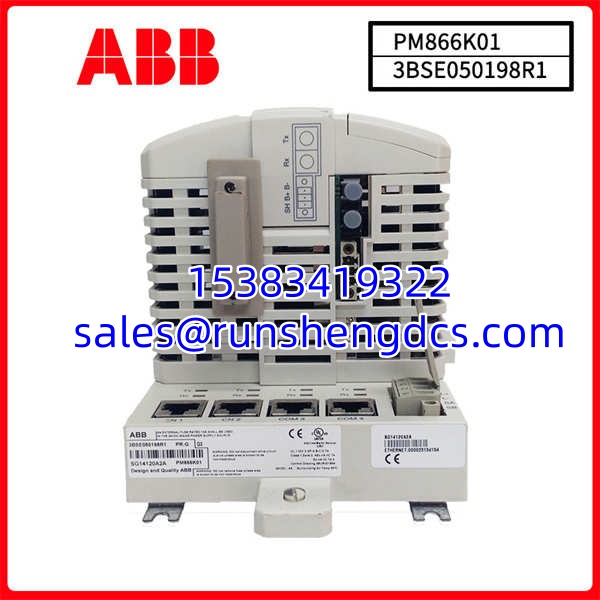

Description
Key Technical Specifications
- Processor: 133MHz microprocessor
- Memory: 64MB RAM
- Ethernet Ports: 2 × RJ45 (CN1, CN2) for control network connection with built-in redundancy
- Serial Ports: COM3 (RS-232C with modem control signals), COM4 (isolated, for configuration tool connection)
- Storage: CompactFlash card slot for program storage and backup
- Real-Time Clock: Built-in RTC with external battery backup module (TB821/SS821)
- Redundancy Support: CPU redundancy, CEX-Bus redundancy, communication interface redundancy, and S800 I/O redundancy
- Bus Interface: CEX-Bus via BC810/BC820 hardware for Ethernet, PROFIBUS DP, and other fieldbus connections
- Programming Software: ABB 800xA Control Builder
- Mounting: DIN-rail with slide-and-lock mechanism on TP830 baseplate
- Baseplate Ethernet Address: Unique hardware address per CPU (label on TP830 baseplate)
- Protection Rating: IP20 (no enclosure required)
- EMC Certification: Full industrial EMC compliance
- RoHS Status: Not RoHS 2 (2011/65/EU) compliant — spare part for systems placed on market before July 22, 2011
- Safety Certification: ISA safety certified
Product Introduction
You’re staring at an AC800M rack in a power plant or a chemical facility, and the PM866K01 is the brain keeping the whole process alive. This isn’t a high-end CPU by today’s standards — 133MHz and 64MB sounds like a pocket calculator — but in the AC800M world, it’s the workhorse that was purpose-built for high-integrity process control applications where deterministic scan times and proven reliability matter more than raw megahertz. The PM866K01 sits on a TP830 baseplate, slides into a DIN-rail mounted rack, and talks to your S800 I/O over the CEX-Bus while handling fieldbus communication through BC810/BC820 interface modules.
The “High Integrity” designation is the key differentiator here. This processor was designed for applications where a spurious trip or a missed scan could cost millions — think boiler drum level control, turbine protection, or reactor safety interlocks. It supports full CPU redundancy, meaning you can run two PM866K01s in a hot-standby pair. If the primary fails, the secondary takes over with zero bump to the process. The dual Ethernet ports (CN1/CN2) provide redundant control network paths, and the isolated COM4 port is your lifeline for connecting a laptop running Control Builder without risking ground loops.
The CompactFlash slot is where your control program lives. Swap the CF card and you’ve got a full system backup in your pocket — a feature that’s saved more than one engineer during a catastrophic rack failure. But be warned: this is a legacy unit. ABB superseded it with the PM866AK01, and finding new-old-stock PM866K01s is getting harder. If you’re maintaining an existing AC800M installation, you need to know how to work with what you’ve got.
Troubleshooting Quick Reference
| Fault | Cause | Probability | Quick Check | Fix |
|---|---|---|---|---|
| CPU not starting / no LEDs | Power supply failure or baseplate connection issue | 40% | Check 24V DC supply at baseplate; verify TP830 baseplate seating | Measure voltage at baseplate terminals; reseat CPU module |
| Redundancy sync failure | CEX-Bus communication loss between primary/secondary | 35% | Check TK851V010 redundancy cable connection; verify both CPUs same firmware | Reseat redundancy cable; match firmware versions via Control Builder |
| CompactFlash not recognized | CF card corruption or incompatible card type | 30% | Check CF card LED status; try known-good CF card | Replace CF card; re-download program from engineering station backup |
| COM4 port unresponsive | Wrong cable type or baud rate mismatch | 25% | Verify null-modem cable for COM4; check terminal settings (19200/8/N/1 typical) | Use correct RS-232 cable; match communication parameters in Control Builder |
| Ethernet link down on CN1/CN2 | Cable fault, switch port issue, or baseplate address conflict | 30% | Check Ethernet cable LEDs; verify unique baseplate Ethernet address | Replace cable; confirm no duplicate Ethernet addresses on network |
| Watchdog timeout / CPU reset | Program scan time exceeding watchdog limit | 20% | Check program execution time in Control Builder online diagnostics | Optimize control program; reduce scan load or increase watchdog timeout |
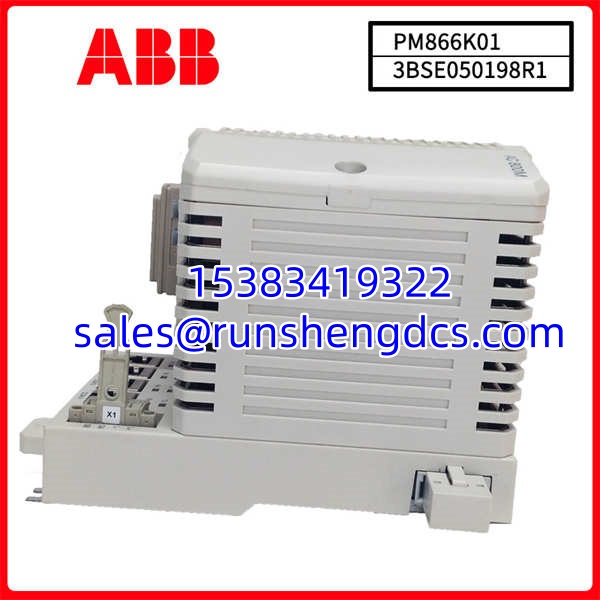
ABB PM866K01 3BSE050198R1
Application Scenarios & Pain Points
Power Plant — Boiler Drum Level Control: The PM866K01 runs the three-element drum level control algorithm in a coal-fired unit. Redundancy is non-negotiable here — a single CPU failure can’t cause a unit trip. Pain point: the external battery backup module (TB821) for the real-time clock has a finite lifespan. When it dies, the RTC resets on power cycle, which can mess up sequence-of-events (SOE) timestamping. Replace the battery module proactively every 3–5 years.
Chemical Plant — Reactor Safety Interlock System: High-integrity designation means this processor handles SIL-rated safety functions. The CEX-Bus connects to S800 I/O modules monitoring pressure, temperature, and flow. Pain point: if the CEX-Bus termination isn’t correct, you get intermittent I/O communication faults that look like field instrument failures. Always verify BC810/BC820 bus termination resistors when chasing ghost I/O faults.
Pulp & Paper — Digester Control Network: The PM866K01 communicates with remote I/O racks over PROFIBUS DP via a CI854 module. The dual Ethernet ports connect to the plant’s control network for HMI data exchange. Pain point: the isolated COM4 port is your only direct connection to the CPU for offline programming. If COM4 dies (ESD damage from a laptop ground loop is common), you’re locked out of direct CPU access and must go through the Ethernet network — which may not be available during a network outage.