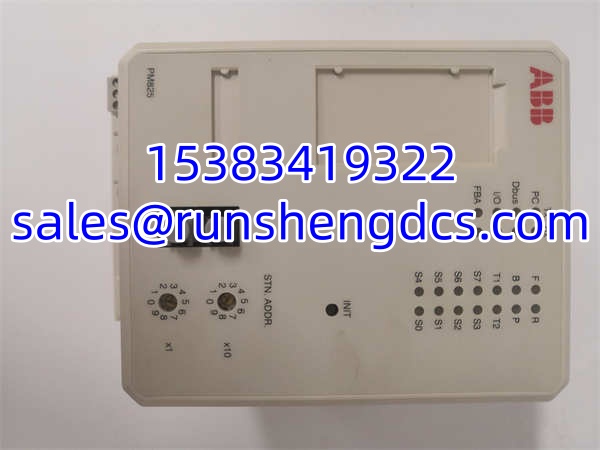
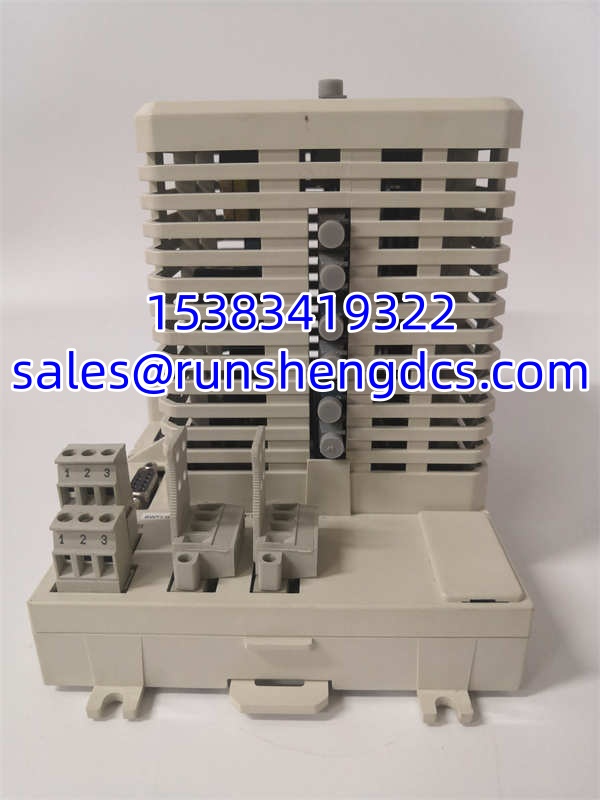

Description
Key Technical Specifications
| Parameter | Specification |
|---|---|
| Model | PM825 |
| Order Number | 3BSE010796R1 |
| Brand | ABB |
| Platform | AC800M / Compact 800 DCS — S800 I/O system |
| Processor | MPC8250 PowerQUICC, 133 MHz clock |
| System Memory | 16 MB SDRAM |
| Flash Memory | 8 MB Flash |
| Battery-Backed RAM | 128 KB (data retention ~5 years) |
| Backup Battery | Built-in 3.6 V lithium battery (spare part: 4943013-6) |
| Computing Performance | ~1,000 Boolean operations in 0.5 ms |
| Power Supply | 24 V DC (range: 19.2–30 V DC) |
| Power Consumption | Typical 1.5 W; maximum 3.5 W |
| Ethernet Port | 1× RJ45, 10/100 Mbps auto-negotiation (Modbus TCP, Ethernet/IP support) |
| RS-232 Port | 1× (programming and debugging) |
| RS-485 Ports | 2× (Modbus RTU, max communication distance 1,200 m) |
| Fieldbus Support | Profibus DP, DeviceNet, CANopen, Modbus TCP (via expansion/communication modules) |
| I/O Expansion | Supports S800 I/O modules — up to 12 I/O modules per station (192 digital or 96 analog channels); fiber-optic ModuleBus extension supports up to 7 I/O slaves per station |
| Redundancy | Supports redundant CPU configuration for high-availability applications |
| Hot-Swap | Yes |
| Programming Software | Control Builder (ABB) — all 6 IEC 61131-3 languages (IL, ST, FBD, LD, SFC, CFC) |
| Operating Temperature | Typically 0°C to +60°C (verify against specific installation guide) |
| Humidity Range | 5%–95% non-condensing |
| Dimensions | 178 mm × 102 mm × 25 mm |
| Weight | Approximately 0.5 kg |
| Exchange Number | EXC3BSE010796R1 (for replacement/upgrade reference) |
| Safety & Protection | Overcurrent protection, overvoltage protection, short-circuit protection |
| Typical Applications | Process industries (chemical, metallurgy, power generation, oil & gas, water/wastewater), infrastructure (HVAC, building automation), marine propulsion control, paper manufacturing, glass production |
Product Introduction
The ABB PM825 (order number 3BSE010796R1) is a processor module in ABB’s AC800M distributed control system (DCS) family, designed for mid-range process automation and plant control applications. It belongs to the S800 I/O system segment of the Compact 800 / AC800M platform — ABB’s modular, rail-mounted controller architecture that integrates CPU, communication, power, and I/O modules into a single scalable control system.
At the heart of the PM825 is a Freescale (now NXP) MPC8250 PowerQUICC processor running at 133 MHz. The PowerQUICC architecture combines a PowerPC core with integrated communication coprocessors, making it well-suited for control systems that must simultaneously execute control logic and manage multiple communication channels. The processor is paired with 16 MB of SDRAM for program execution, 8 MB of Flash for firmware and application storage, and 128 KB of battery-backed RAM for retaining critical data (such as setpoints, alarms, and historical values) during power outages — with the built-in 3.6 V lithium battery providing approximately 5 years of data retention.
The PM825’s computing performance is rated at approximately 1,000 Boolean operations in 0.5 ms, positioning it as a mid-tier processor within the AC800M family — suitable for medium-complexity control tasks such as PID loop regulation, sequence control, interlocking, and data logging in process industries. It is not the highest-performance CPU in the AC800M lineup (that role belongs to the PM86x series), but it offers a cost-effective balance of processing power, communication capability, and reliability for applications that do not require ultra-fast scan times or extremely large I/O counts.
Communication is one of the PM825’s strongest features. The module integrates one RJ45 Ethernet port (10/100 Mbps, supporting Modbus TCP and Ethernet/IP), one RS-232 serial port (dedicated to programming and debugging via Control Builder), and two RS-485 serial ports (supporting Modbus RTU with communication distances up to 1,200 meters). Additional fieldbus protocols — including Profibus DP, DeviceNet, and CANopen — are supported through ABB’s CI8xx-series communication interface modules that plug into the AC800M backplane. This multi-protocol capability allows the PM825 to serve as a communication gateway between heterogeneous field devices and higher-level SCADA or MES systems.
The interfaces with ABB’s S800 I/O system via the ModuleBus backplane. A single S800 station can accommodate up to 12 I/O modules, providing up to 192 digital I/O channels or 96 analog I/O channels (or a mix of both). For larger installations, fiber-optic ModuleBus extension allows up to 7 I/O slave stations to be connected to a single , significantly expanding the system’s I/O capacity without requiring additional CPUs. The S800 I/O system also supports redundant power supplies and redundant I/O channel configurations, further enhancing system reliability.
One of the ‘s key differentiators is its support for redundant CPU configuration. Two modules can be installed in a redundant pair, with one acting as the primary (active) CPU and the other as the standby (backup) CPU. In the event of a primary CPU failure, the standby CPU automatically takes over control without process interruption — a critical feature for continuous-process industries such as power generation, chemical processing, and oil refining where unplanned downtime carries significant financial and safety consequences.
Programming is performed using ABB’s Control Builder software, which supports all six IEC 61131-3 programming languages: Instruction List (IL), Structured Text (ST), Function Block Diagram (FBD), Ladder Diagram (LD), Sequential Function Chart (SFC), and Continuous Function Chart (CFC). Control Builder provides a unified development environment for configuration, programming, debugging, and visualization, reducing the learning curve for engineers familiar with standard PLC programming practices.
The module is hot-swappable, meaning it can be inserted or removed from the backplane without powering down the entire system — a significant advantage for maintenance and replacement in live installations. The also includes built-in protection against overcurrent, overvoltage, and short-circuit conditions, helping to safeguard both the module itself and connected field devices.
Troubleshooting Quick Reference
| Fault | Likely Cause | Probability | Quick Check | Fix |
|---|---|---|---|---|
| CPU not starting / no RUN LED | Power supply out of range (must be 19.2–30 V DC) or backplane connection issue | 55% | Measure 24 V DC at power terminals; verify module is fully seated in backplane slot | Restore supply voltage within range; reseat module; check backplane fuse |
| Communication lost with engineering station (Control Builder) | RS-232 cable fault, wrong COM port settings, or driver issue | 50% | Verify RS-232 cable pinout; check COM port and baud rate in Control Builder; try different USB-to-serial adapter | Replace cable; reconfigure COM settings; install correct USB-to-serial driver |
| Ethernet communication failure | IP address conflict, subnet mismatch, or cable fault | 45% | Ping IP address from engineering station; check Ethernet cable and switch port LEDs | Resolve IP conflict; correct subnet mask; replace Ethernet cable |
| I/O modules not recognized | ModuleBus communication error or I/O module not seated | 40% | Check ModuleBus status LEDs; verify all I/O modules are properly seated | Reseat I/O modules; check ModuleBus termination; replace faulty I/O module |
| Battery-backed RAM data loss | Backup battery depleted (typical life ~5 years) | 35% | Check battery voltage (should be ~3.6 V); look for low-battery warning in Control Builder | Replace battery (spare part: 4943013-6); re-download application if data was lost |
| Redundancy switchover failure | Standby CPU not synchronized or communication link between primary and standby broken | 30% | Check redundancy status LEDs on both CPUs; verify redundancy cable connection | Resynchronize standby CPU; check redundancy cable; review redundancy configuration in Control Builder |
| Overheating / thermal shutdown | Ambient temperature exceeding operating range or insufficient cabinet ventilation | 25% | Measure cabinet internal temperature; check airflow around module | Improve cabinet ventilation; install cooling fan; verify operating temperature within spec |
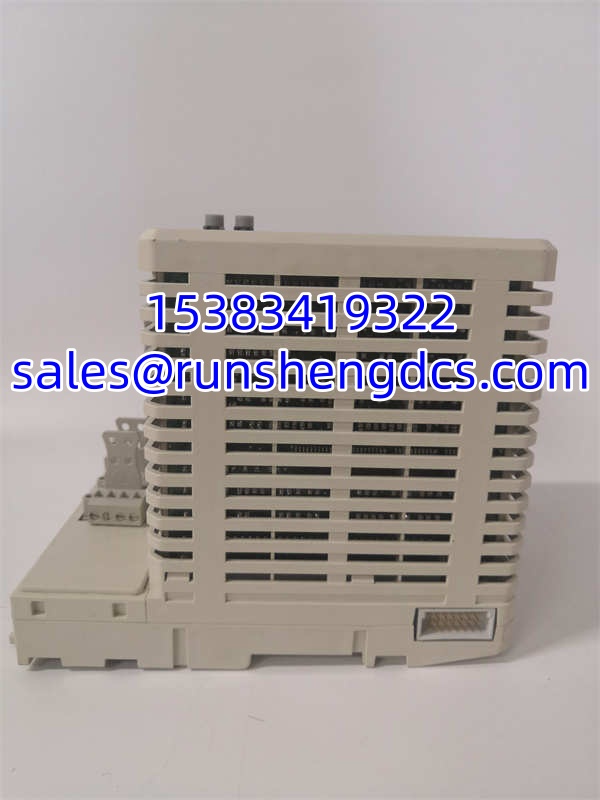
ABB PM825 3BSE010796R1
Application Scenarios & Pain Points
Power plant boiler control. modules deployed as the primary CPU in -based boiler control systems, managing fuel-air ratio, drum level, and steam temperature PID loops. Pain: the 0.5 ms / 1,000 Boolean operations performance is adequate for most boiler control tasks, but for ultra-fast protective interlocks (e.g., furnace pressure trip), the scan time may be marginal. Engineers should verify that the total program scan time (including I/O overhead) meets the required response time for safety-critical functions — and consider the higher-performance PM86x series if faster scan times are needed.
Water and wastewater treatment. used as the main controller for municipal water treatment plants, managing pump sequencing, chemical dosing, and flow/level monitoring across multiple process units via Modbus RTU over RS-485. Pain: the two RS-485 ports support Modbus RTU, but the maximum communication distance of 1,200 meters may be insufficient for geographically dispersed treatment facilities. For longer distances, engineers should use fiber-optic converters or deploy remote I/O stations with fiber-optic ModuleBus extension instead of relying solely on RS-485.
Metallurgical process control. Rolling mill and continuous casting lines where the coordinates multiple drives, sensors, and HMI stations via Profibus DP and Ethernet. Pain: fieldbus communication modules (e.g., CI854 for Profibus DP) are separate purchases and must be correctly configured in Control Builder. A common commissioning error is forgetting to assign the correct GSD file for connected Profibus devices, resulting in communication timeouts. Always verify GSD file versions match the actual field device firmware.
Marine propulsion control. modules integrated into shipboard propulsion control systems, managing diesel-electric or diesel-mechanical propulsion plants. Pain: marine environments demand compliance with classification society standards (DNV, ABS, LR, etc.). While the is rated for industrial use, marine installations require verification of shock/vibration ratings, conformal coating requirements, and temperature derating — specifications that should be confirmed with ABB’s marine certification documentation before specifying the module for shipboard use.
Redundant process control (chemical, oil & gas). deployed in redundant CPU pairs for continuous-process applications where unplanned downtime is unacceptable. Pain: redundancy configuration in Control Builder requires careful attention to synchronization settings and switchover logic. A common mistake is testing redundancy by simply pulling the primary CPU — which may trigger a hard switchover — without first verifying that the standby CPU has fully synchronized its application program and process data. Always perform a “bumpless” switchover test during commissioning to confirm seamless transfer of control.