Description
Key Technical Specifications
- Input Signal Range: Up to 20 mV/V (Bridge / Load Cell)
- Analog Outputs: 0–10 V DC and 4–20 mA (Dual Output)
- Excitation Voltage: Built-in 5V or 10V DC for sensor supply
- Control Accuracy: ±0.1% (Closed-loop tension control)
- Response Time: < 10 ms
- Supply Voltage: 24V DC (Acceptable range: 18–36V)
- Max Output Load: 5A
- Power Consumption: 7.5W
- Operating Temperature: -40°C to +70°C
- Protection Rating: IP20 (Requires panel mounting)
- Signal Processing: Dual channel (A/B), SUM/DIFF display, Digital filtering
- Mounting: Standard DIN Rail
Product Introduction
Raw load cell signals in web handling lines are notoriously susceptible to electrical noise and mechanical vibration. The ABB PFEA111-20 acts as the critical translation layer between the Pressductor sensor and the PLC or drive system. It takes the微弱 millivolt-level bridge signals, applies temperature compensation and digital filtering, and outputs clean, standardized 0-10V or 4-20mA signals.
This module is engineered for high-speed web processing where tension must remain constant during rapid acceleration. With a response time under 10ms and an accuracy of ±0.1%, it prevents material snapping or wrinkling in thin-film and foil applications. The dual-channel architecture allows operators to monitor SUM and DIFF values directly, making it easy to spot misaligned rollers or failing bearings before they ruin a production run. Bottom line — it turns noisy sensor data into reliable process control.
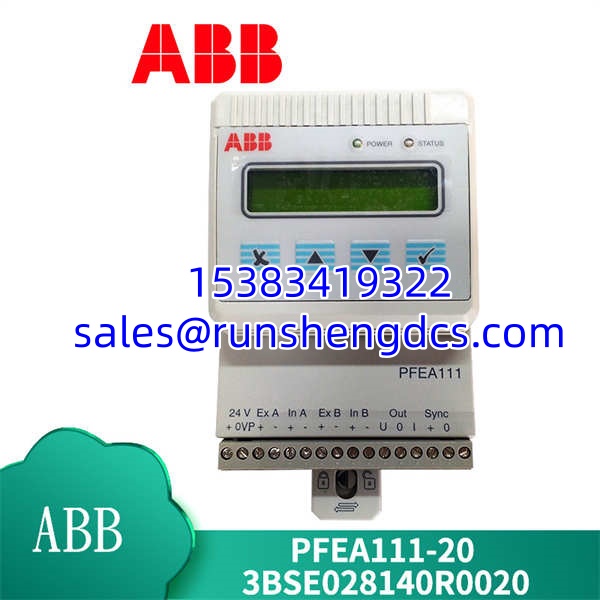
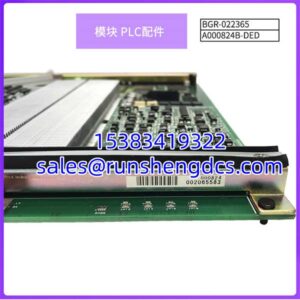
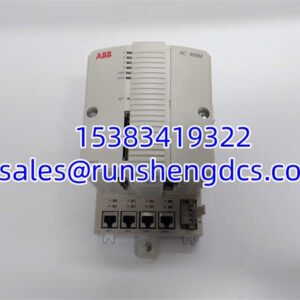
ABB-PFEA111-20
QA/QC Transparency SOP
Tension amplifiers are only as good as their calibration. Here is how we validate every PFEA111-20 before it leaves our facility:
- Intake & Origin Verification: We verify the 3BSE028140R20 ordering code and inspect the DIN rail clips and terminal blocks for stress or corrosion.
- Live Functional Testing: Units are powered up on a test bench. We inject precise mV/V signals using a calibrated simulator to verify the 0-10V and 4-20mA outputs track linearly across the full 20mV/V range.
- Electrical Parameter Tests: A Fluke multimeter verifies the 24V supply draw stays under 7.5W and checks isolation between the sensor excitation and the analog outputs.
- Firmware/Config Verification: We verify the internal digital filter settings and zero-tare functions respond correctly via the front panel buttons.
- Final QC & Anti-Static Packaging: Terminals are torqued to spec, and the module is sealed in an ESD-safe bag with desiccant to prevent moisture ingress during transit.
Field Engineer Gotchas
- Sensor mV/V Mismatch: The “-20” in PFEA111-20 means it maxes out at 20mV/V. If you pair this with a 65mV/V sensor, the input will saturate and you’ll lose measurement range. Always match the amplifier to the sensor’s exact mV/V rating.
- Shield Grounding Loops: Tension signals are microvolts. If you ground both ends of the sensor shield cable, you create an antenna for ground loop noise. Ground the shield at the PFEA111-20 module only.
- 变频器 (VFD) Interference: Running sensor cables parallel to VFD output cables is a death sentence for tension accuracy. Maintain at least 30cm of separation, or cross them at 90 degrees.
- Zero Drift from Thermal Stress: If your zero point drifts daily, the sensor might be mechanically bound, or the enclosure is exceeding 70°C. High heat accelerates electrolytic capacitor aging inside the module.
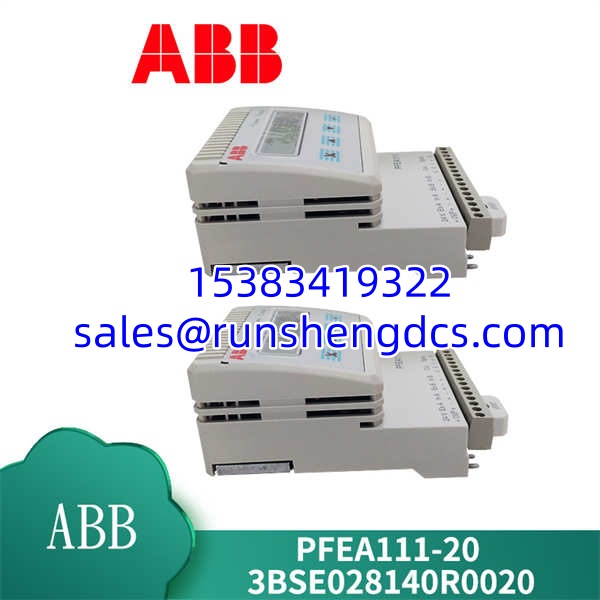
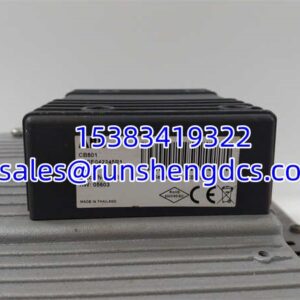
ABB-PFEA111-20
Application Scenarios
- Thin-Film Extrusion Lines: Maintaining constant tension on 30μm polymer films during high-speed winding. A 0.1% control accuracy prevents gauge banding and roll telescoping.
- Metal Foil Slitting: Aluminum and copper foils have almost zero elasticity. The <10ms response time is mandatory to prevent snapping the web during splicing or speed changes.
- Lithium Battery Separator Coating: Battery separator films are extremely delicate. Precise tension control prevents stretching, which would alter the microscopic pore size and ruin the battery’s performance.
- Web Printing & Laminating: Keeping paper or non-woven substrates at exact tension prevents register marks and color misalignment during high-speed offset printing.
FAQ
Q: Can I use a third-party load cell with the PFEA111-20?
Yes, but it must be a standard bridge-type sensor outputting ≤20mV/V. If your sensor outputs a different signal (like 0-10V directly), this module is the wrong choice. Verify the sensor’s datasheet before wiring.
Q: Does this module do closed-loop tension control by itself?
No. The is primarily a high-precision signal conditioner and amplifier. True closed-loop PID tension control requires integration with a PLC or ABB drive system (like ACS880) that uses this module’s 4-20mA output as feedback.
Q: My display shows “SENSOR FAULT” and the ALARM LED is flashing. What’s wrong?
That’s typically an Err-05 code. Check your sensor wiring first — a broken wire or bad shield ground is the most common cause. Next, verify the sensor’s mV/V rating matches the module. Finally, use a multimeter to measure the sensor output; if it’s outside ±1% of expected, replace the sensor.
Q: Can I mount this module outside the control panel?
No. It is rated IP20. Dust, moisture, and conductive debris will destroy the board. Always mount it inside a sealed, climate-controlled electrical cabinet.
Q: How do I calibrate the zero point?
With no load on the sensor, press and hold the zero (tare) button on the front panel for over one second. The green LED will flash to confirm. Never apply a calibration weight without following the official ABB calibration procedure, as incorrect weights will permanently skew your readings.
It is a legacy platform, but ABB still supports it, and the PFTL/PFCL sensors it pairs with are widely available. For new builds, ABB may recommend newer platforms, but for maintaining existing lines, the remains a highly reliable and cost-effective solution.