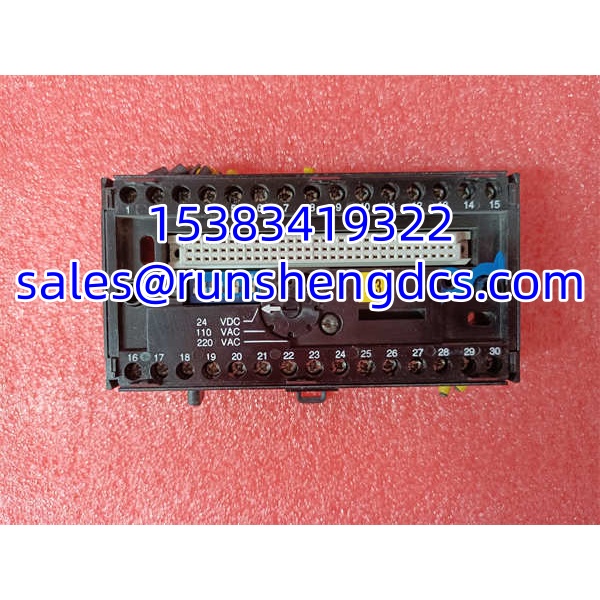

Description
Key Technical Specifications
| Parameter | Value |
|---|---|
| System Name | ABB CS31 (Control System 31) |
| Manufacturer | ABB |
| Physical Layer | RS-485, shielded twisted pair |
| Topology | Linear bus, master-slave |
| Max Slave Stations | 31 logical slave stations |
| Transmission Rate | Up to 187.5 kbps |
| Max Distance | 500 m without repeater; up to 2000 m with repeater |
| Power Supply | 24 V DC for remote I/O units |
| Addressing | Rotary/DIP switch on front panel |
| Data Exchange | Cyclic process image; diagnostic/acyclic services supported |
| Compatible Platforms | ABB AC31 (40/50/90 series), AC500, AC500-eCo |
| Typical Master | AC31 CPU with CS31 port, AC500 CM574-RS, AC500-eCo COM1 + RS485 option board |
| Typical Slaves | CI592-CS31, DC551-CS31, AC31 remote I/O units |
| Configuration Tool | Automation Builder / Control Builder Plus for AC500; legacy AC31 programming tools for older systems |
| Data Confidence | Verified from ABB documentation and system manuals; confirm exact limits with the OEM manual for your CPU/module revision |
System Introduction
CS31 is one of those ABB protocols that looks “simple” until you find a wrong baud rate, a missing terminator, or a duplicated rotary-switch address on site. It is not a general-purpose open fieldbus like PROFIBUS DP or Modbus TCP. It is an ABB-proprietary RS-485 distributed I/O bus, originally introduced with the AC31 family and later carried into AC500 for backward compatibility and cost-effective remote I/O expansion.
In an system, CS31 is typically enabled through a CPU serial port, a CM574-RS communication module, or an -eCo RS485 option board. The master polls up to 31 slave stations, exchanging cyclic process data with remote I/O modules such as CI592- and DC551-. Each slave can also extend local S500 I/O modules, so one node can represent multiple physical I/O blocks while still occupying only a defined number of logical software modules.
In legacy AC31 systems, is even more deeply embedded. Many 50-series and 90-series CPUs have a built-in port, and remote I/O units such as 07KT9x/07KRxx family modules act as slaves on the same twisted-pair bus. That makes especially common in brownfield water, power auxiliary, material handling, and small process systems where replacing the entire control platform is not justified.
From a procurement and commissioning perspective, is attractive because it reduces cabinet wiring and keeps remote I/O close to the field devices. The trade-off is that it is ABB-specific, bandwidth-limited compared with Ethernet fieldbuses, and highly sensitive to addressing and termination discipline.
QA/QC Transparency SOP
- System Identification: Confirm whether the site uses or , and whether runs from a CPU port, CM574-RS, or -eCo RS485 option board.
- Physical Inspection: Check RS-485 cabling, shielding, connector tightness, and 24 V DC slave power. Reject segments with broken shields, loose terminals, or corroded bus connectors.
- Address Verification: Read every rotary/DIP switch on slaves and confirm no duplicate addresses. In , ensure the configured address matches the hardware setting.
- Live Communication Test: Power the bus, verify master recognition of each slave, and confirm cyclic I/O data exchange without timeout faults.
- Final Documentation: Record baud rate, segment length, slave addresses, S500 module mapping, and any analog/digital module slot limits before handing over.
Field Engineer Gotchas
- vs confusion: exists on both platforms, but module families and configuration tools differ. Do not assume an remote unit can be configured directly in Automation Builder without checking device support.
- Address mismatch: The most common fault is a rotary-switch address that does not match the PLC configuration. Always verify both sides.
- Baud rate inconsistency: All nodes on the same segment must use the same baud rate. Mixing 187.5 kbps and 9.6 kbps devices on one segment will fail.
- Termination and grounding: Missing or double RS-485 termination causes intermittent communication loss. Ground the shield properly and avoid ground loops.
- Logical module limits: In , one physical device may consume multiple logical software modules depending on its digital/analog channel count. This can reduce the usable number of slave stations below 31.
- Not a replacement for PROFIBUS/Ethernet: is suitable for distributed I/O, not for high-speed motion, large data blocks, or multi-vendor device integration.
Application Scenarios
- remote I/O expansion: Extends digital and analog I/O to distributed locations using CI592- or DC551-, reducing cabinet wiring and terminal count.
- brownfield maintenance: Keeps legacy systems running by replacing failed remote I/O units or master CPUs without migrating the entire platform.
- Water and wastewater stations: Connects pump station I/O, level transmitters, valve feedback, and local alarms over a single RS-485 segment.
- Power auxiliary and material handling systems: Provides deterministic I/O collection for conveyors, switchgear rooms, and small process skids where Ethernet infrastructure is unnecessary.
FAQ
- Is an open protocol?
No. is an ABB-proprietary RS-485 distributed I/O bus used mainly with and systems. - How many slaves can one master support?
Up to 31 logical slave stations, subject to module mapping limits. - What is the maximum communication distance?
Typically 500 m without a repeater and up to 2000 m with repeaters. - Can use remote I/O via ?
In many cases yes, because retains compatibility for legacy remote I/O. Confirm the exact module support in the current ABB documentation before design. - Which modules are typical slaves?
CI592-, DC551-, and legacy remote I/O units such as 07KT/07KR family modules. - Can replace PROFIBUS DP or PROFINET?
Not generally. is best for distributed I/O. For multi-vendor devices, high bandwidth, or motion control, use PROFIBUS DP, PROFINET, EtherNet/IP, or EtherCAT. - Is still supported?
Yes. ABB continues to list as a supported protocol for communication interface modules, while many devices remain in service as legacy/brownfield components.