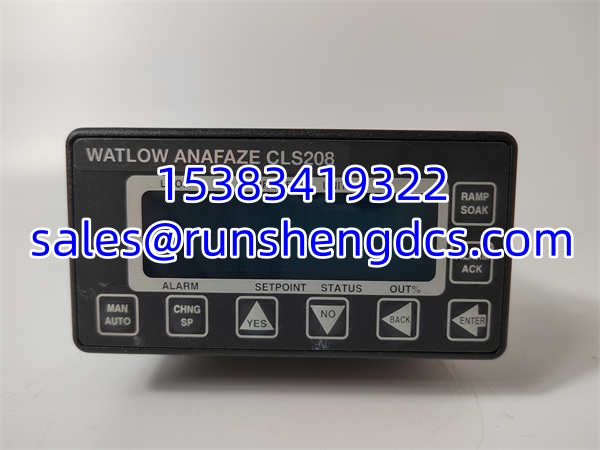

Description
Key Technical Specifications
| Parameter | Value |
|---|---|
| Control Loops | 8 Independent PID Loops |
| Sensor Inputs | Thermocouple, RTD, Linear Voltage/Current, Frequency |
| Digital Outputs | 34 Configurable (Control & Alarm) |
| Communication | TIA/EIA-232 & TIA/EIA-485 Serial |
| Control Features | Ramp/Soak, Cascade, Ratio, Differential Control |
| Auto-Tuning | Yes, per loop |
| Alarm Configuration | High/Low Process, Deviation, per input |
| Power Supply | 24 V DC or 100-240 V AC (Verify Suffix) |
| Mounting Style | DIN Rail or Panel Mount |
| Operating Temp | 0°C to 50°C (32°F to 122°F) |
| Programming | PC Software or Front Panel Menu |
| Compliance | CE, UL, CSA |
Product Introduction
Running eight separate single-loop controllers in a plastic extrusion barrel or packaging machine is a wiring and panel space nightmare. The WATLOW ANAFAZE CLS208 solves this by packing eight independent PID loops into one compact footprint. It’s a workhorse for multi-zone thermal management, letting you control eight heaters or coolers from a single device while sharing power and communication wiring. This isn’t just about saving space; it’s about reducing the failure points and commissioning time that come with managing eight discrete units.
Bottom line — it handles complex thermal profiles without the overhead. The WATLOW ANAFAZE CLS208 supports ramp/soak programming for batch processes and offers advanced features like cascade and ratio control for applications where zones are thermally coupled. With 34 configurable digital outputs, you can dedicate outputs to control, alarms, or remote setpoint status without needing extra relay modules. Just remember: this is a legacy platform. If you’re integrating with a modern MES, verify the serial protocol matches your SCADA system before ordering.
QA/QC Transparency SOP
- Intake & Origin Verification: We trace the WATLOW ANAFAZE CLS208 back to its decommissioning source or authorized surplus channel. We verify the PCB revision and configuration label against Watlow’s CLS200 series documentation to ensure it’s not a mislabeled CLS204 or CLS216.
- Live Functional Testing: Each unit is powered up on a test bench with a simulated 24VDC supply. We verify all 8 loops accept setpoint changes and that the auto-tune function initiates correctly. Digital outputs are forced via software to confirm relay/opto-isolator switching.
- Electrical Parameter Tests: Using a Fluke 87V, we check the internal power rail stability under load. Input channels are tested with precision thermocouple and RTD simulators to verify linearity and cold-junction compensation accuracy across the specified range.
- Firmware/Config Verification: We connect via the serial port to read the firmware version and current configuration. Any site-specific ramp/soak profiles or custom alarm limits are cleared to factory defaults unless a specific configuration is requested.
- Final QC & Anti-Static Packaging: After passing, the WATLOW ANAFAZE CLS208 is sealed in an anti-static bag with desiccant. A QC sticker noting the test date, firmware version, and verified sensor type is applied to the housing.
Field Engineer Gotchas
- Sensor Type Mismatch: The WATLOW ANAFAZE CLS208 is field-configurable for TC, RTD, or linear inputs, but it does not auto-detect. If your old unit was set to Type K TC and the replacement ships configured for PT100, Loop 1 will read -200°C or over-range. Always check the configuration label or use the PC software to verify sensor type before wiring.
- Communication Ground Loops: The RS-485 port is isolated, but if you’re daisy-chaining multiple WATLOW ANAFAZE CLS208 units across different panels with separate power supplies, you will get noise. Use a common signal ground or install isolators. I’ve seen erratic setpoint changes traced to a single missing ground wire.
- Output Configuration Trap: With 34 digital outputs for 8 loops, the output assignment is software-defined. Don’t assume Output 1 controls Loop 1. If a heater isn’t responding, check the software configuration map first. I’ve wasted an hour replacing a good SSR because the output was accidentally mapped to an alarm function.
- Ramp/Soak Profile Corruption: The non-volatile memory can degrade after 10+ years. If your ramp/soak profile won’t save or reverts to defaults after power cycle, the EEPROM is likely failing. Don’t trust it for critical batch recipes without a backup plan.
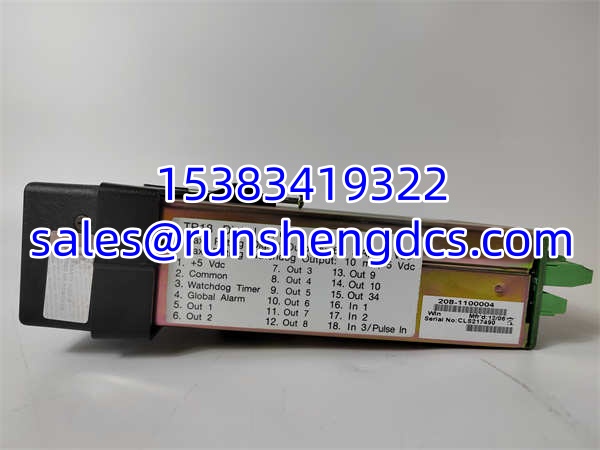
WATLOW ANAFAZE CLS208
Application Scenarios
Plastic Extrusion Barrel Heating: Multi-zone barrels require tight thermal coupling between adjacent zones. The ’s ratio control feature allows downstream zones to follow the lead zone’s temperature profile, reducing thermal shock and improving melt consistency.
Thermal Vacuum Chambers: Aerospace testing chambers use 8+ heater zones to maintain uniform temperature during bake-out. The ’s ramp/soak capability automates the multi-hour heating curve, while deviation alarms prevent sample damage if a zone drifts.
Packaging Machine Sealing: Heat seal bars on form-fill-seal machines need fast, independent temperature control. The compact footprint of the fits inside the machine frame, and the 34 digital outputs can directly drive seal bar SSRs and trigger cycle-complete signals to the PLC.
Real-World Case: A food packaging line had a fail mid-shift, stopping production for 4 hours while techs manually adjusted 8 variacs. We sourced a pre-configured with matching sensor types and ramp profiles. The replacement was installed and commissioned in 45 minutes. Total downtime saved: ~3 hours. The old unit’s EEPROM had failed, corrupting the seal temperature profile.
FAQ
Can I mix sensor types across the 8 loops?
Yes. Each loop on the is independently configurable. You can have Loop 1 as Type J TC, Loop 2 as PT100 RTD, and Loop 3 as 0-10V linear input. Just configure each one correctly in the software or front panel menu.
Does this support Modbus RTU?
No. The uses Watlow’s proprietary serial protocol over RS-232/485. If you need Modbus, you’ll need a protocol gateway or consider upgrading to the newer EZ-Zone or F4T series.
Is hot-swapping supported?
No. The is not designed for hot-swap. Power down the control circuit before replacing. The loops will revert to their last saved state on power-up, but you’ll lose real-time process data during the swap.
What software do I need to configure this?
You need Watlow’s CLS200 Series Configuration Software (legacy DOS/Windows 3.1/95 era) or the newer Watlow Configuration Tool if your firmware supports it. Verify your firmware version first — older units may not be compatible with modern Windows 10/11 PCs without a virtual machine.
Can I use this for cooling control?
Yes. Each loop supports direct/reverse acting PID. For cooling, set the loop to reverse acting and configure the output to drive a cooling valve or fan SSR. The handles both heating and cooling in the same loop if you have a dual-output configuration.
The has 8 loops; the CLS204 has 4. Physically, they’re similar in width, but the uses a different internal layout. They are not drop-in replacements for each other. Verify your loop count before ordering.
Is the battery replaceable?
The uses a non-volatile EEPROM for configuration, not a battery-backed RAM. There’s no battery to replace. If you’re losing settings, it’s either a power surge corrupting the EEPROM or the EEPROM itself failing.