
Description
Key Technical Specifications
| Parameter | Value |
|---|---|
| Processor | 300 MHz Intel Celeron |
| Memory | 32 MB DRAM |
| Cache | 128 KB L2 cache |
| NVRAM | 8 KB battery-backed SRAM |
| Storage | 16 MB or 128 MB CompactFlash |
| Power Supply | 24V DC ±10%, 1.2A max (shared backplane) |
| Operating Temp | -20°C to +70°C (derate above 55°C) |
| Vibration Rating | 0.7g continuous (per GEK 113695) |
| Ethernet | 10BaseT/100BaseTX, RJ-45, TCP/IP, EGD, Modbus |
| Serial Ports | 2× COM (micro 9-pin D): COM1 diagnostic @ 9600 baud, COM2 Modbus @ 9600/19200 |
| Dimensions | 160mm H × 483mm W × 210mm D |
| Weight | 2.8 kg |
| Form Factor | VME bus, Mark VIe chassis (13 or 21 slot) |
| Response Time | ~2 ms deterministic |
| Hot-Swap | Supported |
Product Introduction
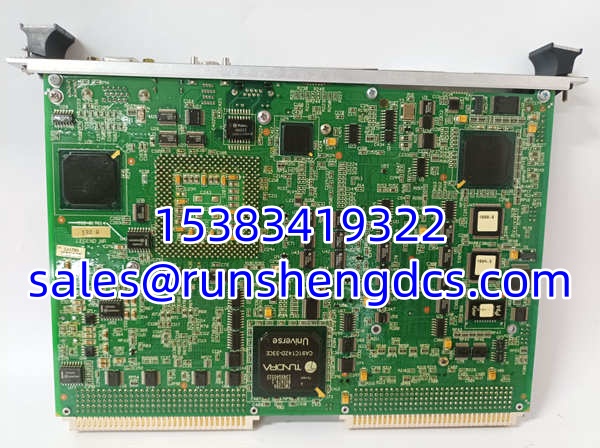
Turbine control racks in combined-cycle and simple-cycle power plants need a controller that can execute protection logic in under 2 ms, survive continuous vibration from the turbine hall, and keep communicating even when a neighboring board fails. The IS215UCVEH2AE fills that slot — it is the VME-format CPU card that runs the real-time operating system (typically VxWorks or QNX), coordinates I/O scanning across the Mark VIe backplane, and manages external network traffic via Ethernet and serial links.
This board carries a 300 MHz Celeron processor with 32 MB DRAM and battery-backed NVRAM, giving it enough headroom to handle combustion control, steam bypass regulation, and diagnostic data logging simultaneously. The 0.7g vibration rating (GEK 113695) means it holds up in frame 9E and 7FA turbine environments where harmonic resonance would shake lesser electronics apart. Hot-swap capability lets maintenance teams pull and replace the card without tripping the rack — a detail that has saved plants six figures in avoided downtime during valve calibration events.
QA/QC Transparency SOP
For surplus or pulled IS215UCVEH2AE boards, follow this validation sequence:
- Intake & Origin Verification — Confirm the silkscreen reads IS215UCVEH2AE with GE branding. Check the revision suffix (2AE vs. 2AB vs. 2AF — these are not interchangeable). Inspect the VME edge connector for bent pins, the RJ-45 jack for damaged contacts, and the CompactFlash slot for debris.
- Live Functional Testing — Seat the board in a powered Mark VIe VME chassis. Verify the processor boots and the status LEDs cycle through their normal startup sequence. Connect Ethernet and confirm the board responds to ping and EGD traffic. Load a known configuration via the GE toolbox software and confirm the board accepts it without fault codes.
- Electrical Parameter Tests — Measure backplane current draw at 24V DC. Confirm it stays under the 1.2A max spec under load. Check the battery-backed SRAM voltage — if the onboard lithium cells are dead, NVRAM data will not survive a power cycle.
- Firmware/Config Verification — Read the firmware revision through the GE diagnostic port (COM1 at 9600 baud). Compare against the target system’s required firmware level. Back up any stored configuration before clearing.
- Final QC & Anti-Static Packaging — Remove all test connections. Place in ESD-safe bag with foam cradle. Label with part number, revision, firmware version, test date, and pass/fail status.
Field Engineer Gotchas
- Revision suffix matters — a lot. The IS215UCVEH2AE is not a drop-in for the IS215UCVEH2AB or IS215UCVEH2AF. Different suffixes carry different firmware baselines, I/O mappings, and sometimes different physical connectors. I’ve seen a procurement team order the wrong revision and spend two days on the phone with GE support before realizing the board simply would not handshake with their existing Mark VIe rack. Always match the exact suffix from the original board’s label.
- CompactFlash corruption after power loss. The onboard CompactFlash stores the boot image and configuration. If the board experiences an ungraceful power cut while writing to flash, the filesystem can corrupt. Keep a known-good CF image backed up on your engineering laptop. If the board hangs at boot with no LED activity, try swapping in a fresh CF card with a verified image before condemning the board.
- Battery-backed SRAM dies silently. The 8 KB NVRAM relies on onboard lithium cells. When those cells drain (typically after 5-7 years on a shelf), the board will boot but lose its stored configuration every time power cycles. If your replacement board keeps forgetting its identity after a rack reboot, check the SRAM battery voltage first.
- COM port baud rate confusion. COM1 is fixed at 9600 baud for diagnostics. COM2 runs Modbus at either 9600 or 19200 — selectable via configuration. If your SCADA system expects 19200 and the board is set to 9600, you will get garbage characters and assume the port is dead. Verify the baud setting before blaming the cable.
- VME backplane slot assignment. The Mark VIe chassis assigns specific functions to specific VME slots. Dropping this controller card into the wrong slot will result in the rack failing to initialize. Consult the Mark VIe hardware manual for your specific chassis configuration before racking the board.
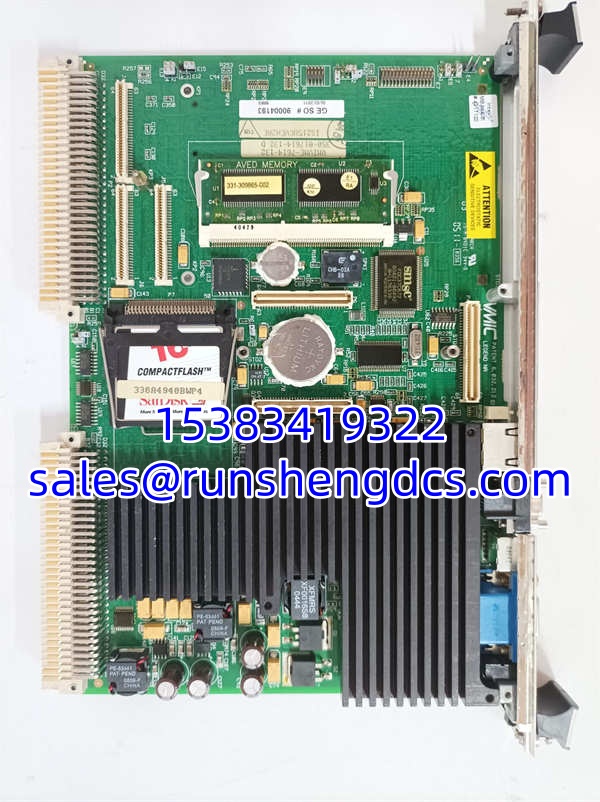
VMIC VMIVME-7614-132350-017614-132 D IS215UCVEH2AE
Application Scenarios
- Gas turbine combustion control — The board executes fuel valve positioning algorithms at 2 ms cycle time, adjusting fuel flow during rapid load changes to prevent flameouts in frame 7FA and 9FA turbines.
- Steam turbine bypass regulation — Controls high-pressure and low-pressure steam bypass valves during startup, shutdown, and load rejection events, maintaining header pressure within safe limits.
- LNG terminal HRSG protection — Monitors heat recovery steam generator parameters and actuates safety valves when humidity or temperature excursions threaten tube integrity.
- Offshore platform turbine control — Operates in sour gas environments where H₂S exposure would degrade standard industrial controllers; the Mark VIe platform’s sealed chassis and conformal-coated boards handle the corrosive atmosphere.
FAQ
Is the IS215UCVEH2AE compatible with Mark VI (non-e) racks?
No. The Mark VIe chassis has a different backplane architecture and slot assignment scheme than the original Mark VI. This board is designed for Mark VIe racks only.
Can I replace a 2AB revision with this 2AE revision?
Not without verifying firmware and configuration compatibility first. Different revision suffixes may carry different I/O maps, boot images, and communication protocols. Consult your GE Mark VIe system integrator or the hardware manual before cross-substituting revisions.
Does this board support redundant operation?
The Mark VIe platform supports triple-modular redundancy (TMR) at the system level. Whether your specific installation uses redundant controllers depends on the rack configuration and licensing. The board itself is capable of operating in a redundant arrangement when paired with matching boards in adjacent VME slots.
What operating system does it run?
Typically VxWorks or QNX, depending on the firmware version and application configuration. The real-time OS handles task scheduling, I/O scanning, and network stack management.
How long do the onboard lithium batteries last?
Typically 5-7 years under continuous operation. On a shelf with no power, the drain is slower but the cells will still deplete over time. If you are buying surplus stock that has been sitting in a warehouse for years, plan to verify or replace the SRAM backup battery before commissioning.
What is the typical lead time for a replacement?
This is a legacy Mark VIe component. OEM supply is limited. Surplus and third-party suppliers typically quote 1-4 weeks depending on revision availability. For urgent turbine trips, some specialty distributors stock common revisions for next-day shipment.
Can I flash new firmware onto this board in the field?
Yes, firmware updates are loaded via the Ethernet connection using the GE Mark VIe toolbox software. However, firmware upgrades on turbine control boards should follow your plant’s change management procedure — an incorrect firmware flash can brick the controller and leave the turbine without protection.