
Description
Key Technical Specifications
| Parameter | Specification |
|---|---|
| Product Type | Tricon System Power Supply Module |
| Platform | Triconex Tricon Safety Control System |
| Input Voltage | 230VAC |
| Input Frequency | 50/60 Hz typical |
| Installation | Tricon chassis power slot / left-side power area |
| Redundancy | Supports redundant power configuration where chassis and system design allow |
| Maintenance | Hot-swap / online replacement capability, procedure dependent |
| Diagnostics | Power status and fault indication via module LEDs and Tricon system monitoring |
| Protection | Overcurrent / overvoltage / overtemperature / short-circuit protection typical |
| Application Class | Safety Instrumented System / SIS power supply role |
Product Introduction
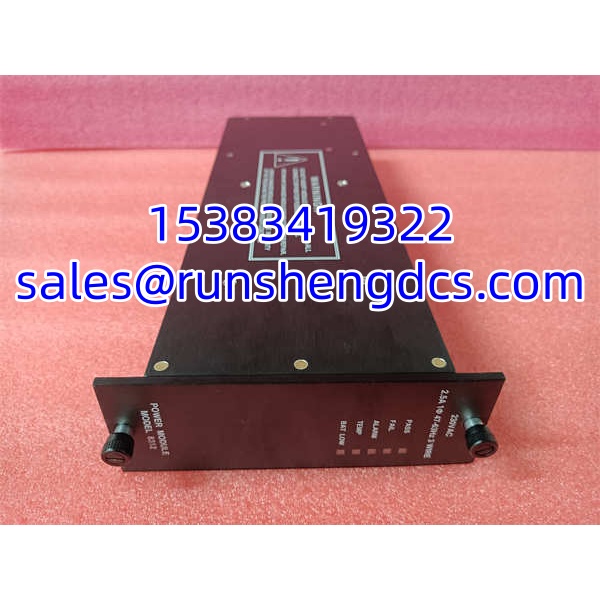
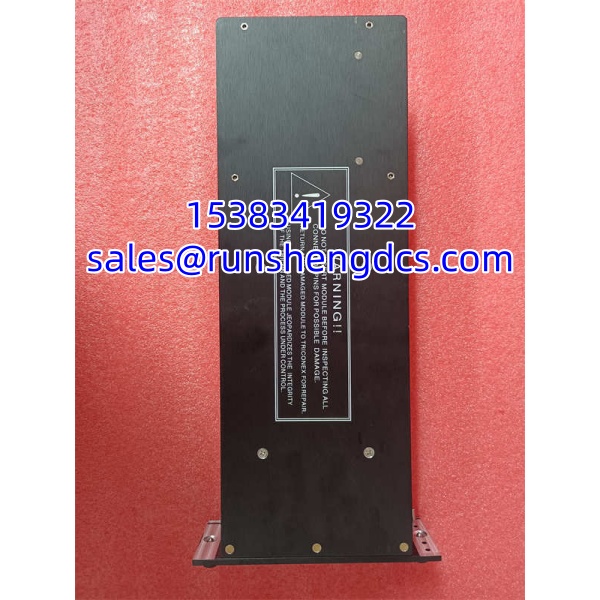
In a Tricon SIS rack, the power module is not a background component — it is the first point of failure when a chassis loses communication, faults on startup, or refuses to recognize I/O. The Triconex 8312 is the 230VAC power supply module used in Tricon main and expansion chassis to convert line power into the regulated DC supply that processors, I/O modules, communication modules, and internal bus circuitry depend on.
What matters in the field is that the 8312 is part of a redundant-capable power architecture. Each Tricon chassis typically uses two power modules, and either one should be capable of supporting the chassis load under rated conditions. That means a single failed supply does not automatically mean a process trip — but only if the second supply is healthy, correctly wired, and the chassis is actually configured for redundant power. The 8312 also provides status and fault feedback to the Tricon system, which is useful for troubleshooting before a nuisance alarm becomes an emergency call at 2 a.m.
QA/QC Transparency SOP
1. Intake & Origin Verification
Check the nameplate for Triconex 8312, revision, serial number, and any safety or certification markings. Inspect the backplane connector for bent pins, corrosion, burnt traces, or signs of overheating. Confirm the module matches a 230VAC Tricon power module physically and by label — not a 24VDC module, not an I/O module, and not a different Tricon power variant.
2. Visual & Mechanical Inspection
Look for cracked housings, missing hardware, damaged locking features, or connector contamination. Verify that the module slides into the chassis guide without force. If the backplane pins are damaged, do not install it. A forced insertion can damage the chassis backplane and create a much bigger problem than one bad power supply.
3. Electrical Parameter Tests
With the module removed from a live safety system, perform insulation and continuity checks only if the test procedure and voltage levels are approved for the module. Measure input-side continuity where applicable, check for shorted input terminals, and verify that no obvious low-resistance faults exist across power paths. Do not apply line voltage on a bench unless the test setup replicates proper grounding, fusing, and isolation.
4. Functional Verification in a Known-Good Chassis
If a suitable Tricon chassis is available, install the 8312 with the second power supply removed or isolated per site procedure. Confirm that the module powers the chassis, that status LEDs behave normally, and that the Tricon system does not report a power fault. Then verify redundant behavior only after confirming both supplies are correctly rated, wired, and approved for parallel/redundant operation.
5. Final QC & Anti-Static Packaging
Record the part number, revision, serial number, test result, and date. Cap or protect the backplane connector. Pack in an anti-static bag with edge and connector protection. Include a test note stating whether the module was visually verified only or functionally tested in a chassis — do not overstate the test scope.
Field Engineer Gotchas
Mixing 8312 with 8310 or 8311
- Risk: 8312 is the 230VAC power module. 8310 and 8311 are different input types in the Tricon power family. Installing the wrong supply can leave the chassis unpowered, trip upstream protection, or damage equipment.
- Solution: Match the module to the available supply voltage and the chassis documentation.
- Blunt warning: If the panel is fed 230VAC, do not install an 8311 just because it fits mechanically.
Assuming Hot-Swap Means “Pull It Anytime”
- Risk: Hot-swap capability depends on chassis configuration, redundant supply health, grounding, and site maintenance procedures. Pulling the last healthy supply on a running SIS chassis is not a maintenance move — it is a process event.
- Solution: Confirm the second power supply is healthy and carrying load before removing the first. Follow the Tricon hardware manual and site permit/process procedures.
- War story: A tech removed a “faulty” power supply without confirming the redundant supply was online. The chassis dropped, I/O faulted, and the unit went into a safe-state scramble. The replacement part was fine; the procedure was not.
Ignoring Alarm Contacts and Status LEDs
- Risk: A power module can look physically fine but still report a fault through the backplane or hardwired alarm contacts. If you only check LEDs and ignore the Tricon diagnostic view, you may miss intermittent input loss or overtemperature warnings.
- Solution: Check module LEDs, chassis diagnostics, and any hardwired alarm contacts.
- Bottom line: If the Tricon system says the power supply is faulty, believe it until you prove otherwise.
Wiring the AC Input Without Verifying Source Voltage
- Risk: Field panels are sometimes relabeled, rewired, or fed from a different transformer after a turnaround. Assuming 230VAC without measuring can lead to misapplication.
- Solution: Measure the actual incoming voltage at the terminal block before energizing the 8312.
- Seen it happen: A replacement 8312 was installed during a panel rebuild, but the supply was actually 120VAC. The module did not operate correctly because the input did not match the expected 230VAC application.
TRICONEX 8312
Application Scenarios
Refinery ESD system power supply
Emergency shutdown systems in refineries depend on continuous, reliable chassis power. The 8312 supplies the Tricon chassis that monitors safety-critical inputs and drives final trip elements. Redundant power modules reduce the chance that a single supply failure causes a spurious trip or loss of protection.
Oil and gas wellhead or platform safety control
Remote platforms and wellhead panels often use Tricon SIS hardware for fire and gas detection, shutdown logic, and valve control. The 8312 provides the chassis power needed to keep processors and I/O modules alive in environments where maintenance windows are short and power quality is not always clean.
Power generation boiler or turbine protection
Boiler protection and turbine trip systems require deterministic behavior during faults. A Tricon chassis powered by matched 8312 modules can maintain protection logic while allowing one supply to be replaced online — assuming the redundant supply is healthy and the procedure is followed.
Anonymized case study:
A chemical plant reported intermittent Tricon chassis faults after a planned outage. The operations team suspected a failed main processor. During troubleshooting, the instrumentation technician found that one 8312 power module showed a fault indication while the second supply appeared normal. The chassis was still running, but the diagnostic history pointed to repeated power-supply alarms. The root cause turned out to be a loose AC input connection at the terminal block, not the module itself. After reterminating the supply wiring, torquing the connections to the panel standard, and clearing the fault history, the alarms did not return. The lesson: in a redundant SIS power arrangement, an intermittent alarm is often a wiring problem before it is a module problem.
FAQ
Is the Triconex 8312 a 230VAC power supply module?
Yes — in standard Tricon documentation context, the 8312 is treated as the 230VAC Tricon power supply module. Always verify the nameplate and revision before installation.
Can I use an 8312 in place of an 8310 or 8311?
Not automatically. The 8312 is associated with 230VAC input, while 8310 and 8311 are different power-module variants. The correct replacement depends on the incoming supply voltage, chassis configuration, and Tricon hardware documentation.
Does the 8312 support hot-swap?
Tricon power modules are generally designed for online replacement when the chassis has a healthy redundant supply and the installation supports it. That does not mean you can remove any power module at any time. Confirm redundant supply status and follow site safety procedures before removing a live module.
What happens if one 8312 fails in a redundant chassis?
If the chassis has two power modules and the second supply is healthy, the chassis should continue operating from the remaining supply. The failed module should generate a fault or alarm indication. The failed unit can then be replaced online if the procedure and site conditions allow it.
How do I know if the 8312 is actually faulty?
Check three things: module LEDs, Tricon chassis diagnostics, and the AC input supply. A power fault can come from a bad module, a loose input connection, a blown fuse or breaker, incorrect supply voltage, or a chassis backplane issue. Do not condemn the module until the external power path is verified.
Is the 8312 suitable for SIS applications?
Yes, it is used as part of a Tricon safety control system power architecture. However, “suitable” depends on the application’s safety requirements, redundancy design, installation standard, and whether the module revision is approved for the target system.
What should I check before installing a surplus 8312?
Check the nameplate part number, revision, serial number, backplane pins, input rating, and physical condition. Then verify that the module matches the chassis power requirement and the available AC supply. Do not install a module just because the model number looks close.