
Description
Key Technical Specifications
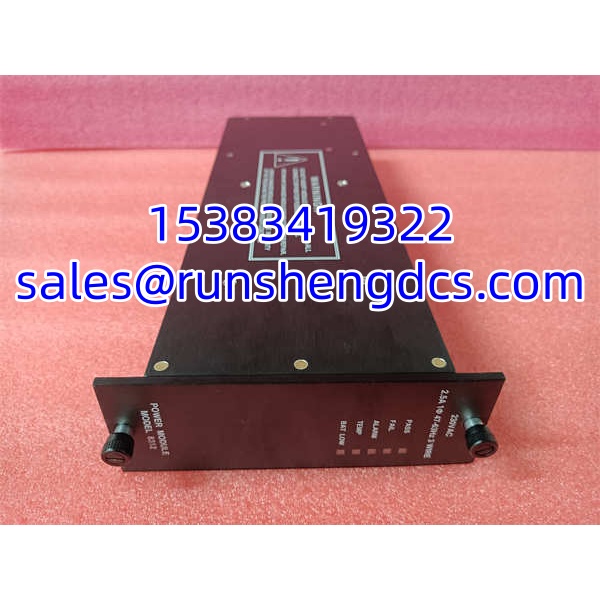
- Module type: Tricon rack power supply module
- Part number: 8312
- Input voltage: 230VAC nominal; legacy documentation describes it as the 230VAC variant within the 8310/8311/8312 power family
- Output: Internal DC bus power for Tricon main processors, I/O modules, communication modules, and associated rack electronics
- Output current / power rating: Not consistently confirmed across sources; verify on the module nameplate or OEM documentation before substitution
- Redundancy: Supports dual power supplies per rack; a single supply can typically carry the full rack load
- Hot-swap: Supported; a failed module can be replaced without shutting down the rack when redundancy is healthy
- Mounting location: Left-side power slots in the Tricon main or expansion rack
- Status indicators: Typically includes PASS, FAULT, ALARM, TEMP, and BATTLOW LEDs; exact behavior depends on revision
- Operating temperature: Commonly cited as 0 °C to 60 °C for Tricon rack modules; confirm against the installed system manual
- Compatibility: Used with Tricon main processors such as 3008/3009 and standard Tricon I/O, communication, and analysis modules
- Safety role: Supports SIL-capable Tricon SIS architectures when installed in a properly configured redundant rack
Product Introduction
The TRICONEX 8312 is the 230VAC power supply module for the Tricon triple-modular-redundant safety instrumented system. It sits in the left-side power slots of a Tricon main or expansion rack and converts external 230VAC into the internal DC power required by main processors, I/O modules, communication modules, and backplane electronics. In a Tricon SIS, the 8312 is not a logic or I/O card; it is the power backbone that keeps the TMR controller alive during normal operation and during fault conditions.
Field relevance is highest when a Tricon rack loses power, reports a power fault, or shows persistent FAULT/ALARM/TEMP LEDs. Because Tricon racks are normally configured with two power supplies, a single 8312 failure should not trip the system if the redundant supply is healthy. Replacement requires confirming that the module is the correct 230VAC variant, that it is installed in the correct power slot, and that the redundant supply is verified before removing the failed unit.
Troubleshooting Quick Reference
| Fault | Likely Cause | Relevancy | Quick Check | Fix |
|---|---|---|---|---|
| Rack loses power | Both supplies failed or lost AC input | High | Check AC feed, fuses, and both PS LEDs | Restore AC; replace failed module |
| FAULT LED on | Internal power module fault | High | Compare with redundant supply status | Replace 8312; verify rack alarms |
| ALARM LED on | Rack-level alarm, not always PS failure | Medium | Check TriStation/ENDM diagnostics | Clear root cause; confirm PS health |
| TEMP LED on | Overtemperature or poor ventilation | Medium | Check cabinet fans and airflow | Improve cooling; reseat module |
| BATTLOW LED on | Low battery or backup power issue | Medium | Inspect system battery circuit | Replace battery; verify retention |
| Redundant supply not taking over | Second supply missing or faulty | High | Verify both power LEDs and AC inputs | Install healthy second 8312 before removal |
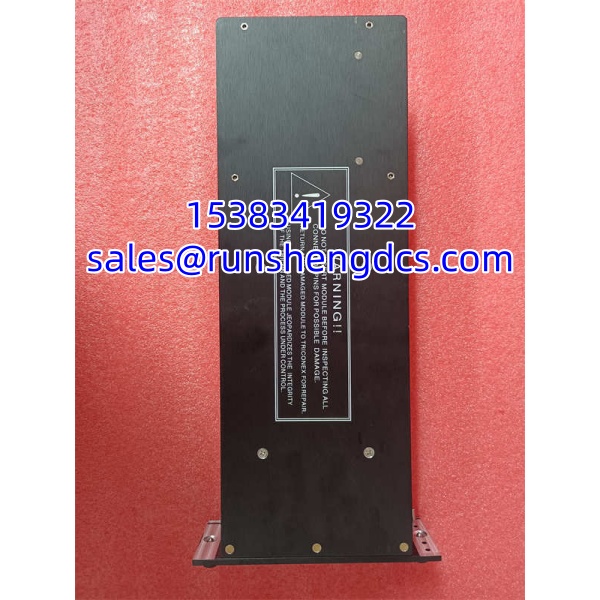
TRICONEX 8312
Application Scenarios & Pain Points
- ESD rack power loss: One 8312 fails during plant operation. The second supply must carry the full rack load until the failed module is replaced.
- F&G system maintenance: Engineers replace a faulty 8312 during a turnaround. If the redundant supply has not been verified, the rack may lose power during removal.
- Spare parts audit: Warehouses sometimes mix 8310, 8311, and 8312. Issuing the wrong voltage variant can prevent the rack from powering up.
- Legacy system support: Older Tricon racks may have mixed revisions. A replacement 8312 must match the rack’s mechanical keying and electrical requirements.
- Case note: A site reported repeated Tricon rack alarms after a power module replacement. The module was seated but the redundant supply had an unstable AC feed. Restoring clean 230VAC to both supplies cleared the alarm.