
Description
Product Introduction
Space-constrained industrial control panels often force engineers to compromise on power quality or thermal management. The PARKER PM3326B-6-1-2-E is the engineered solution designed to eliminate this trade-off, delivering a clean 144W of regulated 24VDC power in an ultra-compact 1U footprint. Built on the Pioneer Magnetics platform, this module integrates active Power Factor Correction (PFC) and a fanless convection-cooled design to ensure reliable operation in dusty, vibration-prone environments where traditional DIN-rail PSUs simply cannot fit or survive.
In our field experience, the PARKER PM3326B-6-1-2-E stands out because of its universal input range (85-264VAC) and exceptional signal integrity. Its low EMI profile makes it an ideal power source for sensitive medical diagnostic equipment or precision robotics, preventing voltage sags from corrupting critical sensor readings. Whether you are retrofitting a legacy semiconductor test cabinet or designing a new automation cell with tight spatial constraints, the PARKER PM3326B-6-1-2-E provides the deterministic, high-efficiency power foundation required to maintain continuous process uptime.

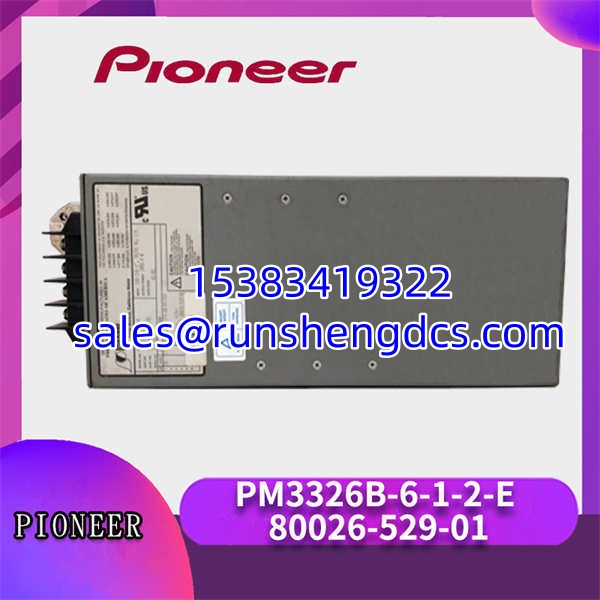
PARKER PM3326B-6-1-2-E-80026-529-01
Key Technical Specifications
- Product Model: PM3326B-6-1-2-E (80026-529-01)
- Manufacturer: PARKER / Pioneer Magnetics
- Product Type: Single Phase Power Module / Static Converter
- Input Voltage: 85-264VAC ±10%, 47-63Hz (Universal)
- Output Rating: 24 VDC / 6 A (144W Total)
- Cooling Method: Convection-Cooled (Fanless Design)
- Dimensions: 122 x 100 x 40 mm (W x H x D)
- Weight: 420g
- Operating Temperature: -25°C to +70°C (Derate above 55°C)
- Installation: Panel-mount with M4 screws (No DIN rail required)
- Signal I/O: Remote On/Off, Power Good Signal
Application Scenarios & Pain Points
The PARKER PM3326B-6-1-2-E typically becomes the focal point when a panel designer runs out of DIN rail space or faces excessive dust accumulation in traditional fan-cooled supplies. We’ve seen cases where a failed fan in a standard PSU caused an entire conveyor control rack to overheat and trip during a summer shift. This module acts as the robust, maintenance-free alternative, utilizing passive convection cooling to eliminate moving parts while maintaining strict voltage regulation even during daily industrial voltage sags.
- Automotive Conveyor Controls: Powering distributed I/O and PLCs in assembly lines. The PARKER PM3326B-6-1-2-E’s active PFC reduces harmonic distortion, protecting upstream transformers and ensuring stable logic power during heavy motor starting cycles.
- Semiconductor Test Equipment: Supplying clean DC to legacy test cabinets. The ultra-compact 1U form factor allows multiple modules to be installed in tight spaces where standard bulky PSUs cannot physically fit.
- Medical Diagnostic Systems: Powering sensitive imaging or lab analysis equipment. The low EMI signature of this module prevents interference with precision analog sensors during critical patient readings or chemical assays.
- Beverage Packaging Lines: Operating in high-dust, washdown-adjacent environments. The fanless design of the prevents internal dust buildup, allowing it to run continuously for years without requiring compressed air cleaning or maintenance.
Quality Control Process
We know that a power supply with degraded electrolytic capacitors can introduce fatal ripple into your 24VDC control bus. That’s why our QC for the goes far beyond a visual check. We treat every unit as a critical infrastructure component, and our testing reflects that level of scrutiny.
- Visual & Mechanical Inspection: We inspect the for damaged M4 mounting threads, compromised conformal coating, and verify the integrity of the input/output terminal blocks. We also check for any signs of thermal stress on the internal MOSFETs and PFC inductors.
- Universal Input & Load Test: We apply a variable AC input starting at 85VAC to verify startup, then ramp to 264VAC. We connect a calibrated electronic load to draw the full 6A (144W) and monitor the output voltage for droop, ensuring it remains tightly regulated at 24VDC under maximum stress.
- Ripple & Noise Verification: Using an oscilloscope, we measure the AC ripple on the 24VDC output while under full load. We verify that the noise levels are well within specification, ensuring that sensitive downstream microcontrollers and analog I/O cards will not experience erratic behavior.
- Protection & Signal Test: We simulate an overcurrent condition to verify the module’s internal protection circuitry safely limits the output. We also test the Remote On/Off and Power Good signals to ensure they transition correctly and provide accurate status feedback to the host controller.
- Final Certification: Only units passing all electrical, thermal, and protection tests receive our QC label. We provide a test report detailing the load regulation and ripple measurements for your maintenance records.

PARKER PM3326B-6-1-2-E-80026-529-01
Installation Pitfalls Guide
I’ve seen a perfectly good fail to power a rack because of inadequate panel ventilation or ignored derating curves. Don’t let a simple mounting error cost you days of downtime. Here are the traps we see most often:
- Thermal Derating Ignored: The is rated for 6A up to 55°C. If your panel ambient temperature reaches 70°C, you must derate the output current. Failing to calculate this thermal headroom will cause the module to prematurely shut down or fail.
- Convection Airflow Blockage: This is a convection-cooled module. Do not mount it flush against a solid backplate or pack it tightly against other heat-generating components. It requires adequate vertical clearance to allow natural air currents to carry heat away from the internal components.
- Power Good Misinterpretation: The Power Good signal is an open-collector output. If you are reading a fault in your PLC, ensure you have properly configured the input card (sourcing vs. sinking) and provided the necessary pull-up resistor. A floating Power Good line will cause unpredictable PLC behavior.
- M4 Mounting Torque: The module is designed for panel mounting via M4 screws, not DIN rail. Over-torquing the M4 screws can crack the PCB or strip the chassis threads. Use a calibrated torque screwdriver and tighten evenly to ensure proper grounding and mechanical stability.
- Input Wiring Gauge: Even though the module is compact, it can draw significant current at 85VAC input. Do not use undersized wire on the AC input terminals. Ensure your input wiring is sized appropriately to prevent voltage drop and terminal overheating during full-load operation.