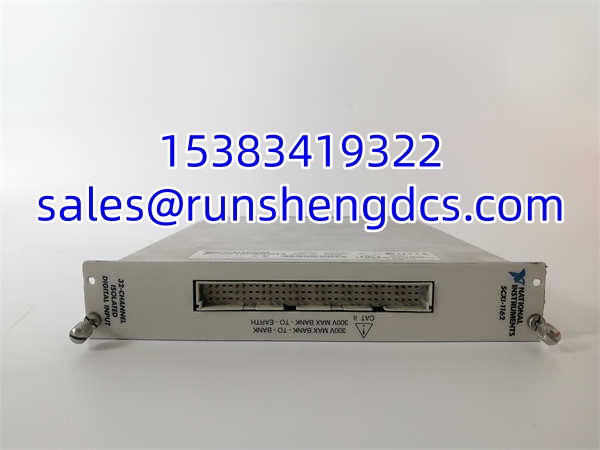

Description
Key Technical Specifications
- Channel Count: 8 independently isolated digital I/O channels
- Isolation Voltage: 2500Vrms channel-to-channel and channel-to-ground (optocoupler-based galvanic isolation)
- Isolation Technology: Optocoupler isolation suppressing ground loop interference and EMI
- Input Logic Threshold: ≥2V DC registers as logic “1” (per NI community field data)
- Input Sensitivity: Earlier revisions required ~30µA; later production lots dropped to ~2µA — verify your specific module revision
- Voltage Range (HV variant): ±10V, ±30V, ±100V, ±300V, ±600V DC; 10/30/100/300/600Vrms AC at 50/60Hz — software-selectable per channel
- Form Factor: 6U SCXI module, single slot
- Compatible Chassis: SCXI-1000, SCXI-1001 series
- Terminal Block Accessory: TBX-1326 (DIN-rail mountable, 48 screw terminals in 8 isolated banks of 6)
- Cable Interface: SH48-48-B ribbon cable from module front connector to TBX-1326
- Driver Software: NI-DAQmx; integrates with LabVIEW, Measurement & Automation Explorer (MAX)
- Channel Configuration: Each bank on TBX-1326 provides Vcc, GND, and 4 channel terminals — each bank isolated from all others
- Base Variant I/O Type: Digital input (per TBX-1326 terminal assignment documentation)
- HV Variant I/O Type: Analog input signal conditioning (per TBX-1326 terminal assignment documentation)
Product Introduction
You’re wiring up a test rack and need to read discrete status signals from a 480V motor control panel — but your DAQ card lives at ground potential, and the last thing you want is a ground loop frying your acquisition hardware. The SCXI-1162 sits in an SCXI-1000 chassis between the field wiring and your DAQ backplane, putting 2500Vrms of optical isolation between each of its 8 channels and everything else. It was NI’s answer to the problem of interfacing industrial discrete signals (limit switches, relay contacts, PLC outputs) to sensitive DAQ systems without sharing a common ground reference.
The HV variant (SCXI-1162HV) pushed this further — software-selectable ranges from ±10V up to ±600V DC or 600Vrms AC, with each of the 8 channels independently configurable. That meant you could read a 24V PLC output on channel 0 and a 480V AC status signal on channel 3 without external voltage dividers or signal converters. The TBX-1326 terminal block broke those 8 channels into isolated banks of 4, each with its own Vcc and GND — a practical design for field wiring where different signal sources float at different potentials. One thing to watch: NI revised the input sensitivity across production lots. Early modules needed ~30µA to register a logic “1”; later units dropped to ~2µA. If you’re replacing a failed module in an existing system, the new unit might trigger on leakage currents that the old one ignored. Verify the revision.
Troubleshooting Quick Reference
| Fault | Likely Cause | Probability | Quick Check | Fix |
|---|---|---|---|---|
| Channel won’t register logic “1” | Input current below module sensitivity threshold | ~70% | Measure input source current capability; check if source can deliver ≥2V DC | Verify source can meet module’s current requirement (2µA vs. 30µA depending on revision); add pull-up resistor if needed |
| Channel reads erratic / floating | Missing Vcc/GND reference on isolated bank | ~65% | Confirm Vcc and GND are wired to the bank for that channel | Connect external 4.5-5.5V supply referenced to that bank’s GND terminal |
| Cross-channel interference | Isolation barrier compromised or wiring error | ~55% | Measure resistance between channel terminals; should be open circuit | Check wiring — ensure banks are not shorted together; verify SH48-48-B cable integrity |
| Module not detected in MAX | SCXI chassis communication fault or DAQmx driver issue | ~50% | Check chassis power; verify DAQ device enumerates in Measurement & Automation Explorer | Reseat module in chassis slot; reinstall NI-DAQmx; verify chassis firmware version |
| HV variant reads incorrect voltage | Attenuation jumper misconfigured on | ~45% | Check hardware jumpers (100:1 vs. 1:1 attenuation setting) | Configure correct attenuation ratio in MAX under module properties; match jumper setting to software config |
| Ground loop persists despite isolation | Chassis ground or DAQ card ground reference conflict | ~40% | Measure potential difference between SCXI chassis ground and signal source ground | Ensure isolated banks are truly floating; do not tie isolated GND to chassis ground |
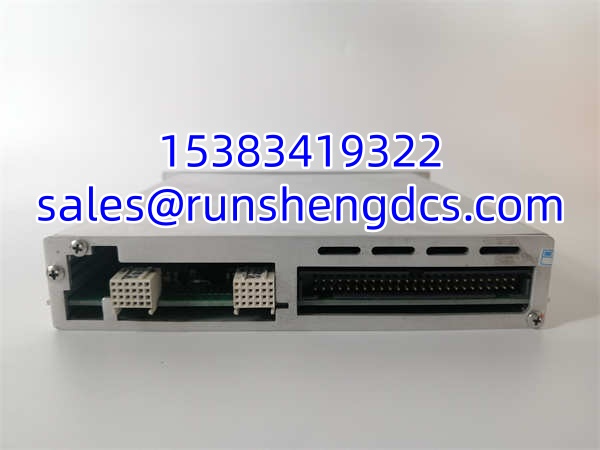
NI SCXI-1162
Application Scenarios & Pain Points
Industrial motor control monitoring:
Reading discrete status signals (contactor auxiliary contacts, overload relay trips, door interlocks) from 480V MCCs into a lab DAQ system. The 2500Vrms isolation keeps the DAQ hardware safe when the MCC ground floats hundreds of volts above lab ground. Pain point: the input sensitivity revision change means a replacement module might trigger on leakage current that the original ignored — causing false “closed” readings on open contacts.
High-voltage battery testing (EV/energy storage):
The SCXI-1162HV variant monitors cell contactor status and interlock circuits across battery packs operating at 400-800V DC. Software-selectable ±600V range eliminates external dividers. Pain point: terminal block jumpers must match the attenuation setting configured in MAX. Mismatched jumper/software config gives you readings that are off by 100x — and it’s not obvious until you cross-check with a handheld meter.
Semiconductor test equipment:
Discrete I/O for wafer handler interlocks, vacuum sensor status, and process chamber door switches. Optically isolated channels prevent ground loops between the test head and the factory control system. Pain point: the SCXI platform is end-of-life. NI’s current lineup (PXIe-based) doesn’t offer a direct drop-in replacement for this specific isolation architecture. Migration requires rethinking the entire signal chain.
Power system relay testing:
Reading trip signals and auxiliary contacts from protective relays in substations. The isolated banks on the let you interface multiple relay outputs floating at different potentials without cross-contamination. Pain point: finding the SH48-48-B ribbon cable and terminal block as spares is harder than finding the module itself. These accessories are often the bottleneck, not the module.