
Description
Key Technical Specifications
| Parameter | Specification |
|---|---|
| Product Type | Digital Output Module |
| Channel Count | 16 Sinking Outputs |
| Output Current | 2 A per channel (16 A max per module) |
| Voltage Range | 5 to 30 VDC |
| Update Rate | 20 kHz per channel |
| Protection | Fused outputs for short-circuit protection |
| Isolation | 2300 Vrms backplane-to-channel isolation |
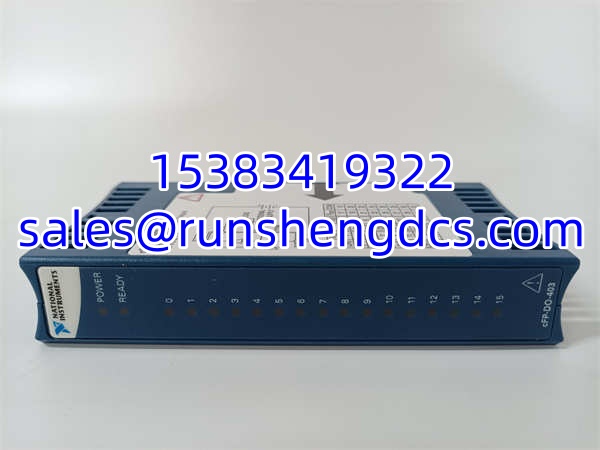
| Status Indicators | Individual LED per channel |
| Backplane | Compact FieldPoint (e.g., CFP-BP-4/8) |
| Connector | CFP-CBB-X Connector Block |
| Operating Temp | -40°C to 70°C (at 25V input) |
Product Introduction
Driving inductive loads like relays and solenoids in industrial environments is a fast track to frying your I/O cards if you don’t have proper protection. The NI CFP-DO-403 solves this by integrating fuses on all 16 sinking output channels, preventing a single short circuit from taking out your entire Compact FieldPoint bank. It handles 5-30VDC at 2A per channel, making it a direct interface for most industrial control loads without needing external interposing relays.
This module delivers a 20kHz update rate per channel, which is more than sufficient for discrete control but not designed for high-speed PWM. The CFP-DO-403 features 2300Vrms isolation between the backplane and outputs, protecting your controller from field-side transients. It includes individual LEDs for each channel, so troubleshooting a stuck output takes seconds instead of pulling out a multimeter. Bottom line: it’s a rugged, protected workhorse for discrete automation.
QA/QC Transparency SOP
- Intake & Origin Verification: Confirm part number CFP-DO-403 and check for physical damage to the Compact FieldPoint connector. Inspect the fused output section for signs of thermal stress or blown fuse indicators.
- Live Functional Testing: Mounted on a CFP-BP-8 backplane with a CFP-2210 controller. Each of the 16 channels is toggled via LabVIEW/Measurement & Automation Explorer (MAX) while driving a 24VDC resistive load. All LEDs must illuminate correctly.
- Electrical Parameter Tests: Verify output voltage drop under 2A load (must be within spec). Check isolation resistance between backplane and output terminals using a megger. Confirm fuse continuity on all channels.
- Firmware/Config Verification: Read module identity via MAX. Verify channel configuration (power-up state, open-wire detection) matches factory defaults or specified customer config.
- Final QC & Anti-Static Packaging: Backplane connector pins inspected for straightness. Sealed in anti-static bag with desiccant. Hard-shell case to prevent connector damage during transit.
Field Engineer Gotchas
- Power-Up State Defaults: After a power loss, the CFP-DO-403 may default all outputs to ON (true) until the controller boots and applies configuration. If this is unacceptable, configure individual channel power-up states in MAX. I’ve seen this melt a solenoid coil during a brief power blip.
- Flyback Diode Conflicts: The module has internal flyback diodes. If you’re driving relays that need fast release times, adding external diode-resistor networks across the load won’t help—the internal diode still clamps the voltage. For faster relay release, connect the positive supply directly to the load (not to Vsup) and use an external protection network.
- Vsup Wiring: Don’t forget to wire Vsup on the CFP-CBB-X connector block. The field-side power for the outputs comes from Vsup, not the backplane. I’ve seen techs spend hours troubleshooting “dead” outputs that were simply missing Vsup wiring.
- Total Current Limit: 2A per channel is fine, but the module maxes out at 16A total. If you’re running all 16 channels at 1A, you’re at 100% capacity. Derate for ambient temperature above 50°C. Thermal shutdown will save the module but kill your process.
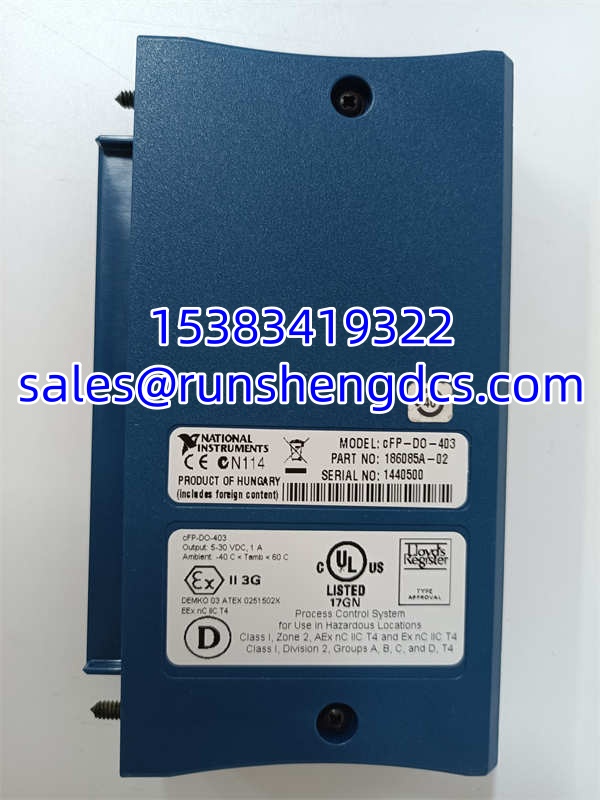
NI CFP-DO-403
Application Scenarios
- Tower Light Control: Driving 24VDC incandescent or LED stack lights on packaging lines. The CFP-DO-403 handles the inrush current of incandescent bulbs without nuisance tripping.
- Solenoid Valve Banks: Controlling pneumatic valve manifolds on assembly machines. Fused outputs protect against valve coil shorts, keeping the rest of the machine running.
- Motor Starter Interlocks: Providing interlock signals to motor control centers. The 2300Vrms isolation protects the Compact FieldPoint controller from VFD-induced transients.
FAQ
Can I use this module for PWM motor speed control?
No. The is a discrete output module with a 20kHz update rate, but it’s not designed for continuous PWM duty cycles. Use an analog output module or a dedicated motor drive for speed control.
Are the outputs fused individually?
Yes. Each of the 16 channels has its own fuse for short-circuit protection. A fault on one channel won’t disable the others. This is a key advantage over unfused DO modules.
What backplane do I need?
Any Compact FieldPoint backplane: CFP-BP-4 (4-slot) or CFP-BP-8 (8-slot). The module slides into the backplane and receives power and communication through the backplane connector. No separate power supply needed for the module itself.
Can I hot-swap this module?
No. Compact FieldPoint modules are not designed for hot-swapping. Power down the backplane before inserting or removing the . Hot-swapping risks backplane damage and data corruption.
Is this module sinking or sourcing?
Sinking only. The outputs switch the ground (COM) side of the load. Your field devices must be wired with the positive supply connected to the load, and the load’s negative side connected to the output channel.
The CFP-DO-410 is a newer revision with enhanced diagnostics and possibly different fuse characteristics. Functionally, they’re similar, but verify pinouts and configuration software compatibility before substituting. Check the NI datasheet for exact differences.
How do I configure power-up states?
Open Measurement & Automation Explorer (MAX), navigate to Remote Systems >> [Controller IP] >> Bank >> >> Channel Configuration tab. Set each channel’s power-up state individually. Note: there’s a delay from power-on to state application due to controller boot time.