Description
Key Technical Specifications
- Processor Options: MPC7410 with AltiVec (400 or 500MHz), MPC755 (400MHz), or MPC750 (450MHz)
- Architecture: Motorola PowerPlus II with HAWK Processor Host Bridge (CPU-to-PCI) and MPIC
- System Bus: 100MHz front-side bus; VME64 compliant (ANSI/VITA 1-1994)
- Memory: Up to 512MB onboard ECC SDRAM; expandable to 1GB with optional RAM500 memory mezzanine
- Flash Storage: Up to 17MB onboard flash
- L2 Cache: Up to 2MB external backside cache
- Ethernet: Dual Intel E100 10BaseT/100BaseTX ports (RJ-45 front panel)
- Serial Ports: Dual 16550-compatible asynchronous UARTs (RS-232)
- Expansion: Dual IEEE P1386.1 PMC slots (32/64-bit, 33/66MHz)
- RTC/NVRAM: M48T37 real-time clock with battery-backed non-volatile memory
- Memory Bandwidth: 582MB/s read, 640MB/s burst write; 264MB/s sustained PCI throughput
- I/O Modes: PMC mode (backward compatible with MVME2300/2400) or IPMC mode (via IPMC712/IPMC761 mezzanine for MVME761/712 transition board compatibility)
- Operating Temperature: Commercial grade 0°C to +55°C; Industrial grade -20°C to +71°C
- Firmware: PPCBug monitor/debugger onboard
- OS Support: VxWorks, Linux (2.6.x kernel series), LynxOS, QNX
- Form Factor: 6U VME, single slot — even with dual PMCs and memory mezzanine installed
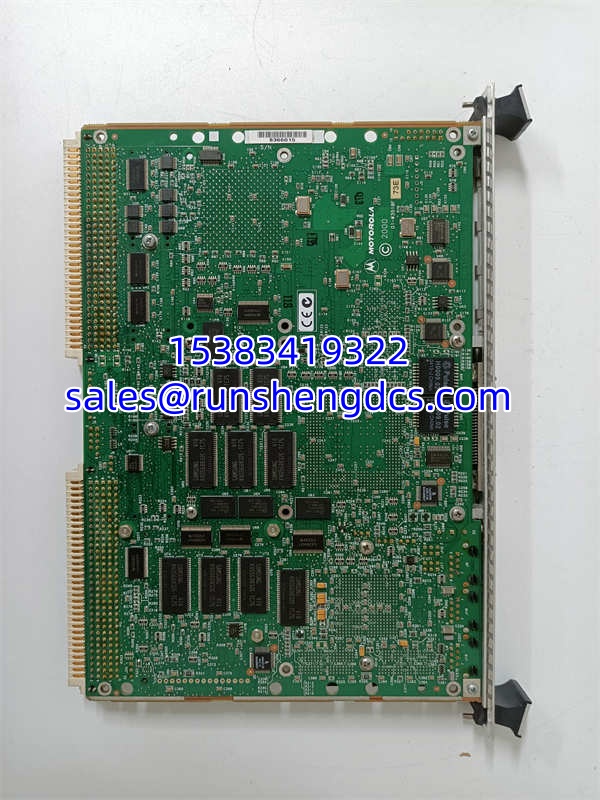
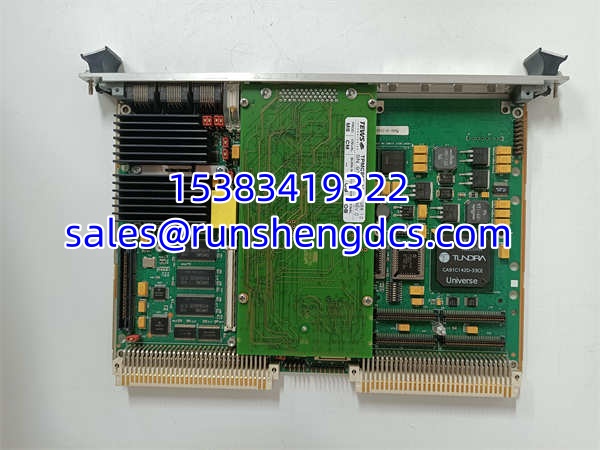
GE MVME5100
Product Introduction
If you’re pulling a board out of a VME chassis and it’s labeled MVME5100, you’re holding one of the last serious PowerPC-based SBCs Motorola built for the VME market. This wasn’t a budget board — the PowerPlus II architecture with the HAWK host bridge was designed to push 582MB/s of memory read bandwidth through a single VME slot, which in the late 1990s and early 2000s was genuinely impressive. The MPC7410 variant with AltiVec vector processing was aimed at signal-intensive workloads like radar processing and semiconductor metrology, while the lower-power MPC755/MPC750 variants targeted field-deployable military and aerospace systems.
The dual PMC slot design is what separates the MVME5100 from its predecessors (MVME2600/2700 had one PMC slot, MVME2300/2400 had two but limited onboard I/O). The 5100 merged both design philosophies into one board — you get full onboard Ethernet, serial, and RTC, plus two PMC slots for custom I/O. The IPMC mode, activated by populating an IPMC712 or IPMC761 mezzanine card in PMC slot 1, lets you route rear-panel I/O through a MVME761 or MVME712 transition board — a clever backward-compatibility play for OEMs with existing backplane wiring. Bottom line: this board was built for systems where downtime costs six figures per hour.
Troubleshooting Quick Reference
| Fault | Likely Cause | Probability | Quick Check | Fix |
|---|---|---|---|---|
| Board won’t boot / no PPCBug prompt | SODIMM failure or memory mezzanine not seated | ~75% | Listen for beep codes; check PPCBug output on serial console | Reseat SODIMM and RAM500 mezzanine; try known-good ECC SDRAM module |
| Ethernet ports show no link | PHY failure, bad cable, or switch port mismatch | ~65% | Check RJ-45 link LEDs; verify Intel E100 driver loaded in OS | Swap cable; test with known-good switch port; check MII register status via PPCBug |
| PMC module not detected | PMC slot power fault or PCI enumeration failure | ~60% | Verify PMC module is fully seated; check PCI config space via PPCBug | Reseat PMC; verify 3.3V/5V at PMC connector; check for IRQ conflicts in PCI enumeration |
| System crashes under AltiVec load | Thermal throttling or inadequate heatsink contact | ~55% | Monitor MPC7410 temperature via onboard sensors; check heatsink retention clips | Reapply thermal compound; verify heatsink clips are fully engaged; improve chassis airflow |
| RTC/NVRAM data lost after power cycle | M48T37 battery depleted | ~50% | Measure battery voltage at M48T37 pins (should be >2.5V) | Replace M48T37 chip (battery is integrated); reconfigure RTC and NVRAM parameters |
| VMEbus timeout / AERR errors | VME address map conflict or backplane termination issue | ~45% | Check VME A16/A24/A32 address assignments; verify terminator plug in last slot | Reconfigure address decoder map in PPCBug; ensure proper VME bus termination |
| IPMC mode not functioning | IPMC712/761 mezzanine not populated or jumper misconfigured | ~40% | Verify IPMC mezzanine is installed in PMC slot 1; check P2 I/O mode jumpers | Install correct IPMC mezzanine; set jumpers for IPMC mode per hardware manual |
GE MVME5100
Application Scenarios & Pain Points
Semiconductor process equipment:
The MPC7410’s AltiVec vector processing handled real-time wafer metrology data — edge detection, thickness mapping, defect classification — at speeds that scalar processors couldn’t match. Dual PMC slots hosted custom analog acquisition cards. Pain point: these systems run 24/7 in cleanrooms. When an MVME5100 fails, the entire process tool goes idle at $10K-50K per hour. Finding a replacement with the exact processor speed and memory configuration is critical.
Military/aerospace radar and EW systems:
The industrial-grade variant (-20°C to +71°C) with MPC755 low-power processor was deployed in mobile radar shelters and avionics test racks. VME’s rugged backplane and the board’s ECC memory made it suitable for high-vibration environments. Pain point: many of these systems are still in service 20+ years later. Obsolescence management is a constant battle — the PPCBug firmware and VxWorks BSPs are no longer updated.
Particle accelerator beam diagnostics:
A documented installation at a synchrotron facility used the MVME5100 (MPC750 at 450MHz, 512MB RAM) running VxWorks 5.4 as the host processor for beam position monitoring. An ADC8411U acquisition card in the PMC slot sampled at 100kHz across 16 channels at 16-bit resolution. Pain point: Linux kernel support for the MVME5100 was dropped after the 2.6.x series. Facilities running modern Linux distributions must maintain legacy kernel trees or migrate to newer hardware — a multi-month engineering effort.
Industrial automation — high-speed packaging lines:
Dual Ethernet ports connected the MVME5100 to both the plant MES network and a dedicated machine-control subnet, eliminating the need for an external switch. PMC slots hosted fieldbus interface cards (Profibus, DeviceNet). Pain point: the M48T37 RTC/NVRAM chip has an integrated battery with a 10-year lifespan. Most boards in the field are well past that threshold. When the battery dies, you lose RTC calibration and any configuration parameters stored in NVRAM.