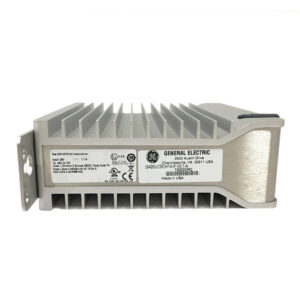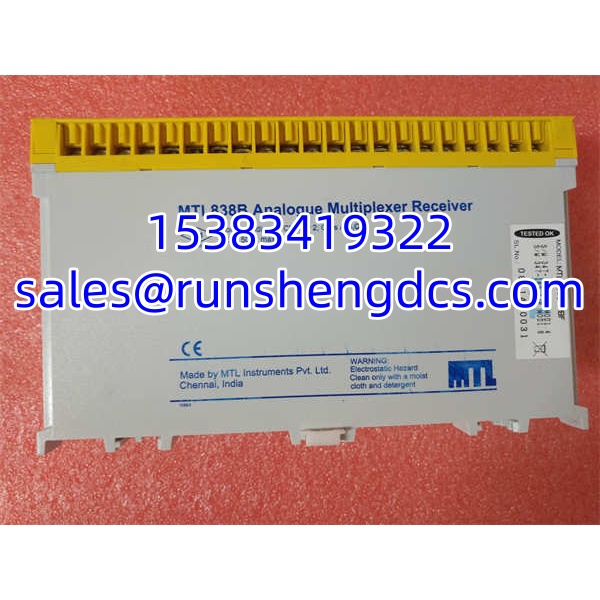

Description
Key Technical Specifications
| Parameter | Specification |
|---|---|
| Manufacturer | MTL Instruments (Eaton MTL) |
| Model | MTL838B-MBF |
| Product Type | Analog multiplexer receiver (safe-area) |
| Host System | MTL800 multiplexed temperature system |
| Field Transmitter | Up to 2 × MTL831B per receiver |
| Communication Output | Dual redundant RS485, Modbus ASCII/RTU |
| Baud Rate | 300–19200 baud |
| Power Supply | 20–35 VDC (nameplate confirms 20–35 VDC) |
| Configuration | PCS83 PC software or HAN83 handheld configurator |
| Typical Condition | Used surplus or refurbished |
| Documentation | Verify against MTL800/MTL838B-MBF manual and physical nameplate |
Product Introduction
The MTL838B-MBF is the safe-area receiver in MTL’s MTL800 multiplexed temperature system. Instead of running individual thermocouple or RTD cables back to the control room, field signals are collected by MTL831B transmitters in the hazardous area, then sent over a single pair of intrinsically safe data-highway wires to the MTL838B-MBF receiver. The receiver translates that data into RS485 Modbus for the DCS or PLC.
This makes it valuable for legacy temperature-intensive installations — refineries, chemical plants, power generation, and pulp and paper systems — where replacing hundreds of thermocouple runs is impractical. But it is not a generic Modbus I/O gateway. It only works as part of the MTL800 architecture with MTL831B transmitters and, where required, MTL3052 digital isolators on the data highway.
QA/QC Transparency SOP
- Intake & Origin Verification: Record model , serial number, firmware/revision if present, and source system. Reject units with damaged RS485 terminals, burnt power terminals, or missing nameplates.
- Power-Up & LED Check: Apply 20–35 VDC. Verify communication LEDs for Highway A and Highway B. Both green indicates healthy links to connected MTL831B units.
- Modbus Communication Test: Connect to a Modbus master or PC running PCS83. Verify node address, baud rate, parity, and register mapping. Confirm the receiver responds and returns valid channel data.
- Highway Integrity Check: Test with known-good transmitters. Verify that each transmitter is recognized and that channel values are stable. Check for open-highway faults or missing transmitter addresses.
- Final QC & Anti-Static Packaging: Clean terminals, verify switch settings (SW101/SW301), place in an ESD bag with desiccant, and ship with a test report including power-up status, LED status, and Modbus response.
Field Engineer Gotchas
- Not a Direct Analog Input Module: The does not accept thermocouple, RTD, mA, or voltage signals directly. It only receives data from transmitters.
- “8-Channel” Listing Noise: Some surplus pages describe it as an 8-channel analog receiver with voltage output. That is misleading. Channel count depends on the connected units (up to 16 TC or 15 RTD per ).
- MTL3052 Isolator Requirement: When transmitters are installed in the hazardous area, each data highway must pass through an MTL3052 digital isolator before reaching the .
- Configuration Mode Trap: Shorting MODE and COM puts the unit into configuration mode. If left shorted during operation, the DCS will lose communication.
- Data Scaling Factor: MTL800 temperature values are often scaled by a factor of 10 in the Modbus registers. The DCS must divide by 10 to restore engineering units.
- Switch Sensitivity: SW101 sets the Modbus address; SW301 sets communication parameters. Incorrect switch positions cause silent communication failures.
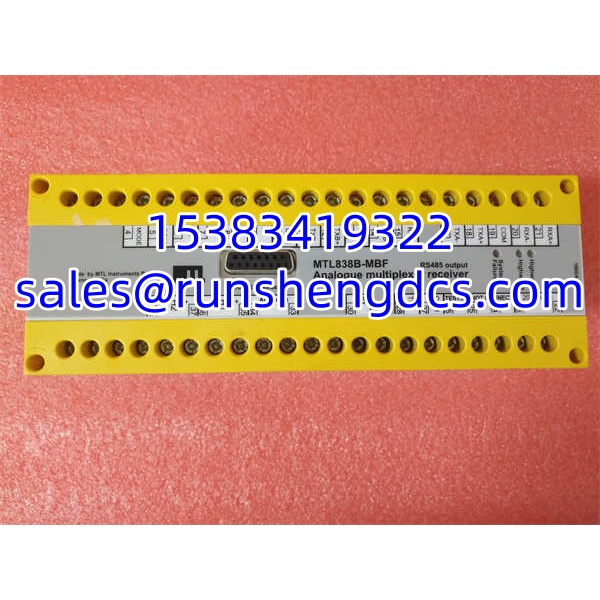
MTL MTL838B-MBF
Application Scenarios
- Legacy Temperature Multiplexing: Reducing hundreds of thermocouple/RTD cables in refinery or chemical plant hazardous areas by multiplexing through → .
- DCS Migration Support: Keeping existing field temperature wiring intact while migrating the host DCS, since the presents standard Modbus RS485 to the new system.
- Failed Receiver Replacement: Swapping out a faulty in an existing MTL800 system where OEM spares are scarce.
- Surplus Spare Pool: Stocking a tested receiver for plants still running temperature multiplexing architecture.
FAQ
No. It is a Modbus receiver that reads multiplexed data from field transmitters. It does not directly connect to thermocouples, RTDs, or analog signals.
One receiver supports up to 2 × transmitters. Each handles up to 16 thermocouple/mV inputs or 15 RTD inputs, so a single receiver can handle up to 32 TC or 30 RTD points.
Does it need MTL3052 isolators?
Yes, when transmitters are located in the hazardous area, each data highway must be protected by an MTL3052 digital isolator in the safe area.
What communication protocol does it use?
RS485 Modbus ASCII or RTU, baud rate 300–19200.
How is it configured?
Via PCS83 PC software using a serial connection, or via the HAN83 handheld configurator. Switch SW101 sets the Modbus address; SW301 sets communication parameters.
Is refurbished stock acceptable?
Yes, if the seller provides nameplate photos, power-up test results, LED status, and Modbus communication verification.
What must I confirm before ordering?
Confirm model , power supply rating, RS485 terminal condition, switch settings, source system compatibility, and whether the existing /MTL3052 architecture matches.