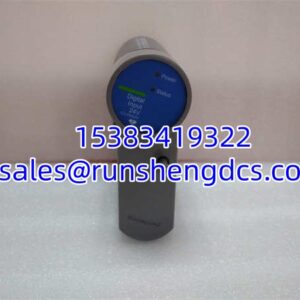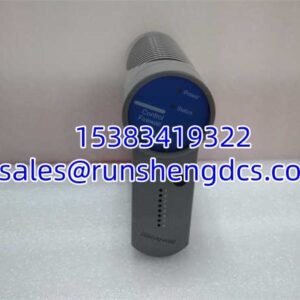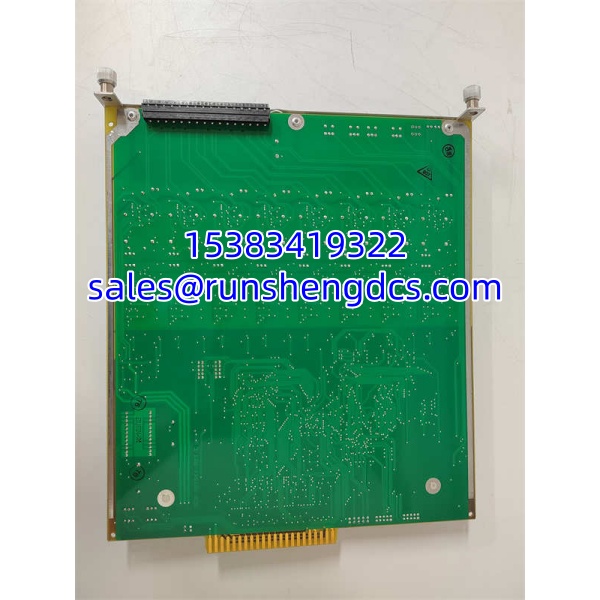

Description
Key Technical Specifications
| Parameter | Typical Value / Note |
|---|---|
| Manufacturer | METSO (now Valmet) |
| Model | IOP320 |
| Product Type | I/O Processor Module |
| Digital Inputs | Up to 32 channels |
| Digital Outputs | Up to 16 channels |
| Memory | 1 MB RAM, 2 MB Flash |
| Communication Protocols | Modbus, EtherNet/IP, Profibus |
| Power Supply | 24VDC |
| Operating Temperature | -20°C to 60°C |
| Mounting | Modular DIN-rail or rack-mount form factor |
| Certifications | Not publicly confirmed — verify markings on the nameplate |
| Status | Legacy/discontinued |
Product Introduction
The METSO IOP320 is an industrial I/O processor module designed for signal acquisition, digital I/O handling, and local control logic within Metso automation architectures. With up to 32 digital inputs and 16 digital outputs, it serves as a distributed I/O node that communicates over standard industrial protocols — Modbus, EtherNet/IP, and Profibus — back to a central controller or HMI.
This module is positioned as a workhorse for mining, aggregates, power generation, water treatment, and manufacturing applications where Metso/Valmet control systems are deployed. The 24VDC supply, -20 to 60°C operating envelope, and modular form factor make it suitable for harsh industrial cabinets. Important caveat: Metso merged with Valmet in 2020, and the IOP320 is a legacy product. Official OEM documentation is limited, and surplus units may carry site-specific configurations or firmware variants. Always verify the hardware revision and I/O count from the physical nameplate before integration.
QA/QC Transparency SOP
- Intake & Origin Verification: Record model IOP320, part number, hardware revision, serial number, and firmware version from the nameplate. Inspect for physical damage, connector corrosion, and signs of prior rework.
- Live Functional Testing: Power the unit from a verified 24VDC supply. Confirm boot sequence, LED status indicators, and communication link establishment over the available protocol interface.
- I/O Channel Verification: Apply known 24VDC signals to digital input channels and verify correct readback. Actuate digital output channels and confirm switching. Test all available channels for consistency.
- Communication & Protocol Test: Establish communication over Modbus, EtherNet/IP, or Profibus (depending on the unit’s configuration). Verify register mapping, tag readback, and diagnostic access from a master device.
- Final QC & Packaging: Complete a full power-cycle test. Seal in ESD packaging with desiccant. Label with model, serial, hardware revision, firmware readout, I/O configuration, and test date.
Field Engineer Gotchas
- Legacy Product, Limited Documentation: The IOP320 is a discontinued Metso module. Official datasheets are scarce, and specifications can vary by hardware revision. Always rely on the physical nameplate and any available OEM manual for the specific unit.
- Firmware/Protocol Mismatch: A surplus IOP320 may have been configured for a specific protocol (Modbus vs. EtherNet/IP vs. Profibus) at its original site. It may not communicate on your preferred protocol without reconfiguration or firmware loading.
- I/O Count Variability: While listed as “up to 32 DI / 16 DO,” the actual enabled channel count may differ depending on the hardware revision or option configuration. Verify from the unit itself.
- Valmet Transition: Since Metso merged with Valmet in 2020, support for legacy modules may be limited. If you are building a new system, consider migrating to the current Valmet DNA or Valmet Industrial Internet platform.
- Site-Specific Configuration Locks: Used units may retain previous site configurations, tag databases, or communication parameters. A factory reset and full reconfiguration may be required before commissioning.
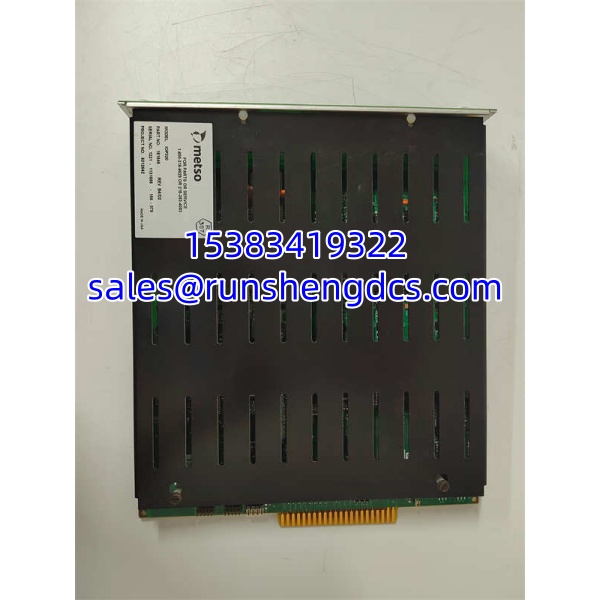
METSO IOP320
Application Scenarios
- Mining and aggregates process control: Distributed I/O for conveyor monitoring, crusher interlocks, and bin level indication feeding into a central Metso/Valmet controller.
- Water and wastewater treatment: Digital I/O for pump status, valve position feedback, and alarm signaling over Modbus or Profibus.
- Power generation auxiliary systems: Monitoring auxiliary equipment status — fans, dampers, and lube oil systems — via digital inputs.
- Manufacturing line integration: Serving as a remote I/O node on a packaging or material handling line, communicating over EtherNet/IP to a PLC.
FAQ
It is a METSO/Valmet I/O processor module that handles digital input/output signal processing and local control logic in industrial automation systems.
2. How many I/O points does it support?
Up to 32 digital inputs and 16 digital outputs.
3. What communication protocols does it support?
Modbus, EtherNet/IP, and Profibus.
4. What is the power supply requirement?
24VDC.
5. Is it still available new?
The is a legacy product. Most available stock is surplus or refurbished. For new installations, consider the current Valmet automation platform.
6. Can it handle analog signals?
The is primarily a digital I/O processor. Some sources reference analog output variants, but this is not confirmed for the standard . Verify the specific module’s capabilities from the nameplate.
7. What should I verify before buying a surplus unit?
Confirm the hardware revision, firmware version, enabled I/O channels, communication protocol configuration, and whether any site-specific locks or configurations are present.