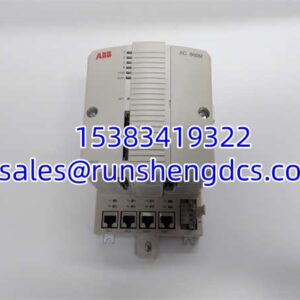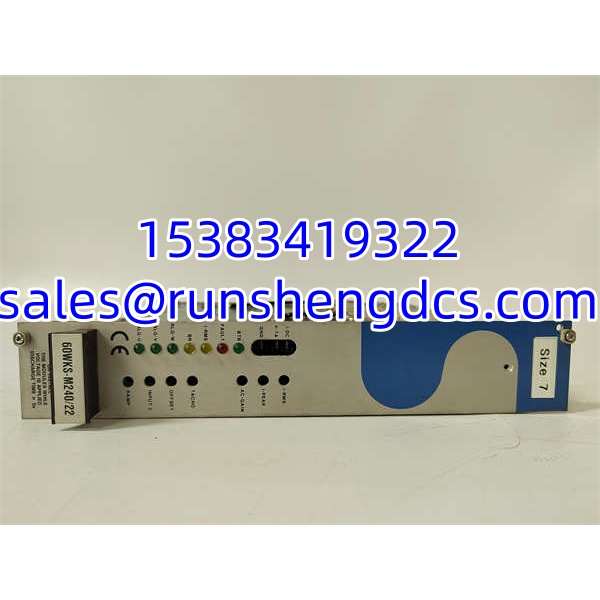

Description
Key Technical Specifications
| Parameter | Detail |
|---|---|
| Product Model | 60WKS-M240/22 (60WKS-M24022) |
| Manufacturer | Kollmorgen |
| Product Type | Analog Servo Amplifier |
| Series | 60WKS (legacy analog servo amplifier family) |
| Power Input | 240 VAC-rated DC link (single- or three-phase, platform-dependent) |
| Control Mode | Analog speed/position control (PI controller) |
| Command Input | ±10 V analog reference (typical) |
| Feedback Interface | Resolver and/or encoder input (motor-dependent) |
| Compatible Motors | Kollmorgen Goldline / SR series synchronous servo motors |
| Mounting | 19-inch rack module or backplane-mounted (F-backplane / R-backplane, platform-dependent) |
| Protection | Undervoltage, overvoltage, transistor temperature monitoring |
| Status Indicators | LED indicators for operational status and faults |
| Software/Tools | Manual potentiometer adjustment; custom PCB option for user-adjustable parameters |
| Current Status | Discontinued / legacy product — available primarily through surplus channels |
Product Introduction
When a legacy Kollmorgen drive faults out on a 20-year-old CNC retrofit, the first question is never “what drive is this?” — it is “can I still get one?” The 60WKS family has been out of production for years, but it still lives inside countless machines that were built when analog ±10 V was the universal language of motion control.
The KOLLMORGEN 60WKS-M240/22 is an analog servo amplifier from Kollmorgen’s retired 60WKS series. It drives Kollmorgen Goldline and SR-series synchronous servo motors using a PI speed/current control loop, accepts a ±10 V analog command signal, and reads motor position via resolver or encoder feedback. Unlike modern digital drives that auto-tune over EtherCAT, the 60WKS family relies on manual potentiometer adjustment and, in some variants, a user-customizable PCB for parameter configuration. It typically mounts in a 19-inch rack or on an F/R backplane inside the control cabinet.
Bottom line: if you are keeping a legacy Kollmorgen servo axis alive, this amplifier is a direct replacement for the original 60WKS-M240/22. If you are designing a new machine, look at the AKD or Kollmorgen Efficient Servo System instead — the 60WKS family is end-of-life.
QA/QC Transparency SOP
1. Intake & Origin Verification
Verify the full model number 60WKS-M240/22 on the nameplate. Inspect for burnt components, swollen capacitors, corroded terminals, and signs of previous rework on the custom PCB. Confirm it is a 60WKS analog amplifier, not a 60WKS-CE variant or a newer AKD/S700 drive.
2. Live Functional Testing
Install in a test setup with a compatible Kollmorgen Goldline/SR servo motor. Apply rated AC power and verify DC link voltage buildup. Apply a ±10 V analog reference and verify motor rotation in both directions. Check resolver/encoder feedback acquisition and closed-loop stability.
3. Electrical Parameter Tests
Use a Fluke 115 or equivalent multimeter to verify AC input voltage, DC link voltage, and output phase-to-phase voltages. Check for shorts on power terminals. Measure quiescent current draw with no motor connected. Verify undervoltage and overvoltage protection thresholds.
4. Potentiometer/PCB Verification
If the unit has a custom PCB, document all potentiometer positions and jumper settings before any adjustment. Verify that gain, current limit, and integrator settings match the original machine documentation. A misadjusted current limit pot can destroy a motor.
5. Final QC & Anti-Static Packaging
Document test results, model number, DC link voltage, motor used during testing, and all potentiometer/PCB settings. Seal in ESD-safe packaging. Include a test certificate referencing the test motor model and supply voltage used.
Field Engineer Gotchas
60WKS-M240/22 vs. 60WKS-CE240/22PB
The “M” and “CE” suffixes denote different variants within the 60WKS family. They may differ in mounting style (rack vs. backplane), feedback interface, and PCB configuration. Do not assume drop-in compatibility — verify the nameplate and original machine documentation before substituting.
Analog Drive, Not Digital
The 60WKS-/22 is an analog servo amplifier. It does not support EtherCAT, CANopen, or any digital fieldbus. If your machine was upgraded to a digital bus architecture, this drive will not integrate without an external analog interface from the motion controller.
Potentiometer Drift Over Time
After 15–20 years, the trim pots on these drives drift. A drive that once ran smoothly may develop oscillation, following error, or excessive motor heating simply because a gain pot has rotated a few degrees from vibration. Document original settings before adjusting anything.
Resolver vs. Encoder Feedback
The 60WKS family supports both resolver and encoder feedback, but the wiring and scaling differ. Swapping a motor from resolver to encoder (or vice versa) without reconfiguring the drive will cause immediate faulting or uncontrolled motion.
DC Link Capacitor Aging
Electrolytic capacitors in the DC link degrade over time, especially in drives that sit unused for years. A 60WKS that has been in storage for a decade may fail on first power-up. Consider reforming the capacitors or replacing them proactively if the drive has been idle.
No Auto-Tuning
Unlike modern AKD drives with WorkBench auto-tuning, the 60WKS requires manual gain adjustment. If you are not experienced with analog servo tuning, bring the original machine parameters or work with a Kollmorgen specialist.
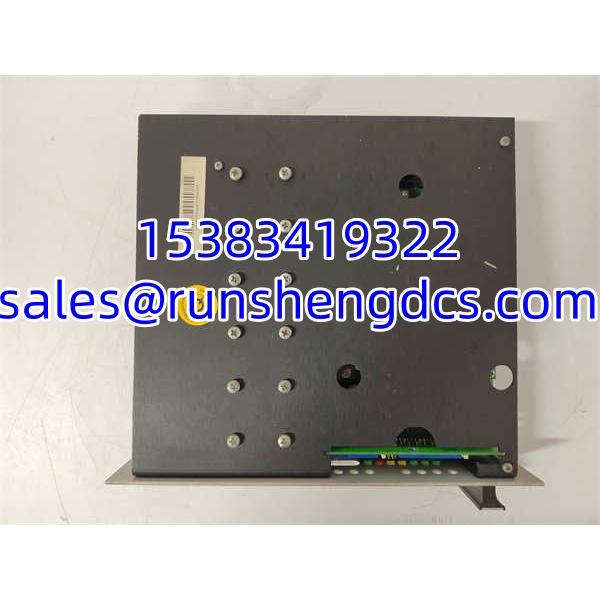
KOLLMORGEN 60WKS-M24022
Application Scenarios
Legacy CNC Machine Retrofits
Many 1990s and early-2000s CNC machines used Kollmorgen 60WKS amplifiers with Goldline motors on spindle and axis drives. When the original amplifier fails, a tested surplus 60WKS-/22 is often the fastest path to restoration without rewiring the entire axis.
Industrial Robotics (Legacy Cells)
Older robotic cells with Kollmorgen servo axes sometimes rely on 60WKS amplifiers. Replacement with modern drives requires mechanical and electrical redesign; keeping the original amplifier type simplifies maintenance.
Test Stands and Specialized Machinery
Custom test equipment built around Kollmorgen servo systems in the 1990s–2000s often used 60WKS amplifiers. These machines may still be in service because the mechanical structure is sound, even though the electronics are obsolete.
Case Study (Anonymized):
A precision grinding machine from the late 1990s lost its X-axis drive after a power surge. The original amplifier was a Kollmorgen 60WKS variant with a custom PCB. The maintenance team attempted to replace it with a modern digital drive, but the machine’s CNC controller only output ±10 V analog and had no fieldbus interface. After two weeks of integration attempts, they sourced a tested surplus 60WKS amplifier matching the original suffix. The machine was back in production within a day. The lesson: on legacy analog machines, the correct legacy amplifier is often faster than a “modern upgrade.”
FAQ
No. The 60WKS family is a discontinued/legacy product line from Kollmorgen. Units are available primarily through surplus and refurbished channels. For new designs, consider the AKD family or Kollmorgen Efficient Servo System.
What motors does it work with?
It is designed for Kollmorgen Goldline and SR-series synchronous servo motors. Compatibility with other motor brands is not guaranteed and requires careful matching of feedback type, impedance, and thermal characteristics.
Does it support EtherCAT or CANopen?
No. The 60WKS-/22 is an analog servo amplifier. It accepts ±10 V analog commands and resolver/encoder feedback. It does not have digital fieldbus interfaces.
Can I replace it with a 60WKS-CE240/22PB?
Not automatically. The “M” and “CE” suffixes may differ in mounting, feedback interface, and PCB configuration. Verify compatibility against the original nameplate and machine documentation before substituting.
How do I tune this drive?
Tuning is done manually via potentiometers on the front panel or custom PCB. Adjust velocity gain, current limit, and integrator settings while monitoring motor response. Document all settings before making changes.
What if the drive faults on power-up?
Check AC input voltage, DC link voltage, and motor/feedback connections first. A missing or miswired resolver is a common cause of immediate faulting. Also verify that the custom PCB (if present) is seated correctly.
Can I use this in a new machine design?
Technically yes, but it is not recommended. The 60WKS family is end-of-life, and spare parts availability will only decrease. For new designs, use a current Kollmorgen product such as the AKD or Efficient Servo System for long-term support.