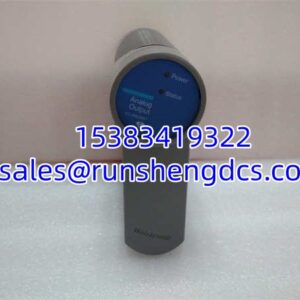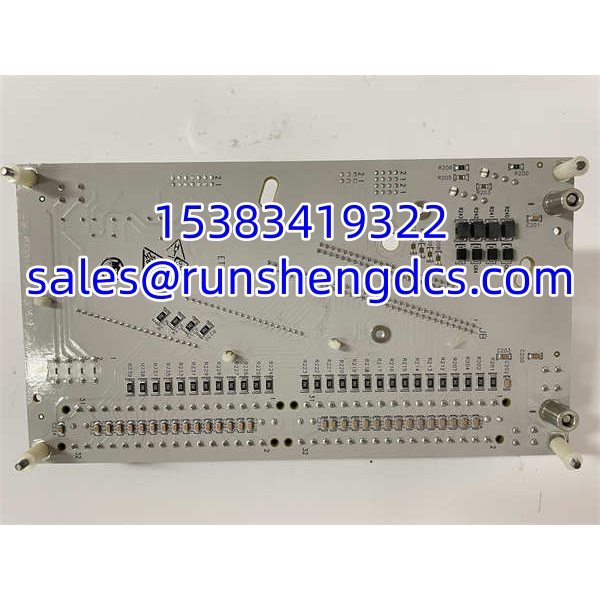

Description
Key Technical Specifications
| Parameter | Specification |
|---|---|
| Manufacturer | Honeywell Process Solutions |
| Product Type | C300 Digital Input IOTA Terminal Board (Non-Redundant) |
| Platform | Experion PKS C300 Process Module I/O |
| Primary Function | Field termination and signal routing for 24 VDC digital input modules |
| Channel Count | 32 points (defined by paired DI PM) |
| Input Voltage | 24 VDC typical (per paired PM specification) |
| Redundancy | Non-redundant (use CC-TDIL11 for redundant DI applications) |
| Paired PM | CC-PDIL01 — 24 VDC DI module, 32-point |
| Architecture | C-Series IOTA — integrated terminal board + signal conditioning |
| Terminal Type | Two-level removable terminal blocks (C-Series IOTA feature) |
| Power Distribution | Receives 24 VDC bus power from IOTA carrier; distributes to field side |
| Mounting | C300 I/O rack / IOTA carrier channel |
| Typical Applications | Status monitoring of switches, relays, valve position feedback, permissive interlocks |
Product Introduction
In a Honeywell Experion PKS C300 cabinet, the IOTA board is where field wiring meets the control system — and a wrong IOTA selection can turn a DI replacement into a wiring and compatibility problem. The HONEYWELL CC-TDIL01 is the non-redundant 24 VDC digital input IOTA terminal board within the C300 C-Series I/O architecture. It terminates field wiring for 32 digital input channels, provides signal conditioning, and interfaces directly with the paired CC-PDIL01 DI process module, which performs the actual digitization and diagnostic reporting back to the C300 controller.
Its practical value is architectural clarity. Honeywell’s C-Series IOTA design integrates the terminal board, signal conditioning, and field power distribution into a single unit — no separate FTA or external signal conditioner is required. The CC-TDIL01 is specifically the non-redundant variant; for redundant DI applications, the CC-TDIL11 is the correct IOTA. Bottom line — this is a DI IOTA, not a standalone module. It must be paired with the correct PM (CC-PDIL01) and matched to the system’s redundancy architecture.
QA/QC Transparency SOP
- Intake & Origin Verification — Confirm label reads CC-TDIL01. Inspect for physical damage, corrosion, cracked terminal blocks, or bent IOTA connector pins.
- Visual & Mechanical Inspection — Verify two-level removable terminal block integrity, IOTA mating connector condition, and carrier mounting clips. Reject units with damaged terminals or corroded contacts.
- Continuity & Isolation Tests — Check terminal-to-IOTA connector continuity across all 32 channels, inter-channel isolation, and shield/ground paths. Flag any shorted or open channels.
- PM Compatibility Verification — Confirm pairing with CC-PDIL01 (non-redundant 24 VDC DI, 32-point). Verify that the system architecture is non-redundant; redundant DI requires CC-TDIL11.
- Final QC & Anti-Static Packaging — Document part number, revision, test results, and paired PM. Pack in ESD-safe materials with terminal block protection to prevent pin damage during shipment.
Field Engineer Gotchas
- CC-TDIL01 ≠ CC-TDIL11. The CC-TDIL01 is non-redundant; the CC-TDIL11 is the redundant DI IOTA. Installing a non-redundant IOTA in a redundant DI slot will cause commissioning failures. Verify the redundancy architecture before ordering.
- It is not a standalone DI module. The CC-TDIL01 is the IOTA terminal board. The actual digital input processing is performed by the CC-PDIL01 PM. If channels are reading incorrectly, the fault may be in the PM, not the IOTA.
- C-Series IOTA integrates signal conditioning. Unlike older FTA-style architectures, the IOTA board itself provides signal conditioning and field power distribution. Do not add external signal conditioners unless explicitly required by the OEM wiring diagram.
- Terminal block wiring errors cause phantom states. Miswired common returns or swapped polarity on 24 VDC inputs can cause false ON/OFF readings. Verify field wiring against the IOTA terminal assignment diagram.
- Revision suffix matters. A different suffix may change terminal layout, fuse ratings, or PM compatibility. Match the OEM spare list.
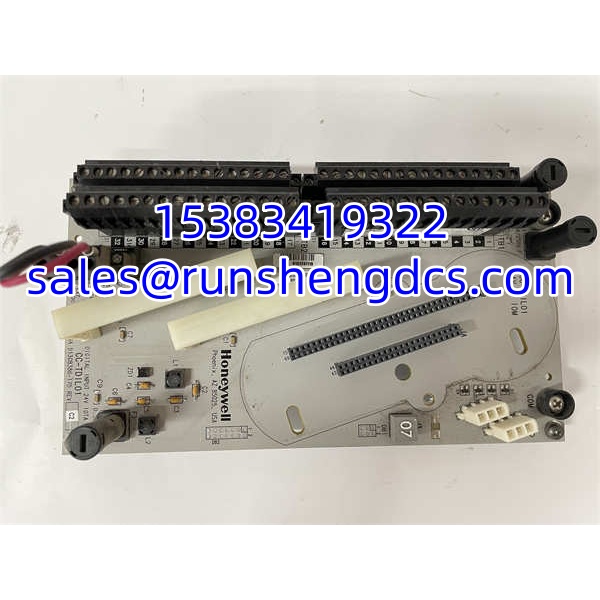
HONEYWELL CC-TDIL01
Application Scenarios
- Provides verified field termination when replacing failed non-redundant DI IOTAs during planned outages.
- Interlock and permissive monitoring: Used for status feedback from limit switches, pressure switches, valve position switches, and relay contacts in simplex DI applications.
- Supports adding new 24 VDC DI points to existing racks where non-redundant architecture is acceptable.
- Spare parts provisioning: Maintains a compatible IOTA for racks where original boards have damaged terminal blocks or corroded connectors.
FAQ
It is the DI IOTA terminal board. The actual digital input processing is performed by the paired CC-PDIL01 process module.
2. How many channels does it support?
32 points, as defined by the paired CC- DI module.
3. Is it redundant or non-redundant?
Non-redundant. For redundant 24 VDC DI applications, use CC-.
4. Which PM does it pair with?
CC- — 24 VDC digital input module, 32-point.
5. Can it be used with CC-PDIS01 (SOE DI)?
CC-PDIS01 is the SOE-capable 32-point DI module. Verify IOTA compatibility with the OEM documentation before pairing, as SOE applications may have specific IOTA requirements.
6. Does it provide field power distribution?
Yes. C-Series IOTA boards receive 24 VDC bus power from the carrier and distribute it to the field side, eliminating the need for external power distribution in most cases.
7. Is refurbished stock acceptable?
Yes, if terminal continuity, insulation, connector condition, and PM compatibility are verified. For critical interlock applications, require documented QA before installation.