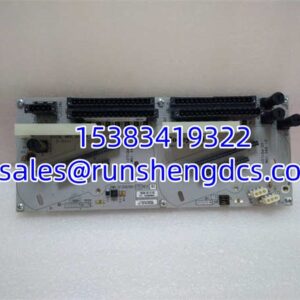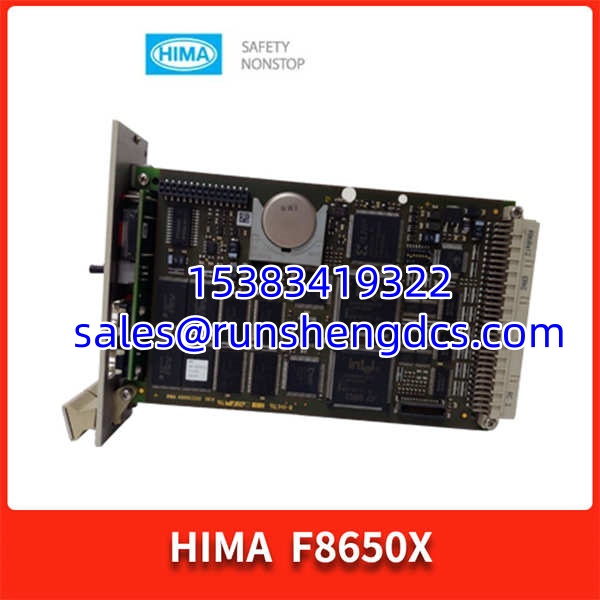

Description
Key Technical Specifications
| Parameter | Specification |
|---|---|
| Product Type | Central module (CPU) for safety systems |
| Model | F8650X |
| Compatible Systems | PES H51q-MS, H51q-HS, H51q-HRS |
| Processor | Dual clock-synchronized Intel 386EX, 32-bit, 25 MHz |
| OS Memory | 1 MB Flash-EPROM |
| User Program Memory | 1 MB Flash-EPROM |
| Data Memory | 1 MB SRAM |
| Serial Interfaces | 2× electrically isolated RS-485 (9-pin) |
| Safety Watchdog | 24V output, short-circuit protected, 500 mA max |
| Diagnostic Display | 4-digit alphanumeric matrix + 2 LEDs (CPU/IO fault) |
| Rack Space | 8 SU (standard units) |
| Supply | 5V / 2A |
| Required OS | BS41q/51q V7.0-8 (05.31) or later |
| Bus Station Range | 1–31 (RS-485), 1–99 (Ethernet via F8627X) |
| Baud Rate Selection | S1-8 switch: ON = 9600 bps, OFF = 57600 bps |
Product Introduction
When a refinery ESD system needs a CPU swap, the last thing you want is to discover the replacement module’s firmware does not talk to your existing I/O racks. The F8650X is HIMA’s central processing module for the H51q family of safety controllers — it is the brain that sits in the central rack, runs the safety logic, and coordinates all I/O and communication modules through the backplane bus.
The dual 386EX processors run in clock-synchronized lockstep, which is the foundation of HIMA’s QMR (Quadruple Modular Redundant) architecture when paired across two CU modules in a 2oo4D configuration. That gives you SIL 3 certification per IEC 61508 without sacrificing online maintainability. Two isolated RS-485 ports handle direct serial communication with programming tools (PADT/ELOP II TCP), while Ethernet connectivity routes through the companion F8627X communication module on the backplane. The 4-digit diagnostic display on the front panel is genuinely useful during commissioning — it shows error codes directly without needing a laptop connected.
QA/QC Transparency SOP
Here is how surplus F8650X stock should be validated before deployment:
- Intake & Origin Verification — Confirm the PCB label reads F8650X. Check for HIMA markings, version stamps (e.g., 0606, 0714), and date codes. Inspect both Eurocard PCBs for cracked solder joints, especially around the processor sockets and the backplane connector. Verify the diagnostic display is physically intact.
- Live Functional Testing — Install the module in a known-good H51q rack with verified power supply. Power up and observe the diagnostic display for POST completion. Confirm the CPU and IO LEDs behave normally (no persistent fault indicators). Connect a PADT or ELOP II TCP tool via RS-485 and verify communication establishes without timeout errors.
- Electrical Parameter Tests — Measure the 5V rail current draw and confirm it stays within the 2A specification under load. Check continuity on all RS-485 pins (pins 3, 8 for data lines; pin 5 for data ground). Run insulation resistance testing between isolated channels and chassis ground.
- Firmware/Config Verification — Read the operating system version through the programming tool. Confirm it matches BS41q/51q V7.0-8 (05.31) or later if ELOP II TCP or self-learning features are required. Back up any stored configuration. Verify the bus station number DIP switch settings match the target system’s configuration.
- Final QC & Anti-Static Packaging — Clear test configurations if required. Package in anti-static shielding with foam protection for the Eurocard edge connectors and the front panel display. Include a test report documenting POST results, communication verification, power draw, and firmware version.
Field Engineer Gotchas
- OS Version Mismatch — The F8650X requires BS41q/51q V7.0-8 (05.31) or later for ELOP II TCP and self-learning functions. If your existing system runs an older OS, dropping in a newer-revision F8650X can cause communication failures or unrecognized module faults. Always check the OS version on your existing central unit before ordering a replacement. One site installed a “new” and spent two days troubleshooting why the programming tool could not connect — the OS on the existing I/O modules was too old to handshake with the newer CPU firmware.
- Battery Replacement Timing — The onboard buffer battery (CR 2477N, HIMA P/N 44 0000018) has a rated life of approximately 1000 days at 25°C and only about 200 days at 60°C. When the display shows a BATI warning, you have a 3-month window to replace it before data loss occurs. If your module sits in a hot cabinet near process piping, plan battery replacements on a 2-year cycle, not the 6-year general recommendation.
- Baud Rate DIP Switch — Switch S1-8 controls baud rate: ON for 9600 bps, OFF for 57600 bps. If you replace a module and forget to match this switch to the existing system setting, serial communication will fail silently or produce garbage data. Check the switch position on the old module before pulling it.
- Ejector Mechanism Handling — The module uses a top-mounted ejector lever for removal. Press the lever and pull straight up quickly. Do not wiggle or rock the module during extraction — slow removal can trigger transient fault signals on the backplane that may propagate to the redundant CPU.
- Fan Design Change on Upgrade — If you are upgrading from an older central module to the , the cooling fan design may need to change. Verify the rack’s airflow configuration matches the thermal requirements before installation.
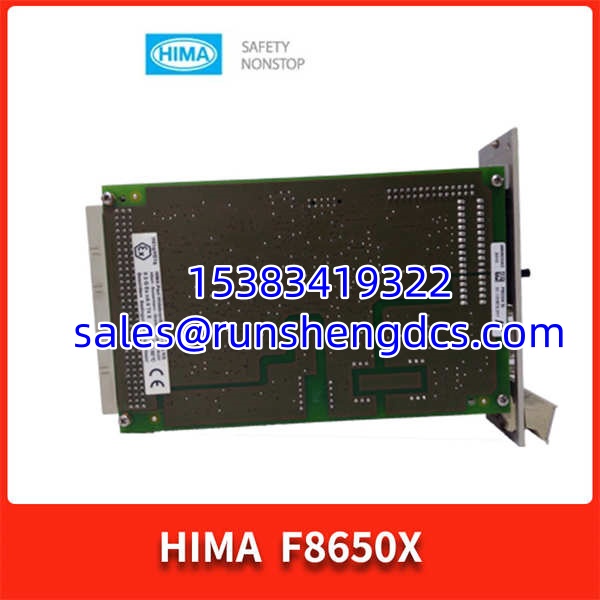
HIMA F8650X
Application Scenarios
- Emergency Shutdown (ESD) Systems in Oil & Gas — Offshore platforms and onshore refineries use the as the central CPU in H51q safety systems, executing trip logic for pressure, temperature, and fire/gas detection with SIL 3 integrity.
- Burner Management Systems (BMS) — Industrial boilers and furnaces rely on the to manage safe startup sequences, flame monitoring, and emergency fuel shutoff in compliance with NFPA 85 requirements.
- High Integrity Pressure Protection Systems (HIPPS) — Pipeline and vessel overpressure protection systems use the dual-processor architecture to achieve the required PFD targets without unnecessary process trips.
- Turbomachinery Protection — Gas turbines, steam turbines, and centrifugal compressors use the to monitor vibration, axial displacement, and overspeed conditions, initiating protective shutdowns within deterministic scan times.
Field Case (Anonymized): A petrochemical facility running an H51q-HRS system experienced intermittent CPU fault alarms on the central module. The diagnostic display showed sporadic error codes that cleared after acknowledgment but returned within hours. The maintenance team initially suspected field wiring noise. After swapping in a replacement , the faults disappeared. Root cause analysis on the removed module revealed a degraded buffer battery that was causing intermittent SRAM corruption during power micro-sags — the battery had been in service beyond its 60°C-rated lifespan because the module sat directly above a steam tracing manifold. The fix was a battery replacement and rerouting the module to a cooler rack slot.
FAQ
No. The is designed for the H51q series (H51q-MS, H51q-HS, H51q-HRS). The H41q is a compact system with a different rack architecture. Do not assume cross-compatibility between H41q and H51q central modules.
What operating system version does this module require?
BS41q/51q V7.0-8 (05.31) or later. Earlier OS versions may boot but will not support ELOP II TCP communication or the self-learning feature. Verify your OS version before ordering.
No. Ethernet connectivity (SafeEthernet, Modbus TCP) is handled through the separate F8627X communication module, which connects to the via the backplane bus. The itself provides two RS-485 serial ports.
Is this module SIL 3 certified on its own?
The is rated for use in SIL 3 safety systems per IEC 61508 when configured in the appropriate redundant architecture (e.g., dual CU modules in a 2oo4D QMR configuration). A single in a 1oo2D structure meets SIL 3; the dual-CU configuration adds availability.
Can I hot-swap this module in a live system?
HIMA H51q systems support module replacement during operation in redundant configurations, but the procedure must follow HIMA’s documented steps precisely — including proper use of the ejector mechanism and verification of redundant CPU takeover before removal. Do not attempt hot-swap in a single-CPU configuration.
What is the bus station number range?
1–31 for RS-485 communication. For Ethernet communication via the F8627X module, the range extends to 1–99, though the actual number of communication partners is limited to 64.
What battery does this module use and how often should it be replaced?
CR 2477N lithium battery (HIMA P/N 44 0000018). General recommendation is replacement every 6 years, or within 3 months of a BATI warning appearing on the display. At elevated ambient temperatures (60°C), battery life drops to approximately 200 days — plan accordingly.