
Description
Key Technical Specifications
| Parameter | Specification |
|---|---|
| Product Model | IS420UCSBH4A |
| Manufacturer | General Electric (GE) |
| Product Type | UCSB Controller Module |
| System Platform | GE Mark VIe / Mark VIeS, EX2100e, LS2100e |
| Processor | Intel EP80579 @ 1066 MHz |
| Memory | 256MB DDR2 SDRAM + 512MB Flash |
| Operating System | QNX Neutrino (real-time, multitasking RTOS) |
| Power Supply | 28V DC nominal (18–30V DC range), supplied via backplane |
| I/O Communication | IONet Ethernet (redundant R/S/T networks) via IS220 I/O packs |
| Additional Interfaces | Modbus, Profinet, Ethernet, VME bus support |
| Redundancy Architecture | Simplex, Dual-redundant, or TMR (Triple Modular Redundant) |
| Redundancy Switch Time | <50ms (hardware-level via VME bus) |
| I/O Capacity | 32 digital + 8 analog points (expandable to 768 points) |
| Operating Temperature | -30°C to +65°C (ambient) |
| Protection Rating | IP20 |
| Hazardous Location Rating | Class I, Division 2, Groups A, B, C, D (UL E207685); ATEX Zone 2, IIC Group (DEMKO 12 ATEX 1114875X) |
| Cooling | Fanless passive cooling (integrated heatsink fins) |
| Mounting | Direct panel mount (sheet metal), vertical airflow through fins |
| Dimensions | 6.4″ × 8.1″ × 1.4″ (162mm × 206mm × 36mm) |
| Weight | Approximately 2.4 lbs (1.1 kg) |
| Configuration Software | ToolboxST (within ControlST suite) |
| Certifications | UL Listed (E207685), CE, ATEX |
| Country of Origin | USA |
Product Introduction
The GE IS420UCSBH4A is a high-performance UCSB (Universal Control Station Board) controller module belonging to GE’s Mark VIe Speedtronic control system platform. Powered by a 1066 MHz Intel EP80579 processor and running the QNX Neutrino real-time operating system, this controller is engineered for mission-critical applications in gas turbine, steam turbine, hydro turbine, excitation (EX2100e), and servo drive (LS2100e) control systems.
Unlike conventional controllers that host I/O directly on a backplane, the IS420UCSBH4A is a standalone computing unit that communicates with distributed IS220 I/O packs over GE’s private IONet Ethernet network. This architecture ensures that each controller has access to all I/O network data, and application input data is preserved even during controller maintenance or replacement. The module supports simplex, dual-redundant, and TMR (Triple Modular Redundant) configurations, with hardware-level redundancy switch times under 50ms.
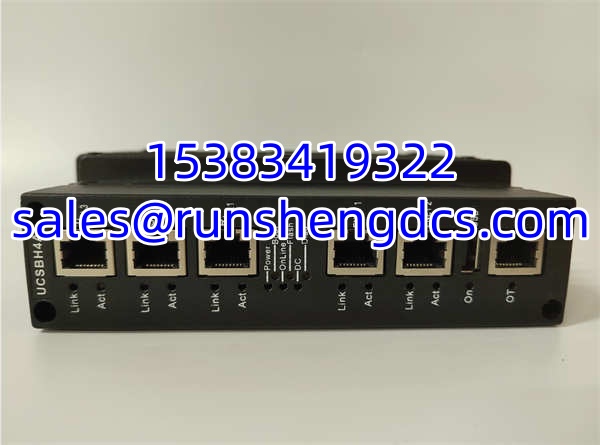
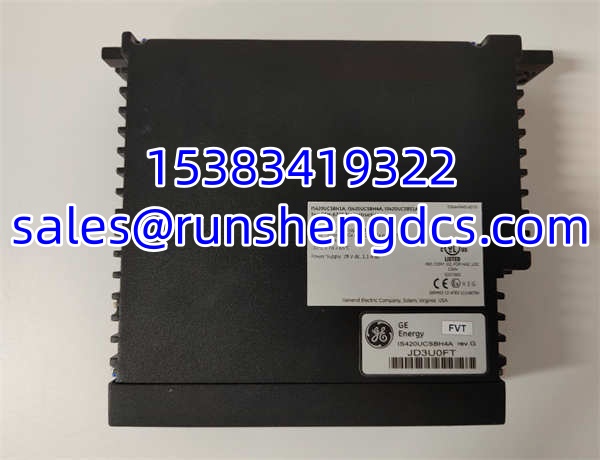
The IS420UCSBH4A features a fanless, battery-free design with passive cooling via integrated heatsink fins, significantly reducing maintenance requirements and failure points in harsh industrial environments. The module mounts directly to the sheet metal of a control panel, with a compact footprint of 6.4″ × 8.1″ × 1.4″, minimizing cabinet space requirements. On-board health diagnostics and front-panel status indicators enable technicians to quickly identify and resolve issues without extensive troubleshooting.
Communication is handled through redundant IONet Ethernet ports (R/S/T networks), supporting IEEE 1588 time synchronization to keep all I/O components and controllers synchronized within 100 microseconds. The controller also supports Modbus, Profinet, and VME bus protocols for integration with auxiliary systems and legacy equipment. Configuration, firmware updates, and diagnostics are performed through GE’s ToolboxST engineering software.
The IS420UCSBH4A is certified for Class I, Division 2, Groups A, B, C, D hazardous locations (UL E207685) and ATEX Zone 2, IIC Group (DEMKO 12 ATEX 1114875X), making it suitable for installation in areas where flammable gases or vapors may be present. The operating temperature range of -30°C to +65°C and IP20 protection rating ensure reliable performance across diverse environmental conditions.
QA/QC Transparency SOP
- Intake & Origin Verification: Confirm the model number is IS420UCSBH4A (UCSB controller family, H4A hardware revision). Verify the module came from a Mark VIe system teardown, surplus stock, or new-old-stock inventory. Check the revision label and compare against your system requirements — the H4A revision is a later-build hardware version with improved component longevity. Inspect the physical condition: look for damaged heatsink fins, bent mounting tabs, corrosion on Ethernet ports, or signs of overheating on the PCB.
- Visual Inspection: Examine the PCB for swollen capacitors, burnt components, cold solder joints, or traces damaged by vibration. Check the Ethernet port connectors (RJ45) for secure mounting and intact locking tabs. Verify that the heatsink fins are clean and unobstructed — accumulated dust or debris can impair passive cooling. Inspect the module label for legibility — the label should clearly show the model number, power specifications (28V DC), and certification marks (UL, CE, ATEX).
- Power-Up Test: Install the module in a Mark VIe control rack or apply 28V DC power through the backplane connector. Observe the front-panel LEDs during power-on. The PWR (power) LED should illuminate steadily, indicating proper power reception. If the module has an ATTN (attention) or fault LED, verify it is not illuminated under normal power-up conditions. Allow the QNX OS to boot fully — this may take 30–60 seconds.
- IONet Communication Test: Connect the module’s IONet Ethernet ports to a Mark VIe I/O network (R, S, or T network). Verify that the module establishes communication with connected IS220 I/O packs. Use ToolboxST to confirm the controller is recognized on the network and can read I/O data. Check that IEEE 1588 time synchronization is active and all networked devices are synchronized within 100 microseconds.
- Redundancy Test (if applicable): For dual-redundant or TMR configurations, verify that the properly synchronizes with its peer controller(s). Simulate a controller failure by disconnecting power to the primary unit and confirm that the backup controller takes over within 50ms without disrupting I/O operations. Verify that bumpless transfer occurs — no output changes or turbine trips during the switchover.
- Application Logic Verification: Download the application code to the controller using ToolboxST. Verify that the control logic executes correctly — check scan times, logic execution status, and I/O data integrity. Monitor the controller’s CPU utilization and memory usage to ensure the 1066MHz processor and 256MB RAM are sufficient for the application load.
- Environmental Stress Test (if applicable): For critical applications, perform a burn-in test by operating the module at elevated temperature (up to +55°C) for 24–48 hours while monitoring for intermittent faults. Verify that the passive cooling system maintains the module within its specified temperature limits under full load. Check that IONet communication remains stable throughout the test.
- Final QC & Packaging: After passing all tests, verify the heatsink fins are clean and the mounting hardware is secure. Document all test results including power-up status, IONet communication test results, redundancy verification, and application logic execution status. Package in an ESD-safe bag with desiccant and shock-absorbing foam. Include a test report with all verification data.
Field Engineer Gotchas
- vs IS420UCSBH1A: These are both UCSB controllers in the Mark VIe family, but they differ in processor speed. The H1A uses a 600 MHz Intel EP80579, while the H4A uses a 1066 MHz version. The H4A is designed for higher-speed applications and may have different firmware requirements. Do not mix H1A and H4A controllers in a redundant pair — they must match exactly for proper synchronization.
- Fanless design means thermal management is critical: The has no onboard fan — it relies entirely on passive cooling through its heatsink fins. When mounting the module, ensure vertical airflow through the fins is completely unobstructed. Do not install the module in a tightly enclosed cabinet without adequate ventilation. Overheating is the most common cause of premature failure in fanless controllers.
- IONet is a private network: IONet is GE’s proprietary Ethernet network for Mark VIe I/O communication. Only Mark VIe I/O modules and controllers are supported on this network — do not connect standard IT equipment or non-Mark VIe devices to IONet ports. Use the dedicated ENET ports (if available on your configuration) for HMIs, historians, and peer-to-peer connections.
- QNX OS boot time: Unlike traditional PLCs that boot in seconds, the QNX Neutrino RTOS on the may take 30–60 seconds to fully boot. Do not assume the controller is faulty if it does not respond immediately after power-up. Wait for the OS to complete its startup sequence before attempting communication.
- ToolboxST configuration: The is configured exclusively through GE’s ToolboxST software (part of the ControlST suite). You cannot configure this module using older Mark V or Mark VI tools (e.g., ToolKitST, ConfigTool). Ensure you have the correct version of ToolboxST compatible with your Mark VIe firmware release.
- Redundancy synchronization: In dual-redundant or TMR configurations, all controllers must run the same application code and firmware version. Mismatched firmware between primary and backup controllers will prevent proper synchronization and may cause redundancy failures. Always verify firmware versions match before placing a redundant pair into service.
- No battery backup: The has no onboard battery. All application code and configuration are stored in flash memory, which is non-volatile. However, any unsaved changes in RAM will be lost on power-down. Always download and save your configuration to flash before powering off the controller.
- Panel mounting orientation: The module must be mounted with the heatsink fins oriented vertically to allow natural convection airflow. Horizontal mounting or inverted installation will significantly reduce cooling efficiency and may cause thermal shutdown. Follow GE’s mounting diagrams precisely.
GE IS420UCSBH4A
Application Scenarios
- Combined-cycle gas turbine control: In a 7HA combined-cycle power plant, a TMR-configured set of controllers serves as the primary Mark VIe turbine control system. The 1066MHz processor handles complex fuel/air ratio control algorithms with ±0.5% precision, optimizing combustion efficiency and reducing NOx emissions. The controllers communicate with IS220 I/O packs over redundant IONet networks, reading turbine speed, exhaust temperature, and vibration data while commanding fuel gas control valves and inlet guide vanes. The fanless design eliminates a common failure point in the high-temperature turbine control cabinet environment.
- EX2100e excitation system retrofit: During a generator excitation system upgrade at a hydroelectric facility, controllers replace legacy Mark V-based excitation regulators. The module’s high-speed processor executes the EX2100e voltage regulation and power factor control algorithms, while IONet communication with IS220 I/O packs provides real-time field current and voltage feedback. The QNX Neutrino RTOS ensures deterministic scan times critical for stable generator voltage regulation during grid disturbances. The module’s Class I Div 2 certification allows installation in the generator hall without requiring a separate non-hazardous control room.
- LS2100e servo drive control: At a petroleum refinery, controllers are used in LS2100e applications to control variable-frequency drives on critical process compressors. The controller’s Modbus interface connects to the drive’s control panel, reading operating parameters and sending speed references. The redundant IONet architecture ensures that a single controller failure does not cause an unplanned compressor shutdown — the backup controller takes over in under 50ms, maintaining continuous process operation. The module’s wide operating temperature range (-30°C to +65°C) handles the refinery’s outdoor-mounted control cabinets without requiring climate control.
FAQ
Q: What’s the difference between and IS420UCSBH1A?
A: Both are UCSB controllers in the Mark VIe family, but the H4A uses a faster 1066 MHz Intel EP80579 processor compared to the H1A’s 600 MHz version. The H4A is designed for higher-speed, more computationally intensive applications. They are form/fit/function compatible in most Mark VIe installations, but do not mix them in a redundant pair — both controllers in a redundant configuration must be the same model and firmware version.
Q: What software do I use to configure the ?
A: The is configured using GE’s ToolboxST engineering software, which is part of the ControlST suite. ToolboxST runs on a Windows PC and connects to the controller via Ethernet. It allows you to download application code, monitor real-time data, view diagnostics, update firmware, and configure I/O network parameters.
Q: Can this controller be used in hazardous locations?
A: Yes. The is certified for Class I, Division 2, Groups A, B, C, D (UL E207685) and ATEX Zone 2, IIC Group (DEMKO 12 ATEX 1114875X). This makes it suitable for installation in areas where flammable gases or vapors may be present under abnormal conditions, such as near gas turbines, compressors, or fuel handling equipment.
Q: Does the have a battery?
A: No. The is battery-free. All application code and configuration are stored in non-volatile flash memory. However, any unsaved runtime data in RAM will be lost on power-down. Always download and save your configuration to flash before powering off.
Q: Can I hot-swap this controller?
A: In redundant configurations (dual or TMR), the supports hot-swap. You can remove and replace a failed controller while the backup controller(s) maintain system operation. However, in simplex (non-redundant) configurations, removing the controller will cause a system shutdown. Always follow your plant’s procedures and GE’s Mark VIe maintenance manual before performing hot-swap operations.
Q: What I/O modules is this controller compatible with?
A: The communicates with all GE Mark VIe IS220-series I/O packs over IONet Ethernet, including discrete input/output modules, analog input/output modules, RTD/thermocouple modules, and communication interface modules. The controller does not host I/O directly on a backplane — all I/O is networked via IONet.
Q: Is this module still available new?
A: The is part of GE Vernova’s Mark VIe platform, which remains an active product line. New units are available from GE and authorized distributors. The H4A revision is a later-build hardware version with improved component longevity compared to earlier revisions. For critical applications, I’d recommend keeping a verified spare in your inventory — while the fanless design reduces failure points, electronic components can still degrade after years of continuous operation.