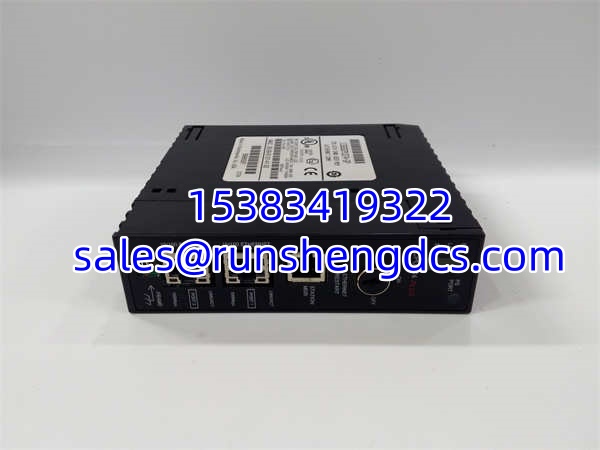
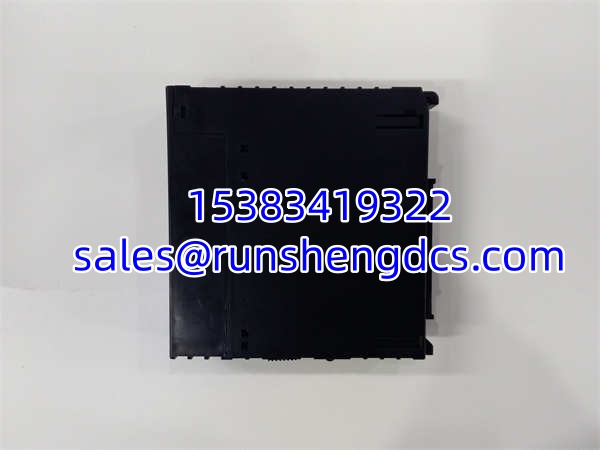

Description
Key Technical Specifications
| Parameter | Specification |
|---|---|
| Product Model | IC693CPU374 (CPU374 PLUS) |
| Manufacturer | GE Fanuc (now Emerson Automation Solutions) |
| Device Type | Single-slot PLC CPU Module |
| Platform Compatibility | GE Fanuc Series 90-30 (IC693 chassis/backplane only) |
| Processor | AMD SC520, 586-class, 133MHz |
| Math Co-processor | Hardware floating-point unit (accelerates complex calculations) |
| User Memory | 240KB (245,760 bytes) — RAM + Flash, battery-backed |
| Configurable Memory | %R, %AI, %AQ: 128 to 32,640 words each (user-defined allocation) |
| Fixed Memory | %I (inputs): 2,048 bits; %Q (outputs): 2,048 bits; %M (discrete global): 1,280 bits; %G (global): 4,096 bits; %S/%SA/%SB/%SC (system): 256/32 bits each |
| Boolean Logic Scan Rate | 0.15 milliseconds per 1K contacts |
| I/O Capacity | Up to 4,096 discrete I/O points (local + remote); 2,048 DI / 2,048 DO / 2,048 AI / 512 AO max |
| Rack Expansion | Up to 8 racks total (1 CPU baseplate + 7 expansion/remote racks) |
| Ethernet Ports | Dual 10/100Base-T/TX RJ-45 ports with built-in auto-sensing switch (shared single IP address) |
| Ethernet Protocols | SRTP (Server & Client), Ethernet Global Data (EGD), Modbus/TCP (Server: Conformance Classes 0, 1, 2; Client: Classes 0, 1 + Function Codes 15, 22, 23, 24 for Class 2) |
| Serial Communication | RS-485 port via power supply module (supports SNP/SNPX protocols) |
| Programming Software | VersaPro 2.03 or later; CIMPLICITY Machine Edition Logic Developer 2.60 or later; Control Software 2.50 or later |
| Programming Languages | Ladder Diagram (LD), Structured Text (ST), C Language, State Logic |
| Power Requirement | 5VDC @ 1.4A (7.4W) — drawn from Series 90-30 backplane; high-capacity power supply recommended |
| Battery Backup | Internal battery (in power supply): ~1.2 months retention; External battery (IC693ACC302): ~15 months retention |
| LED Indicators | STAT (CPU status), RUN, FAULT, FORCE, OK; Ethernet LINK/ACT (Port 1 & 2), 100Mbps; PS/EOK/PORT indicators |
| Special Features | EZ Store device support (program download without PC); Periodic Subroutine feature; Hold Last State on communication loss; System fault isolation |
| Operating Temperature | 0°C to 60°C (32°F to 140°F); Low-Temperature (LT) variant available for –40°C to 60°C |
| Storage Temperature | –40°C to +85°C (–40°F to 185°F) |
| Humidity | 5% to 95% RH, non-condensing |
| Protection Rating | IP20 |
| Certifications | UL 508, C-UL (Class I, Div II, Groups A, B, C, D), CE Mark |
| Mounting | Single-slot installation in Series 90-30 IC693 chassis |
| Status | Discontinued — spare replacement only; no official direct successor in the 90-30 family |
Product Introduction
The GE IC693CPU374 (also marketed as CPU374 PLUS) is the flagship high-performance CPU module for the GE Fanuc Series 90-30 PLC platform, designed for mid-to-large-scale industrial automation applications that demand fast scan times, substantial I/O capacity, and robust Ethernet connectivity. At its core is an AMD SC520 586-class processor running at 133MHz with a dedicated hardware floating-point unit — a significant performance advantage over earlier 386EX-based 90-30 CPUs when executing complex math, PID loops, or data manipulation routines. The CPU delivers a Boolean logic scan rate of 0.15ms per 1K contacts, making it one of the fastest processors in the Series 90-30 lineup, and provides 240KB of configurable user memory (split between RAM and Flash with battery backup) to accommodate large ladder logic programs, extensive data tables, and I/O image tables. It occupies a single slot in the IC693 chassis, leaving the remaining slots available for discrete and analog I/O modules, communication coprocessors, and specialty function modules.
What set the IC693CPU374 apart from its predecessors when it was launched was its integrated dual-port Ethernet interface with a built-in auto-sensing switch — both RJ-45 ports share a single IP address, enabling simple daisy-chain or star network topologies without requiring an external Ethernet switch. The CPU supports SRTP (Service Request Transport Protocol) for programming and HMI communication, Ethernet Global Data (EGD) for peer-to-peer data exchange between multiple PLCs, and full Modbus/TCP server and client functionality (including advanced function codes for Class 2 conformance), making it straightforward to integrate with third-party devices, SCADA systems, and enterprise-level MES platforms. The module also supports the EZ Store device, allowing technicians to download a stored program directly into the CPU without a laptop — a valuable feature for field replacements. As a discontinued legacy product, the IC693CPU374 is no longer in active production by Emerson, but it remains widely deployed in automotive manufacturing, petrochemical processing, power generation, and water/wastewater treatment facilities. Organizations running Series 90-30 systems with CPU374 modules must either maintain a spare inventory of tested replacements or plan a migration to Emerson’s PACSystems RX3i platform, which offers backward compatibility with many 90-30 I/O modules through a carrier-based adapter system.
Troubleshooting Quick Reference
- CPU Not Running / STAT LED Red or Flashing: Check the FAULT LED pattern — a steady red FAULT indicates a hardware fault (bad module, backplane communication failure, or power issue), while a flashing FAULT typically indicates a program error (illegal instruction, watchdog timeout, or I/O configuration mismatch). Use VersaPro or Machine Edition to go online and read the fault table for the specific error code. If the CPU won’t enter RUN mode, verify that no force tables are active and that the program checksum is valid.
- Ethernet Communication Failure (LINK/ACT LEDs Off): Verify the Ethernet cable is properly seated and that the connected device (switch, HMI, or PC) is powered. The dual Ethernet ports share a single IP address — if you’re connecting to Port 2, ensure the network path from Port 1 is intact (the built-in switch requires Port 1 to be connected for Port 2 to function in a daisy-chain configuration). Use a ping test to verify IP connectivity. If the LINK LED is lit but communication fails, check that the SRTP or Modbus/TCP port numbers are correctly configured in the client device.
- Program Download Failure: Ensure you’re using a compatible programming software version (VersaPro 2.03+ or Machine Edition Logic Developer 2.60+). Verify the Ethernet connection is stable — a dropped connection mid-download can corrupt the CPU’s program memory. If downloading via the RS-485 port on the power supply, confirm the SNP/SNPX protocol settings match between the PC and the PLC. For EZ Store downloads, ensure the EZ Store device contains a valid, checksum-verified program for this specific CPU model.
- Memory Loss After Power Cycle (Program or Data Disappears): The CPU’s RAM is battery-backed. If the program or retentive data is lost after a power outage, the backup battery is depleted. The internal battery (located in the power supply module) provides approximately 1.2 months of retention; the external battery (IC693ACC302) provides approximately 15 months. Replace the battery promptly — the CPU has a large capacitor that holds data for approximately 20 minutes during a battery swap, giving you a window to replace it without losing the program.
- Slow Scan Times / Watchdog Timeout: A scan time exceeding the watchdog timeout setting will cause the CPU to fault. Use the programming software to monitor the actual scan time. Common causes include excessive use of indirect addressing, large block moves, or complex C language routines. Optimize the program by moving non-critical logic to periodic subroutines (a feature supported by the CPU374) or by restructuring the ladder logic to reduce the number of rungs evaluated every scan.
- I/O Modules Not Responding / Rack Communication Error: The CPU374 supports up to 8 racks (1 CPU baseplate + 7 expansion). If remote I/O racks are not communicating, check the expansion cable connections and verify that the last rack in the chain has the I/O Bus Terminator Plug installed. The three green LEDs on the bus expansion module indicate module status, rack activity, and terminator presence — use these to diagnose the fault location. If a specific rack is down, the Hold Last State feature should keep outputs in their last valid state; verify this behavior to prevent unsafe conditions.
- Modbus/TCP Communication Not Working: Confirm the CPU is configured as a Modbus/TCP server (the default) or client as required. For server mode, verify the Modbus register addresses (%R, %AI, %AQ) are correctly mapped and that the client device is using the correct function codes (the CPU374 supports FC 15, 22, 23, and 24 for Class 2 conformance). For client mode, ensure the target device’s IP address and port are correctly entered in the CPU’s Modbus client configuration table. Use a Modbus diagnostic tool (such as ModScan or QModMaster) to test connectivity independently of the PLC program.
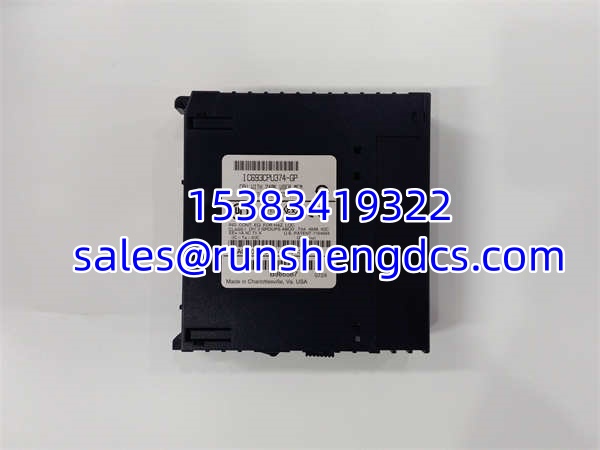
GE IC693CPU374
Application Scenarios & Pain Points
- Automotive Manufacturing (Assembly Line Control): The IC693CPU374 is commonly used in automotive body shops and paint shops to control conveyor systems, robotic cell interfacing, and paint booth environmental controls. Its fast 0.15ms/1K scan rate ensures tight synchronization between multiple conveyor zones, and the dual Ethernet ports allow direct connection to robot controllers and HMIs without an external switch. The hardware floating-point unit accelerates the math-intensive calculations needed for paint flow rate control and curing oven temperature profiling. Pain point: As a legacy CPU, finding replacement units with verified battery backup and functional Ethernet ports is increasingly challenging. Automotive plants typically run 24/7 with minimal shutdown windows, so a CPU failure can halt an entire production line. Maintaining a tested spare with a fresh battery and a current program backup on an EZ Store device is critical.
- Oil & Gas Refining (Process Control & Safety Interlocking): Refineries deploy the IC693CPU374 in process control applications such as distillation column control, pump station sequencing, and tank farm monitoring. The 240KB memory accommodates large analog control loops and extensive alarm management logic. The Modbus/TCP server capability allows integration with third-party analyzers, flow computers, and custody transfer meters. The CPU’s support for periodic subroutines enables deterministic execution of critical safety interlocks independent of the main program scan. Pain point: The Series 90-30 platform does not natively support SIL-rated safety applications — for safety instrumented systems (SIS), a dedicated safety PLC (such as Emerson’s Triex or a third-party SIL3-certified controller) should be used. Using a standard for safety functions is a compliance risk.
- Power Generation (Turbine Auxiliaries & BOP Control): In power plants, the controls balance-of-plant (BOP) systems including cooling water circulation, fuel gas conditioning, and lube oil systems for gas and steam turbines. The dual Ethernet ports provide redundant communication paths to the plant DCS, and the EGD protocol enables fast peer-to-peer data exchange with adjacent PLCs for coordinated start/stop sequences. The hardware floating-point unit is valuable for real-time efficiency calculations and heat rate monitoring. Pain point: Power plant environments often have significant electrical noise and temperature variations. The ‘s 0–60°C operating range is adequate for control rooms but may be marginal for field-mounted enclosures. The LT (Low-Temperature) variant rated for –40°C to 60°C should be specified for outdoor or unheated installations.
- Water & Wastewater Treatment (SCADA & Pump Station Control): Municipal water facilities use the as the local controller at remote pump stations, lift stations, and treatment process units. The Ethernet connectivity allows direct integration with the plant’s SCADA system over fiber optic or wireless Ethernet links. The 4,096 I/O capacity is sufficient for large pump stations with multiple variable frequency drives (VFDs), flow meters, and level sensors. The C language programming capability is useful for implementing custom algorithms such as pump alternation logic and energy optimization routines. Pain point: Many water facilities operate on limited budgets and defer PLC upgrades. The ‘s battery backup is a frequent maintenance item — if the battery dies and the program is lost, the pump station may go offline until a technician can restore the program from backup. Implementing a regular battery replacement schedule and maintaining off-site program backups is essential.