
Description
Key Technical Specifications
| Parameter | Specification |
|---|---|
| Gas Sensor Types | Hydrogen Only (H2) or Composite (H2, CO, C2H2, C2H4) |
| H2 Measurement Range | 25 – 2,000 ppm (Trending to 5,000 ppm) |
| H2 Accuracy | ±10% of reading ±25 ppm |
| Moisture Measurement | %RH and ppm (Thin-film capacitive) |
| Response Time | <10 minutes (90% step change) |
| Operating Temp | -40°C to +70°C (Sensor head) |
| Power Supply | 24 VDC / 110-240 VAC (Verify PSU option) |
| Communication | RS-485 (Modbus/DNP3), Optional Ethernet/Fiber |
| Alarms | 4 Programmable Relays (SPDT) + 1 Service Relay |
| Enclosure Rating | NEMA 4X / IP66, Cast Aluminum |
| Installation | Single valve mount, no pumps/moving parts |
| Compliance | UL HazLoc (Class I Div 2), CE, RoHS |
Product Introduction
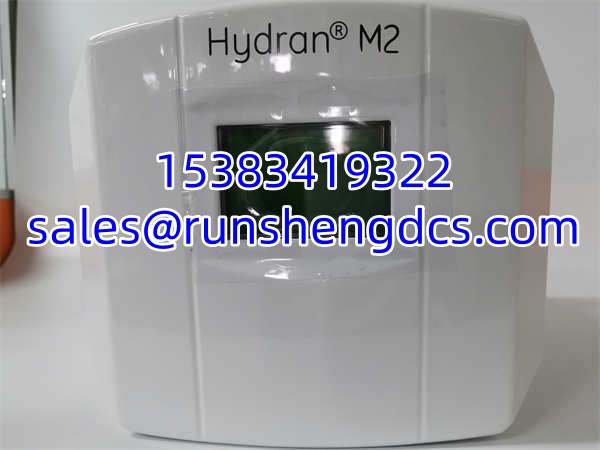
Transformer insulation failure doesn’t happen overnight; it generates gas and moisture weeks before the Buchholz relay trips. The Hydran M2 sits directly on the transformer valve, using a gas-permeable membrane to pull dissolved gases into an electrochemical cell without vacuum pumps or moving parts. It’s a passive watcher that catches the first whiff of arcing (C2H2) or thermal degradation (H2) before you lose a 100MVA asset.
Unlike lab DGA which gives you a snapshot every 3 months, the M2 provides continuous trending and calculates IEEE thermal models (winding hot spot, paper moisture) in real-time. Bottom line — it turns reactive maintenance into predictive strategy. With a 2000 ppm H2 accuracy window and <10 min response time, you get actionable data, not just a blinking light. Just verify the sensor manufacture date; electrochemical cells have a finite life even on the shelf.
QA/QC Transparency SOP
- Intake & Origin Verification: Check serial number against GE’s manufacturing date code. Sensors >5 years old in storage may have degraded electrolyte. We verify the membrane isn’t dried out or cracked under magnification.
- Live Functional Testing: Mounted on a test transformer or oil bath rig. We inject known H2 concentrations and verify the ppm readout matches within ±10%. Moisture sensor is cross-checked against a chilled mirror hygrometer.
- Electrical Parameter Tests: 24VDC input tested under full heater load. We verify the internal sensor heater maintains 15-65°C to prevent oil condensation on the membrane. Relay continuity checked at 1A load.
- Firmware/Config Verification: EEPROM config read and checksummed. We verify the IEEE model constants match the transformer nameplate data entered. Comms tested via Modbus poll for all register blocks.
- Final QC & Anti-Static Packaging: Sensor head sealed with protective cap to prevent ambient moisture ingress. Unit packed in anti-static bag with desiccant. Label includes test gas concentration and date.
Field Engineer Gotchas
- Sensor Shelf Life: The electrochemical cell consumes electrolyte even when unpowered. War story: Installed a “new” M2 from 2018 stock; it read 0 ppm H2 in a running transformer. Dead cell. Always check the mfg date. If >3 years, budget for a sensor swap.
- Valve Orientation: Install with the sensor head horizontal or slightly upward. Never mount pointing straight down; oil sludge settles in the membrane housing and kills response time. Blunt warning: Gravity is your enemy here. Read the install guide.
- IEEE Model Garbage-In/Garbage-Out: The thermal model calculates winding hot spot based on load, top oil temp, and ambient. If you don’t wire the analog inputs for load/temp, the model is just a fancy guess. Reality check: Connect the CT and RTD inputs, or disable the model in config to avoid false alarms.
- Ground Loops on RS-485: Long cable runs to the control room create ground potential differences. We’ve seen 2V AC on the comms shield fry the RS-485 transceiver. Fix: Use isolated RS-485 cards (Option 17046) and ground the shield at one end only.
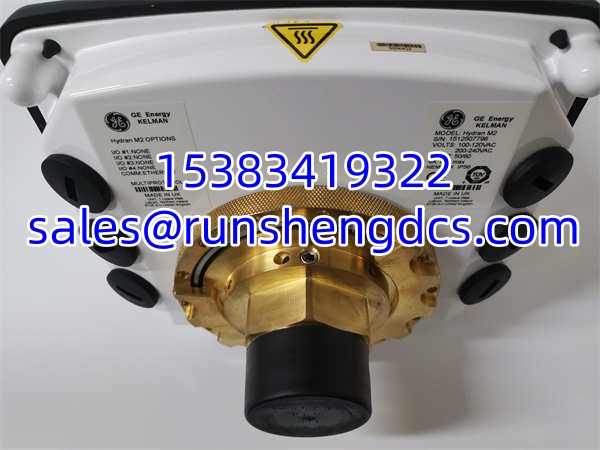
GE HYDRAN M2
Application Scenarios
- Substation Step-Down Transformers: 138kV/13.8kV units with aging paper insulation. M2 tracks moisture migration during load cycles, triggering dehumidification before dielectric strength drops.
- Industrial Rectifier Transformers: High harmonic content causes localized heating. Composite gas sensor catches C2H2 from stray flux arcing that H2-only sensors miss.
- Wind Farm Collection Transformers: Remote, unmanned sites. M2 Ethernet output feeds SCADA for trend analysis, eliminating monthly oil sampling truck rolls.
FAQ
- Is M2 compatible with M2-X sensors? No. The M2-X has a different membrane housing and electronics. You cannot retrofit an M2-X sensor into an M2 head. Verify your exact model before ordering spares.
- Does it measure CO and CO2? Only the “Composite Gas” sensor option measures CO (paper degradation). The standard H2-only sensor ignores CO. Check your purchase order; the label says “H2” or “Comp”.
- Can I calibrate this in the field? No. Factory calibration only. Field “zeroing” is for baseline offset, not full calibration. If it’s drifting >15%, swap the sensor.
- What if the oil valve is closed? The M2 has a service alarm relay for this. It detects no gas diffusion (stuck valve or empty housing). Don’t ignore the service light; it’s not just a fault, it’s a safety interlock.
- Does it work with ester oil? Yes, M2 and M2-X support natural/synthetic esters. But the IEEE thermal model constants differ. You must select “Ester” in the config menu, or the hot spot calculation will be wrong.
- How often should I replace the sensor? Typical life is 5-7 years in service. If you see frequent “Sensor Fault” alarms or flatline readings, it’s end-of-life. Don’t wait for the 15-day self-test to fail.
- Can I use this on a sealed transformer? Yes, but verify the valve type. Some sealed units have non-standard valves. The M2 uses a standard 1″ NPT or flange adapter. Measure twice.