
Description
Key Technical Specifications
| Specification | Details |
|---|---|
| Part Number | HE700GEN200C (suffix “C” denotes a specific hardware revision of the base HE700GEN200; functionally identical to standard HE700GEN200) |
| Manufacturer | Horner APG / GE Fanuc (GE automation business now part of Emerson) |
| Product Type | Dual-Channel uGENI VME-to-Genius Bus Interface Module |
| Compatible Platform | GE Fanuc Series 90-70 VME rack, Series 90-30 VME rack, and other GE VME-based PLC systems |
| Number of Channels | 2 independent Genius bus channels (Channel 1 and Channel 2) |
| Devices per Channel | Up to 32 Genius bus devices per channel (64 total across both channels) |
| Network Topology | Daisy-chain (linear); each channel is a separate RS-485-based Genius bus segment |
| Communication Protocol | GE Genius Bus Protocol (proprietary RS-485-based industrial network) |
| Configuration Method | DIP switches on the module board (no software-only config — physical switches set channel parameters) |
| Front-Panel Connectors | Screw-terminal blocks for both Genius bus channels (Serial 1, Serial 2, Shielded Input, Shielded Output terminals) |
| Network Termination | Each end of each Genius bus daisy chain requires a termination resistor matched to the cable’s characteristic impedance (typically 120Ω for twisted-pair Genius cable) |
| VME Slot Occupancy | Single-width VME slot (standard 3U VME form factor) |
| Backplane Interface | VMEbus P1/P2 connector — communicates with the VME CPU over the VME backplane |
| LED Indicators | Status LEDs for channel activity, communication health, and module fault (specific LED functions vary by revision) |
| Supported Genius Devices | Genius Block I/O (GFK-1065 series), Genius Analog Modules, Genius Counter Modules, Genius Motor Controllers, Genius Operator Interfaces, and any device with a Genius bus port |
| Cable Length | Up to 7,500 feet (2,286 meters) total per channel with proper twisted-pair cable and termination (per GE Genius bus spec) |
| Baud Rate | Fixed by Genius bus standard — 1.5 Mbps (Genius bus operates at a fixed high-speed rate) |
| Isolation | Channel-to-channel and channel-to-VME backplane isolation (optical or transformer isolation per Genius bus spec) |
| Operating Temperature | 0°C to 60°C (32°F to 140°F) — per GE VME hardware manual |
| Storage Temperature | -40°C to +85°C (-40°F to 185°F) |
| Humidity | 5% to 95% non-condensing |
| Standards | UL 508, CSA C22.2 No. 142, CE (EN 61131-2); VMEbus Rev C.1 compliant |
Product Introduction
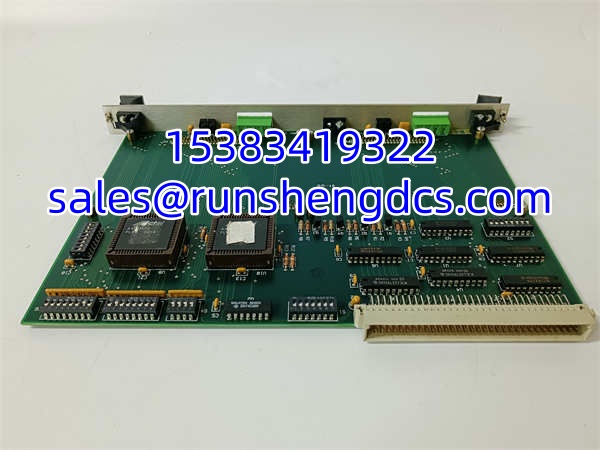
You’re staring at a GE Series 90-70 VME rack in a power plant or a paper mill, and you need to talk to field devices scattered across the facility — remote I/O blocks, analog transmitters, motor controllers — all wired on the Genius bus network. The HE700GEN200C is the bridge that makes that conversation possible. It’s a dual-channel uGENI (micro Genius Interface) module that slots into a VME rack and gives your VME-based CPU two independent Genius bus ports, each capable of driving up to 32 field devices in a daisy-chain topology.
The “200” in the part number tells you this is the dual-channel variant. Its sibling, the HE700GEN100, is the single-channel version — same form factor, same VME interface, but only one Genius bus port. If you need more than 32 devices on a single rack, or you want to split your field devices across two physically separate bus segments (for redundancy, segmentation, or cable routing reasons), the 200C is the module you reach for.
The Genius bus itself is a proprietary RS-485-based industrial network that GE developed in the 1980s. It’s not Ethernet, not Profibus, not Modbus — it’s GE’s own protocol, optimized for deterministic I/O scanning. Each Genius bus segment is a linear daisy chain: CPU → module → device 1 → device 2 → … → device 32, with a termination resistor at each end. The 200C gives you two of these segments, completely independent. That means you can put 32 devices on Channel 1 (say, all the I/O in the north end of the plant) and 32 on Channel 2 (the south end), and a fault on one segment won’t take down the other. That’s a real architectural advantage over a single-channel module.
Configuration is done via DIP switches on the module board — not in software. This is a double-edged sword. On one hand, it means the module’s identity (channel addresses, baud rate, termination settings) is physically set and survives a CPU swap or a software reload. On the other hand, it means you need to physically access the rack to change settings, and you’d better document your switch positions before you pull the module. The front panel has screw-terminal blocks for both channels — Serial 1, Serial 2, Shielded Input, and Shielded Output — which is where you land the Genius bus twisted-pair cable.
One thing to understand clearly: the HE700GEN200C is NOT a standalone PLC. It’s an interface module. It needs a VME-based CPU (like a Series 90-70 IC697CPU or a Series 90-30 VME CPU) to drive it. The CPU scans the Genius bus through the 200C, reads inputs from field devices, writes outputs, and handles all the logic. The 200C is purely the communication gateway — it translates VME backplane transactions into Genius bus frames and vice versa.
The “C” suffix is a hardware revision code. Horner APG (who manufactured these modules for GE) released several revisions over the years — REV 1, REV 2, etc. — with the “C” denoting a specific board-level update. Functionally, all revisions of the HE700GEN200 are interchangeable in the field. The sub-board assembly inside is typically a GNI2C1 (ASM 44A737219-G01, FAB 44A737220-001), and the chip version is typically 3.2. If you’re replacing an older revision with a “C” revision, it’s a drop-in swap — no reconfiguration needed beyond matching the DIP switch positions.
Bottom line — the Genius bus platform is legacy. GE’s automation business was acquired by Emerson in 2019, and the Genius bus has been superseded by Ethernet-based protocols (Ethernet/IP, Profinet, Modbus TCP) on the RX3i and PACSystems platforms. But there are thousands of Genius bus installations still running — in power generation (turbine auxiliaries, boiler controls), water/wastewater (remote lift stations, chemical dosing), paper mills (machine section I/O), and oil & gas (pipeline compressor stations). The HE700GEN200C is a mature, proven design. Refurbished units are available through independent surplus dealers. When replacing one, verify your DIP switch settings match the original, confirm your Genius bus cable is properly terminated at both ends, and document the device addresses on each channel before pulling the module. If you’re migrating away from Genius bus, the replacement path is an RX3i rack with Ethernet-based remote I/O (like the IC695ETM001 Ethernet module and IC694/IC695 remote I/O blocks) — but that’s a full system migration, not a field swap.
Troubleshooting Quick Reference
| Fault | Likely Cause | Relevancy | Quick Check | Fix |
|---|---|---|---|---|
| Module not recognized by CPU | VME slot mismatch, backplane communication failure, or module not seated | ~25% | Check VME slot assignment in CPU config; reseat module; verify VME backplane power | Reseat module; move to a known-good VME slot; check CPU configuration for correct slot mapping |
| Channel 1 or 2 communication fault | Missing termination resistor, cable fault, or device address conflict on the Genius bus segment | ~30% | Verify termination resistors at both ends of the daisy chain; check cable continuity; scan for duplicate device addresses | Install/replace termination resistor (120Ω); repair cable; resolve address conflicts |
| Intermittent communication drops | Loose screw-terminal connection, EMI/RFI interference on unshielded cable, or failing Genius device on the segment | ~20% | Check terminal screw torque; verify shielded twisted-pair cable is used; isolate devices one at a time | Tighten terminals; replace with proper shielded Genius bus cable; replace faulty field device |
| DIP switch configuration mismatch | Switches set incorrectly after module replacement, or switches drifted/oxidized over time | ~10% | Compare DIP switch positions on replacement module vs. original; clean switch contacts | Set switches to match original documentation; clean or replace module if switches are faulty |
| One channel works, the other doesn’t | Internal channel failure, damaged front-panel connector, or firmware corruption on that channel | ~5% | Swap cable from working channel to non-working channel; test with known-good device | If cable swap doesn’t fix it, the module’s internal channel circuitry has failed — replace module |
| All devices on a channel show fault | Power supply issue to field devices, or bus short/open circuit | ~5% | Measure voltage at first and last device on the segment; check for shorted cable pairs | Restore field device power; repair cable; check for water ingress in junction boxes |
| CPU reports “Genius Bus Fault” in software | Genius bus configuration in PLC program doesn’t match physical DIP switch settings | ~5% | Compare Genius bus config in Logicmaster 90-70/90-30 or VersaPro with actual DIP switch positions | Align software configuration with physical DIP switch settings; download updated config to CPU |
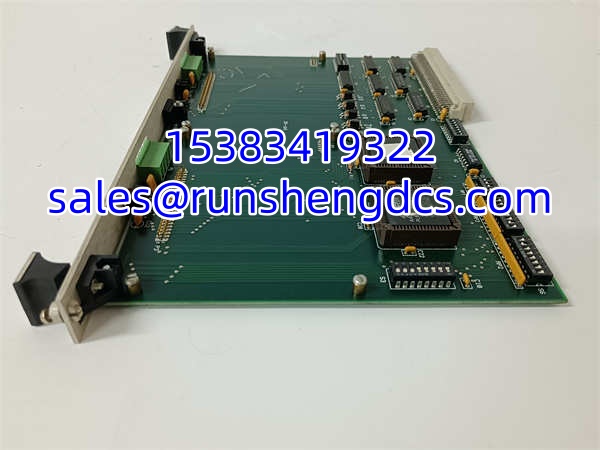
GE HE700GEN200C
Application Scenarios & Pain Points
- Power generation (turbine and boiler controls): Many GE Frame 6/7/9 gas turbine auxiliary control panels and coal-fired boiler BMS (burner management systems) used Series 90-70 VME racks with HE700GEN200C modules to communicate with remote Genius I/O blocks in the turbine hall and boiler deck. The dual-channel capability allowed engineers to separate critical safety I/O (Channel 1) from non-critical monitoring I/O (Channel 2). The pain point: after 20+ years, the DIP switches on old modules can oxidize, causing intermittent channel faults. Plants are struggling to source replacements as original stock dwindles.
- Water/wastewater treatment: Municipal water facilities used Genius bus to connect remote lift station I/O, chemical feed controllers, and flow meters back to a central Series 90-70 or 90-30 VME PLC. The HE700GEN200C’s two channels allowed one segment for the north side of the plant and one for the south, reducing cable runs. The pain point: outdoor junction boxes with Genius bus connections are prone to water ingress, causing corrosion on the twisted-pair cable and intermittent communication faults. Technicians often spend hours tracing cable faults that are actually just corroded splices.
- Paper mills and converting lines: Paper machines have extensive I/O requirements — speed references, tension controls, dryer section temperatures — spread across hundreds of feet of machine width. The Genius bus daisy-chain topology was ideal for this, and the ‘s dual channels allowed splitting the machine into two segments (wet end and dry end). The pain point: vibration on paper machines can loosen the screw-terminal connections on the 200C’s front panel over time, causing intermittent channel communication loss. A simple retightening often fixes the issue, but it’s frequently overlooked in favor of module replacement.
- Oil & gas pipeline compressor stations: Remote compressor stations along pipelines used Series 90-70 VME PLCs with modules to communicate with local Genius I/O for pressure transmitters, temperature sensors, and valve actuators. The dual-channel design provided a degree of segmentation — if one channel failed, the other could still monitor critical parameters. The pain point: in harsh outdoor environments, the Genius bus cable’s shield can degrade, allowing EMI from power cables to corrupt communication. Properly shielded, twisted-pair Genius cable with grounded shields is essential but often neglected in field installations.