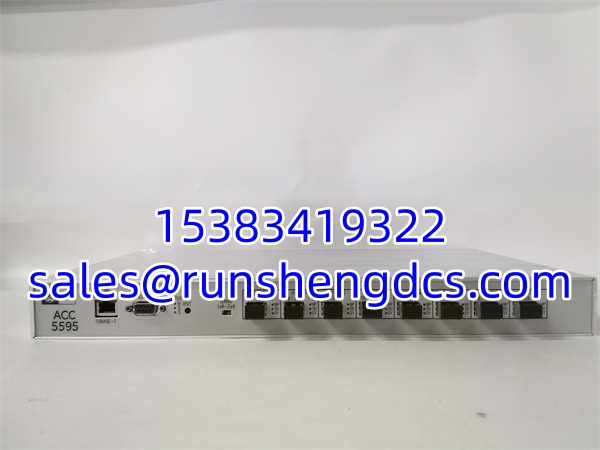
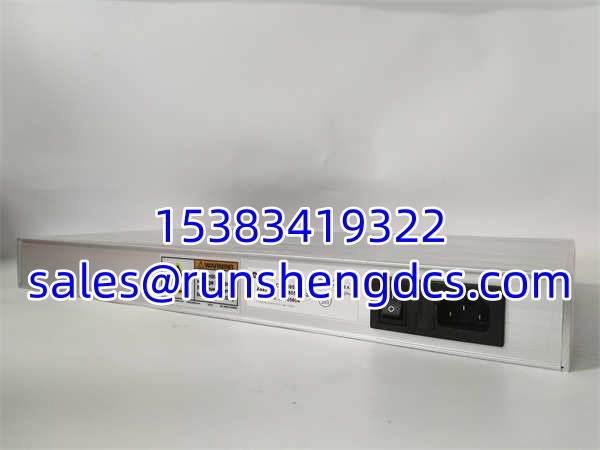

Description
Key Technical Specifications
- Product Model: GE ACC-5595-208
- Assembly Number: 350-805595-208N
- Port Count: 8 Independent Fiber Ports
- Data Rate: 2 Gb/s (170 MB/s effective throughput)
- Latency: ≤1μs End-to-End (Hardware-deterministic)
- Transceiver Type: SFP (Multi-mode 850nm or Single-mode 1310nm/1550nm)
- Max Distance: 300m (MM), 10km (SM), 80km (SM-ER)
- Network Topology: Star, Ring, or Cascaded Star
- Max Nodes: 256 (via cascading)
- Management: RS-232 Local, 10Base-T Ethernet Remote
- Power: Universal Internal PSU (115-230VAC)
- Form Factor: 19-inch 1U Rack or Desktop
Product Introduction
Standard Ethernet switches are useless for hard real-time motion control because TCP/IP stack jitter kills your servo loop. The GE ACC-5595-208 solves this by acting as a transparent optical repeater for the VMI Reflective Memory protocol. It doesn’t store, forward, or parse packets; it simply regenerates the serial optical signal and broadcasts the memory write to all ports simultaneously. If you’re running a flight simulator or a rolling mill with sub-microsecond sync requirements, this box is the only thing keeping your nodes in phase.
Engineers keep the GE ACC-5595-208 in stock because it’s pure hardware logic—no CPU, no OS, no firmware updates to brick the system. The automatic bypass feature is the real lifesaver: if a node dies or a fiber gets pulled, the hub instantly shorts around that port, keeping the rest of the ring alive. I’ve seen plants avoid a 4-hour shutdown because a single SFP failed and the GE ACC-5595-208 just kept the other seven nodes talking. Bottom line: it’s dumb hardware that does exactly one thing perfectly.
QA/QC Transparency SOP
- Intake & Origin Verification: We verify the 350-805595-208N assembly number and check for physical damage to SFP cages. Counterfeit hubs exist; we inspect PCB revisions and component date codes against GE documentation.
- Live Functional Testing: Unit is installed on a test rack with PCIe-5565 cards. We verify memory mirror integrity across all 8 ports, confirm write-broadcast latency is <1μs, and test automatic bypass by pulling a fiber mid-transfer.
- Electrical Parameter Tests: SFP supply voltage is verified at 3.3V. Input/output optical power levels are measured with a fiber power meter to ensure TX/RX margins meet spec. RS-232 and Ethernet management ports are loopback-tested.
- Firmware/Config Verification: Firmware version is read via serial console. We verify DIP switch settings (Ring vs. Star, Bypass mode) match your configuration. Configuration is logged and backed up.
- Final QC & Anti-Static Packaging: SFP ports are capped to prevent dust. Unit is packed in anti-static shielding with fiber cleaning wipes. Test report includes optical power readings and latency measurements.
Field Engineer Gotchas
- SFP Mismatch: The ACC-5595-208 supports both multi-mode and single-mode SFPs, but you cannot mix them on the same link. Plugging a 1310nm SM SFP into a MM fiber will give you zero light. Always verify the wavelength and fiber type before ordering. I’ve seen $800 SFPs returned because someone assumed “SFP = SFP.”
- DIP Switch Configuration: The front panel DIP switches control topology (Star vs. 2×4 Ring) and bypass behavior. If you’re replacing a unit, photograph the switches first. Wrong switch settings = network segmentation or bypass failure. War story: A tech swapped a hub without checking DIPs; the network split into two isolated segments, and the PLC didn’t realize it was talking to itself for 2 hours.
- Fiber Bend Radius: Reflective memory uses high-speed serial optical. Tight bends (>1″ radius) cause micro-cracks and intermittent errors that look like node failures. Use proper fiber management. Don’t zip-tie fibers to the rack frame.
- Power Sequencing: Always power up the hub before the PCIe-5565 cards. If nodes boot before the hub is ready, they may fail to synchronize and lock out. Follow the GE startup sequence. ESD is also a killer; these SFP cages are sensitive. Wear the strap.
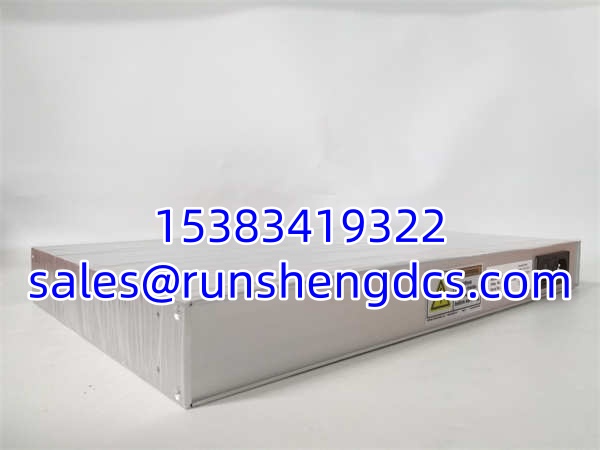
GE 350-805595-208 ACC-5595-208
Application Scenarios
- Flight Simulator Motion Platforms: 6-DOF platforms require <500ns sync between hydraulic actuators. The ACC-5595-208’s deterministic latency ensures all actuators move in unison. Jitter from Ethernet would cause platform oscillation and motion sickness.
- Rolling Mill Synchronization: Multiple drives must coordinate speed within 10μs. The reflective memory hub broadcasts speed commands to all drives simultaneously. No master-slave polling delays. If one drive faults, the hub bypasses it; the rest of the line keeps running.
- Particle Accelerator Diagnostics: 64+ sensor nodes must timestamp data with nanosecond precision. Cascaded hubs create a 256-node star topology with global clock distribution. The optical isolation prevents ground loops from corrupting sensitive beam position monitors.
FAQ
No. Standard Ethernet SFPs use different encoding and protocols. You must use VMI-compatible SFPs (typically 850nm MM or 1310nm SM with specific TX/RX wavelengths). Generic SFPs will not link.
The hub itself is not hot-swappable. However, individual nodes can be hot-plugged; the hub will automatically bypass the disconnected port. Never power-cycle the hub with active nodes unless you’re prepared for a full network resync.
What’s the max cable length for multi-mode?
300 meters with OM3/OM4 fiber at 850nm. Beyond that, you need single-mode SFPs (10km or 80km). Don’t push MM fiber to the limit; signal degradation causes intermittent errors that are hell to diagnose.
How do I know if a port is bypassed?
Check the front panel LEDs. Solid green = active. Off = bypassed or no link. Amber = fault. You can also query via RS-232 or Ethernet to get detailed port status, including optical power levels and sync status.
Can I cascade more than 256 nodes?
No. 256 is the hard limit due to the reflective memory protocol’s node ID addressing. If you need more nodes, you need a different architecture or a newer generation hub.
Do you test with actual PCIe-5565 cards?
Yes. Every -208 is tested with real VMI cards, not just optical loopbacks. We verify memory mirror integrity, latency, and bypass functionality under load. Optical-only testing misses protocol-level faults.
The -280 is a later revision with minor component changes but identical functionality. They are drop-in replacements. Verify the SFP type (MM vs. SM) matches your installation, as both revisions come in multiple optical configurations.