
Description
Key Technical Specifications
| Parameter | Specification |
|---|---|
| Product Type | FBM233 — Redundant Field Device System Integrator (FDSI) |
| Part Number | P0926GX |
| Ethernet Interface | 10/100 Mbps, RJ-45 copper (redundant) |
| Communication Protocol | TCP/IP or UDP/IP; driver-dependent (e.g., Modbus TCP/IP) |
| IP Addressing | Fixed or DHCP |
| Max Devices per FBM233 | Up to 64 external devices |
| Max DCI Connections | Up to 2000 DCI blocks |
| Fastest ECB Block Period | 500 ms |
| Module Bus | Redundant 2 Mbps to FCM100Et, FCM100E, FCP280, or FCP270 |
| Supply Voltage | 24 VDC, +5% / -10% (redundant) |
| Power Consumption | Max 7 W per module |
| Heat Dissipation | Max 7 W per module |
| Environmental Rating | G3 (harsh) per ISA S71.04 |
| Data Types | 2-byte/4-byte signed/unsigned integers, 4-byte IEEE float, binary |
| Redundancy | Primary/tracker pair with automatic failover on heartbeat loss |
Product Introduction
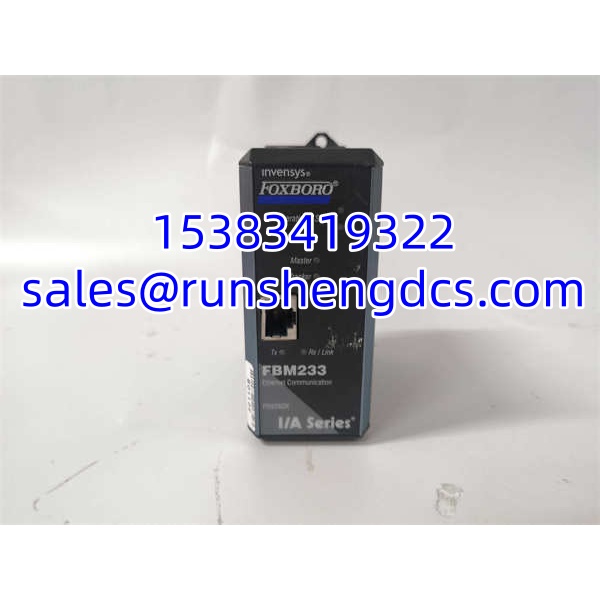
Integrating a Modbus TCP/IP analyzer or a third-party PLC into a Foxboro I/A Series DCS usually means one of two things: a custom gateway project, or an FBM233 sitting in the rack doing exactly that job. The FBM233 P0926GX is Foxboro’s Ethernet-based FDSI module — a hardware platform that loads downloadable protocol drivers to talk to external devices over standard Ethernet, then maps their data into DCI blocks inside the I/A Series control database.
It is not a conventional analog or discrete I/O card. Think of it as a protocol bridge. Each FBM233 can communicate with up to 64 external devices, and a redundant pair provides automatic failover if the primary module loses heartbeat with a connected device. The fastest allowed ECB block period is 500 ms, so this is not the right pick for sub-100 ms closed-loop control of external devices — but for status monitoring, setpoint writes, and batch data exchange, it is a proven approach.
QA/QC Transparency SOP
- Intake & Origin Verification: Photograph the P0926GX label, serial number, RJ-45 ports, and connector pins. Reject units with bent Ethernet jacks, corrosion, or mismatched markings.
- Live Functional Testing: Install in a compatible I/A Series rack with an FCM100Et, FCM100E, FCP280, or FCP270. Confirm module recognition, LED status, and 2 Mbps module bus communication.
- Ethernet & Driver Verification: Connect to a test Ethernet switch. Verify link at 10/100 Mbps. Confirm the correct FDSI driver is loaded and that the module can poll a test Modbus TCP/IP (or equivalent) device.
- Redundancy & DCI Mapping Test: Install a tracker pair. Verify primary/tracker synchronization and automatic role switchover on simulated link loss. Confirm DCI block reads/writes match expected values.
- Final QC & Anti-Static Packaging: Record firmware revision, loaded driver version, IP configuration, and DCI mapping. Pack in ESD-safe bags with desiccant and include full test logs.
Field Engineer Gotchas
- Driver availability is not universal: The FBM233 is a hardware platform — the protocol support comes from downloadable drivers. If your device uses a protocol without an available driver, the module cannot talk to it. Verify the driver library against your system release before ordering.
- 500 ms scan floor: The fastest ECB block period is 500 ms. Do not use this module for fast closed-loop control of external devices. It is a data integration gateway, not a real-time motion controller.
- Redundancy requires a pair: A single works, but redundancy needs two modules configured as primary and tracker. Swapping only one side of a redundant pair without verifying tracker sync can cause a brief data gap.
- IP addressing pitfalls: The module supports fixed IP or DHCP. In a plant network without a reliable DHCP reservation scheme, use fixed IPs. A reboot with a new DHCP lease can break DCI mappings.
- Not a direct replacement for FBM230/231: FBM230/231 are serial (RS-232/422/485) modules. is Ethernet-only. Dropping an into a slot wired for serial devices will not work.
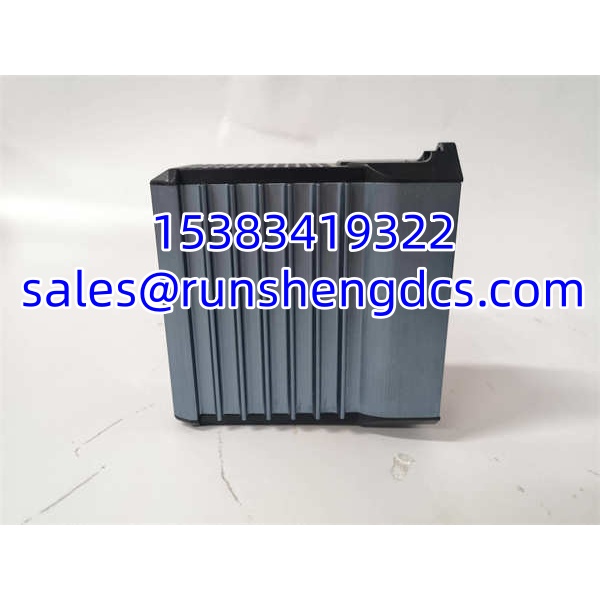
FOXBORO FBM233 P0926GX
Application Scenarios
- Modbus TCP/IP analyzer integration in a refinery: Reads composition data from a process gas chromatograph over Ethernet and writes setpoints back to the analyzer, all mapped into I/A Series DCI blocks for display and interlocking.
- Third-party PLC data exchange in a packaging line: Pulls batch counts, fault codes, and recipe parameters from a standalone PLC into the Foxboro DCS historian and alarm system without a separate OPC gateway server.
- Skid vendor equipment monitoring: Connects to multiple skid-mounted devices (pumps, flow computers, valve controllers) via Ethernet, consolidating their status into the DCS for operator visibility.
FAQ
No. It is an Ethernet communication FBM (FDSI). It does not provide direct analog or discrete field wiring. It talks to external devices over Ethernet and maps their data into DCI blocks.
What protocols does it support?
Protocol support depends on the downloadable driver loaded onto the module. Modbus TCP/IP is a commonly supported driver. Confirm available drivers for your system release with Foxboro/Schneider Electric documentation.
Up to 64 external devices per , performance-dependent. A redundant pair shares the same device list.
Can it do redundancy?
Yes. Two modules can be configured as a primary/tracker pair. If the primary loses heartbeat with a connected device, the tracker takes over automatically.
What controller does it connect to?
It communicates over the redundant 2 Mbps module bus to an FCM100Et, FCM100E, FCP280, or FCP270.
Is the 500 ms scan period fixed?
500 ms is the fastest allowed ECB block period. Actual scan rate depends on driver configuration, device count, and data volume. Do not expect sub-100 ms response.
How do I verify a refurbished unit?
Confirm the loaded driver version, test Ethernet connectivity, verify DCI block reads/writes against a known device, and check redundancy switchover if deployed as a pair.