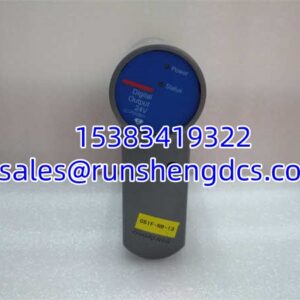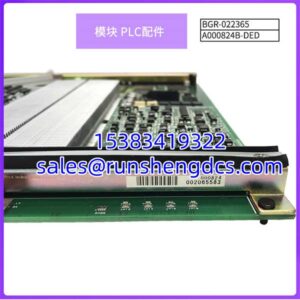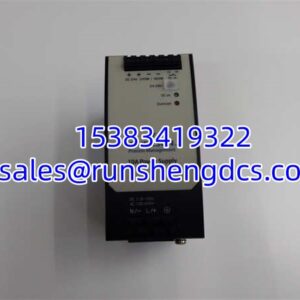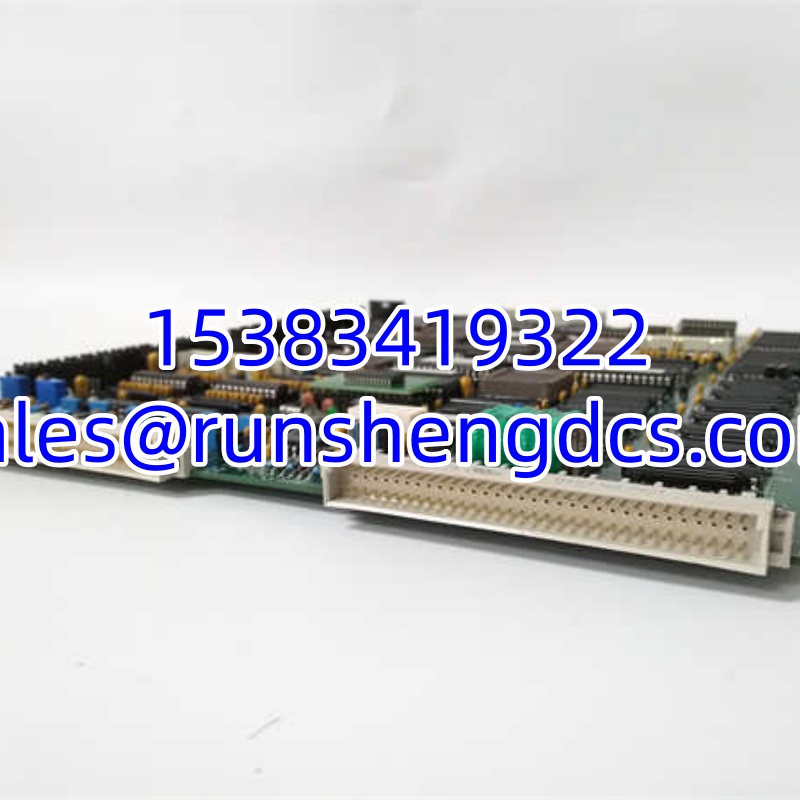
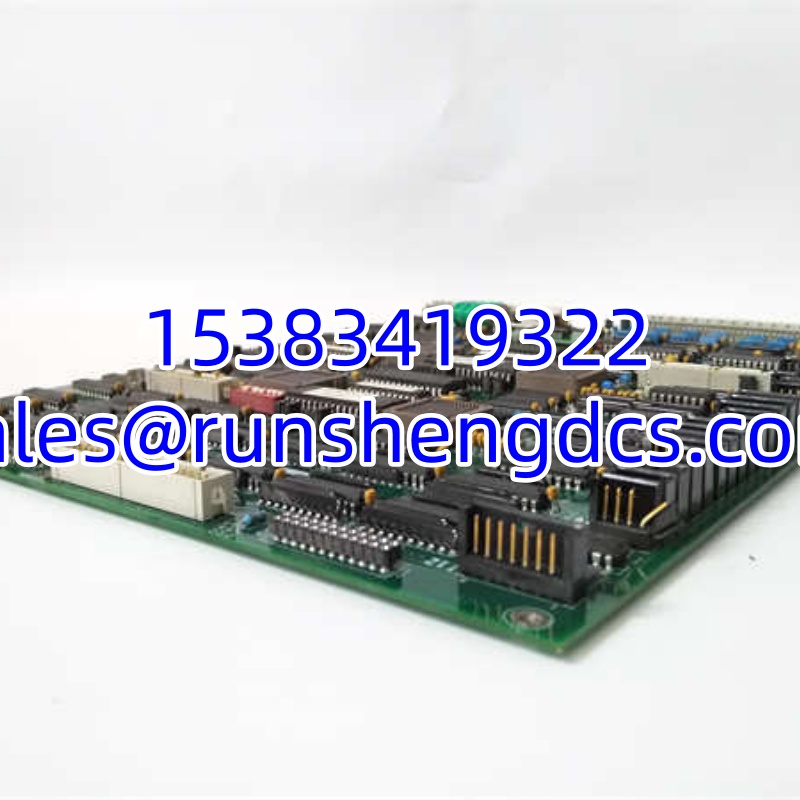

Description
Key Technical Specifications
- Module Type: Encoder Interface / Motion Feedback Processing
- Encoder Compatibility: Incremental encoders, absolute encoders (multi-turn & single-turn)
- Signal Processing: Real-time decoding of encoder pulses into position and velocity data
- Counting Speed: High-speed counting capability for rapid rotation and linear motion applications
- Programming Support: Configurable via dedicated programming software for custom logic and thresholds
- Control Algorithms: Built-in PID control, logic运算, and motion control routines
- Data Acquisition: Analog and digital input sampling from connected sensors and encoders
- Communication Interfaces: Ethernet, serial communication, fieldbus support for integration with上位机 and PLC systems
- Expandability: Modular design allowing connection to additional I/O expansion cards and modules
- Real-Time Performance: High-speed processor optimized for fast response and deterministic control loops
- System Compatibility: Designed for integration with ABB automation platforms and DCS architectures
- Operating Environment: Industrial-grade temperature range, suitable for factory floor deployment
Product Introduction
You’re running a packaging line where the servo drive’s feedback loop keeps drifting after a power cycle. The encoder module is the first thing you grab—and the ELEMASTER IB3110050 is what sits between your high-resolution encoder and the PLC that’s supposed to keep everything on track. It’s not a CPU. It doesn’t run your logic. What it does is take raw pulse trains from incremental or absolute encoders and turn them into clean position and velocity numbers the controller can actually use without second-guessing.
Here’s the thing most datasheets won’t tell you: the IB3110050’s real value isn’t in its specs on paper—it’s in how it handles the messy edge cases. High-speed counting means it won’t drop pulses when your axis accelerates hard. Programmable configuration lets you set thresholds and deadbands so your control loop doesn’t chase noise. And the compatibility with ABB DCS platforms means you’re not stuck building a custom gateway just to read your encoder data. Bottom line—if your motion feedback chain is throwing jitter or losing position data, this module is where you start looking.
Troubleshooting Quick Reference
| Fault Symptom | Probable Cause | Relevancy | Quick Check | Fix |
|---|---|---|---|---|
| Position Drift / Lost Counts | Encoder cable interference or loose connection | High (75%) | Inspect encoder cable connectors; check for shield grounding | Reseat cables; verify shield at single-point ground |
| No Feedback Signal | Encoder power supply failure or module input fault | High (70%) | Measure encoder supply voltage at terminal block | Verify 5V/24V supply; check fuse on encoder line |
| Intermittent Pulse Loss | Cable length exceeding spec or EMI noise | Medium (60%) | Check cable length vs. encoder speed rating; inspect near VFD runs | Shorten cable; add shielding; increase separation from power cables |
| PID Oscillation | Incorrect encoder resolution or scaling factor | Medium (65%) | Verify encoder PPR/CPR settings in programming software | Recalibrate resolution; adjust PID tuning parameters |
| Module Communication Timeout | Ethernet/fieldbus configuration mismatch | Medium (55%) | Check IP address, subnet, and baud rate settings | Reconfigure network parameters; verify cable integrity |
| Overtemperature Warning | Poor ventilation or ambient temp exceedance | Low (30%) | Measure ambient temp near module; check airflow | Improve cabinet ventilation; reduce ambient load |
Application Scenarios & Pain Points
- Packaging Machinery: High-speed servo axes where encoder feedback accuracy determines fill volume consistency. Pain point: Cable fatigue from repeated flexing causes intermittent signal loss. The IB3110050’s noise filtering helps, but cable selection matters more than module specs.
- Textile Manufacturing: Continuous web tension control using rotary encoders on guide rollers. Pain point: Lint and fiber buildup on encoder wheels creates false counts. Module-level signal conditioning can compensate, but physical maintenance is unavoidable.
- Metal Rolling Mills: Position feedback for roll gap control under extreme vibration. Pain point: Mechanical shock degrades encoder coupling over time, causing the IB3110050 to receive jittery signals that no amount of software filtering can fully clean up.
- Wind Turbine Pitch Control: Absolute encoder feedback for blade pitch angle positioning. Pain point: Cold-start behavior—absolute encoders need a reference homing sequence after power loss, and the IB3110050’s configuration must match the encoder’s battery-backed memory protocol.
Field Note: Technician at a bottling plant spent three days chasing a 0.5mm fill-volume variance. Turned out the IB3110050’s encoder scaling factor was set for a 1024 PPR encoder, but the OEM had upgraded to a 4096 PPR unit without updating the module config. Recalibrated through the programming software, variance dropped to acceptable levels. Always check the config before replacing hardware.
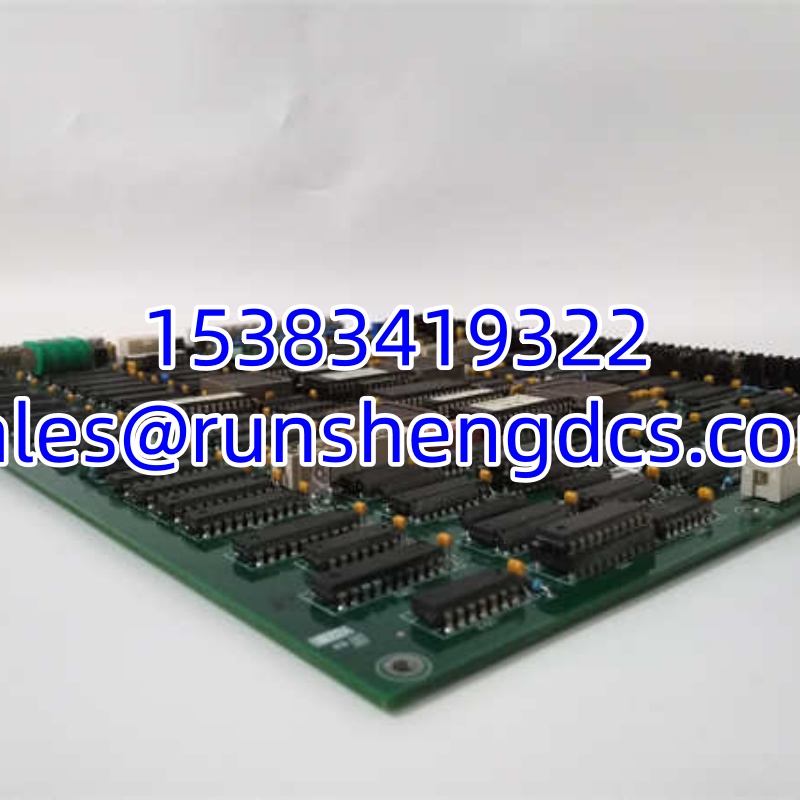
ELEMASTER 3110050
Compatible Replacement Models
- ✅ Drop-in Replacement: (Exact match). Note: Verify revision code (N.132-18/N.143-18, N.145-18/N.105-19, or N.104-19/N.143-18) matches your existing setup. Even identical model numbers can have firmware-level differences. Cost varies (800–3,500) based on supplier and condition.
- ⚠️ Software Compatible: ELEMASTER IB3110250 (Higher-capacity variant). May require reconfiguration of encoder type and channel mapping. Labor: 1-2 hours for config + test. Not a direct swap without verification.
- ❌ Hardware Incompatible: ELEMASTER IB3111500 (Different form factor and I/O architecture). Will not seat in the same rack. Requires mechanical rework and wiring changes. Not recommended.