
Description
Key Technical Specifications
- Product Model: 330103-00-04-10-02-00
- Manufacturer: Bently Nevada
- Product Series: 3300 XL 8mm Proximity Probe
- Tip Diameter: 8 mm
- Measurement Type: Non-Contact Eddy Current (Proximity)
- Linear Range: ±2 mm (4 mm total measurement range)
- Mounting Thread: M10 x 1 Standard Metric
- Recommended Initial Gap: 1.27 mm (-500 mV target)
- Operating Temperature: Up to +177°C (+350°F)
- Connector Type: MIL-C Micro Coaxial
- Required System Components: Extension Cable + Proximitor Transmitter
- Application: Shaft Vibration, Axial Displacement, Eccentricity
Product Introduction
When a 50-ton steam turbine starts vibrating violently at 3 AM, the last thing you want to find is a dead proximity probe. The Bently Nevada 330103-00-04-10-02-00 is the frontline soldier in the 3300 XL 8mm family, designed specifically to survive inside the brutal, oil-misted environment of heavy rotating machinery. By utilizing eddy current technology, it measures shaft movement without ever physically touching the rotor, eliminating mechanical wear and providing continuous, high-fidelity data to the 3500 monitoring frame.
Field technicians rely on this specific probe because of its strict mechanical tolerances and predictable linear range. With a ±2mm linear span, it gives the 330180 proximitor enough headroom to accurately capture everything from micro-vibrations to massive axial shifts during a load transient. It uses a standard M10x1 thread and targets a 1.27mm initial gap. Just be warned: the tip coating is tough, but it is not invincible. If a loose piece of insulation falls into the bearing housing, this probe will get chewed up just like the shaft.
Quality SOP & Tech Pitfalls (The Reality Check)
The Lab Report (SOP):
We don’t just wipe off the grease and ship these. Every Bently Nevada 330103-00-04-10-02-00 goes through a strict validation protocol. First, we inspect the tip under magnification for pitting, scratches, or coating delamination. Next, we test the DC resistance of the coil to ensure it falls within the OEM’s strict tolerance limits. We also check the insulation resistance between the center conductor and the shield to rule out internal moisture damage. Finally, it is sealed in anti-static packaging with a test report.
The Engineer’s Warning (Pitfalls):
Never ignore the extension cable when replacing a probe. I once saw a plant swap in a brand-new 330103 probe, only to have the 3500/42M module throw a “Sensor Open” fault. The old extension cable had been pinched during a previous outage and was slowly failing. Always replace the probe and extension cable as a matched set, or at least test the cable’s continuity first. Also, watch your torque wrench. Over-torquing the M10x1 nut can crack the ceramic tip insulator, causing intermittent faults that drive maintenance teams crazy.
Installation & Configuration Guide
- Pre-Installation: ⚠️ CRITICAL SAFETY STEP. Ensure the machine is locked out and the Bently 330180 proximitor power is OFF. Clean the mounting bracket threads with a tap to remove rust and old threadlocker. Take a photo of the existing cabling routing.
- Removal: Disconnect the micro-coaxial connector. Use a proper wrench to unthread the old probe. Inspect the bracket threads; if they are stripped, fix them before proceeding.
- Installation: SET THE INITIAL GAP EXACTLY. Thread the new Bently Nevada 330103-00-04-10-02-00 in by hand until it bottoms out. Back it off and use a calibrated dial indicator or the OEM gap voltage method to set the target gap to 1.27mm (-500 mV DC). Lock the jam nuts securely.
- Power-On & Testing: Restore power to the proximitor. Check the DC voltage at the transmitter output. It should read exactly -500 mV (±50 mV) at rest. Spin the shaft slowly by hand (if possible) or monitor the live data in System 1 to verify a clean, noise-free waveform.
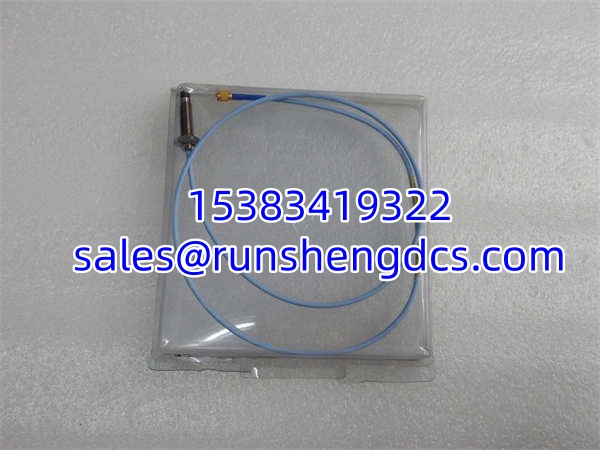
Bently Nevada 330103-00-04-10-02-00
Compatible Replacement Models
| Replacement Model | Compatibility Tier | Notes |
|---|---|---|
| 330103-00-04-10-02-00 | ✅ Drop-in Replacement | Exact same model. Must verify the extension cable length matches the existing 330180 proximitor calibration. |
| 330103-00-05-10-02-00 | ⚠️ Software Compatible | Same 8mm probe family, different cable length/code. Requires verifying the extension cable matches the new probe’s total system length. |
| 330103-00-04-10-02-CN | ✅ Drop-in Replacement | China-manufactured variant for the local market. Hardware and performance are identical, but verify OEM supply chain documentation if required by your facility. |
Frequently Asked Questions (FAQ)
Can I just replace the probe and keep the old extension cable?
Technically yes, but it is a massive gamble. The probe and extension cable form a single tuned electrical circuit. If the old cable has hidden damage, your new probe will read garbage. Best practice is to replace both at the same time.
What happens if I set the initial gap wrong?
If the gap is too tight, the turbine will trip on high vibration the moment you start it. If it is too wide, you will lose the bottom half of your vibration waveform, meaning the 3500 monitor won’t see dangerous rubs or severe axial shifts. Always trust the -500 mV target.
Are these probes sensitive to dirt and oil?
Yes. While the epoxy coating is highly resistant to synthetic lubricants, thick sludge or conductive metal shavings on the tip will alter the eddy current field. During maintenance, gently clean the tip with a cotton swab and isopropyl alcohol. Never use metal scrapers.
Does this probe output a 4-20mA signal directly?
No. The Bently Nevada 330103-00-04-10-02-00 is a passive sensor. It outputs a raw RF signal that must be processed by a 330180 (or similar) Proximitor transmitter. The transmitter is what converts the signal into the 4-20mA or 0-10V signal that goes to your DCS or 3500 rack.
How do I know if the probe is actually bad?
Measure the DC resistance across the center pin and the outer shield at the proximitor end. Compare it to the OEM datasheet value for your specific cable length. If it is open (infinite resistance) or shorted, the probe or cable is dead.