
Description
Key Technical Specifications
| Parameter | Value / Notes |
|---|---|
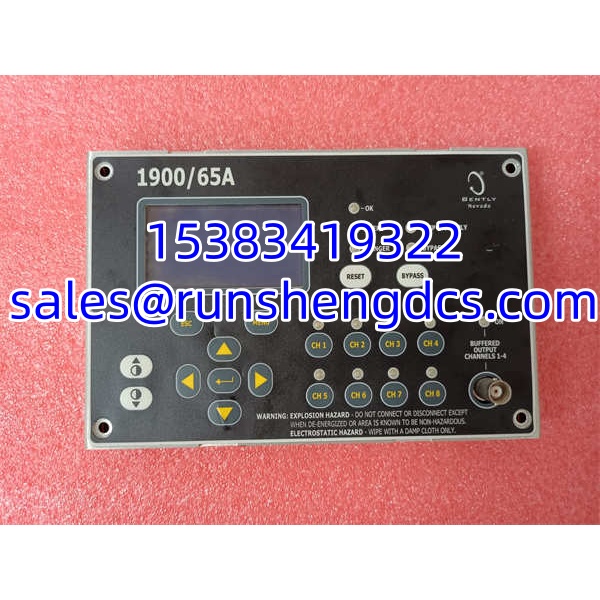
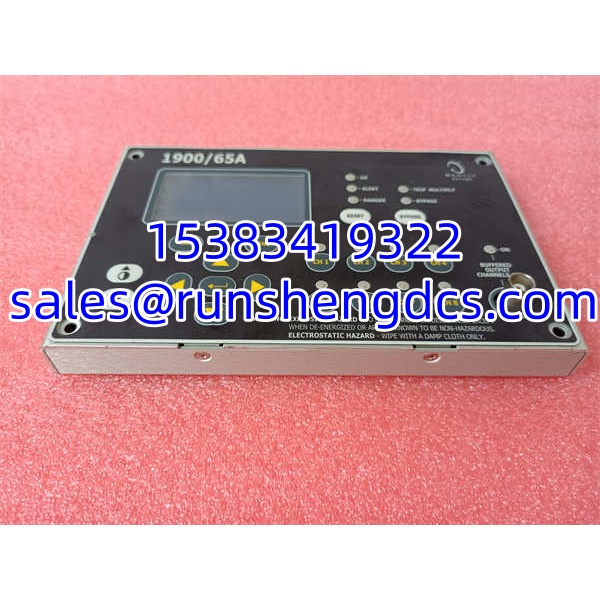
| Product Family | Bently Nevada 1900/65A General Purpose Equipment Monitor |
| Typical Part Format | 1900/65A-AXX-BXX-CXX-DXX-EXX |
| Reference Number | 167699-02 — verify on nameplate; not the full configuration part number |
| Vibration / Sensor Inputs | 4 inputs; software-configurable |
| Temperature Inputs | 4 inputs |
| Relay Outputs | 6 configurable relay outputs |
| Analog Outputs | 4 × 4–20 mA recorder outputs |
| Buffered Outputs | Dedicated buffered sensor outputs available |
| Communication | Optional Modbus gateway; Ethernet and RS232/RS485 support depends on configuration |
| Configuration | PC/laptop configuration software downloaded via Ethernet |
| Mounting | DIN rail or panel mounting, depending on hardware and enclosure option |
| Application | Auxiliary pumps, fans, compressors, motors, gearboxes, and similar rotating equipment |
Product Introduction
A machine that trips on vibration without a clear cause usually forces maintenance into a guessing game: bad sensor, wrong scaling, failed relay output, missing 4–20 mA signal, or a monitor that no longer matches the configuration file. The Bently Nevada 1900/65A sits in front of that problem as a compact, standalone equipment monitor. It takes vibration and temperature signals, evaluates alert and danger conditions, and drives relays, analog outputs, and optional Modbus data back to the control system.
Its practical value is protection without the footprint and cost of a full rack-based machinery protection system. The 1900/65A is commonly used on auxiliary machines where continuous monitoring and automatic shutdown logic are needed, but a larger 3500-style system would be excessive. Bottom line — it works well as a verified spare for an existing 1900/65A installation, but only if the power option, communication option, sensor types, relay logic, and configuration file actually match the machine.
QA/QC Transparency SOP
- Intake & Origin Verification
Confirm the nameplate shows Bently Nevada / GE Bently Nevada, the 1900/65A product family, the full configuration part number if present, the 167699-02 reference if marked, serial number, hardware/firmware revision, and power/communication options. Photograph the front panel, rear connectors, sensor terminals, relay terminals, and Ethernet/serial ports. Reject units with mismatched labels, missing nameplates, or physical damage. - Live Functional Testing
Apply the correct power supply only after confirming the unit’s rated input. Verify that the monitor boots, displays or reports channel status, and does not latch in fault. If possible, simulate vibration or temperature inputs and confirm that alert/danger thresholds, relay states, and 4–20 mA outputs respond as expected. - Electrical Parameter Tests
Check relay contact continuity, 4–20 mA output loop integrity, buffered output signal presence, and sensor input continuity. Use a multimeter or loop tester where applicable. Inspect terminals for corrosion, burnt traces, cracked housings, loose screws, or damaged connector pins. - Firmware/Config Verification
Connect through the Ethernet or serial port and read the firmware version, channel configuration, sensor types, temperature input types, alarm setpoints, relay logic, Modbus mapping, and time/date settings. Back up the existing configuration before making changes. Do not assume a surplus 1900/65A is pre-configured for your machine. - Final QC & Anti-Static Packaging
Inspect the enclosure, mounting hardware, connectors, and terminal blocks. Pack the monitor in anti-static material with rigid protection for connectors and terminals. Include the serial number, configuration status, firmware revision, test status, and a note that installation must follow site LOTO, sensor wiring, and relay safety procedures.
Field Engineer Gotchas
Full configuration part number mismatch
Risk: The unit powers up, but channels, relays, or communication do not behave like the old monitor.
Fix: Compare the full 1900/65A-AXX-BXX-CXX-DXX-EXX code, not just “1900/65A” or “167699-02.”
Blunt warning: Two 1900/65A monitors can look identical and still have different power, display, or Modbus options.
Sensor type configured wrong
Risk: Vibration readings are unstable, too high, too low, or show open-circuit faults.
Fix: Confirm whether each input is a proximity probe, velocity sensor, or accelerometer, and whether it is 2-wire or 3-wire.
War story: A replacement 1900/65A showed erratic vibration on a fan bearing. The old configuration expected a proximity probe; the field sensor was a velocity transducer. The hardware was fine. The input type was wrong.
Thermocouple vs. RTD confusion
Risk: Temperature channels read wildly or fail outright.
Fix: Confirm whether the field device is E, J, K, T thermocouple, or a 2-wire/3-wire RTD, then match the channel configuration.
Bottom line: Temperature input errors are one of the fastest ways to make a “new” monitor look defective.
Modbus mapping does not match the DCS/PLC
Risk: The monitor works locally, but the DCS sees zero, wrong units, or stale values.
Fix: Verify Modbus register mapping, IP settings, baud rate/serial settings, and DCS scaling.
Blunt warning: Modbus communication can be correct electrically and still be useless if the register map changed.
Relay logic not restored after replacement
Risk: The monitor shows healthy channels, but the trip circuit does not operate.
Fix: Verify relay assignment, OK/Alert/Danger logic, de-energize vs. energize logic, and external trip wiring.
Reality check: A 1900/65A replacement can pass every bench test and still fail in service if the relay voting logic is wrong.
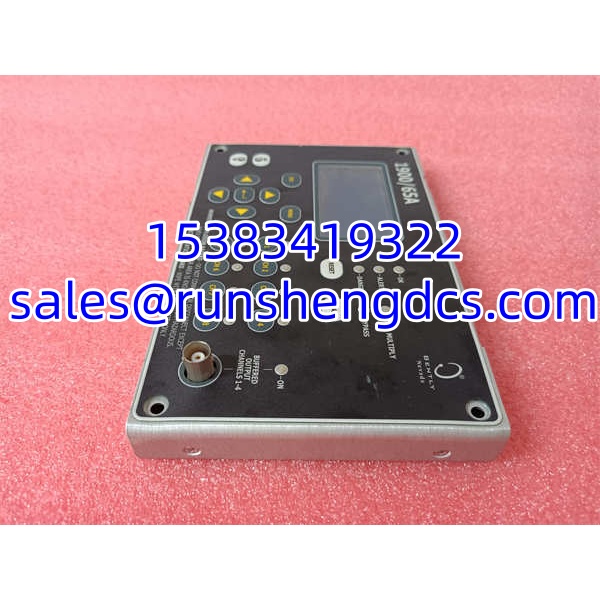
BENTLY 1900-65A 167699-02
Application Scenarios
- Auxiliary pump vibration and bearing temperature protection, where continuous monitoring is needed but a full rack-based machinery protection system is not justified.
- Fan and blower monitoring in power, cement, steel, or chemical plants, where vibration, casing temperature, and trip relays must be available to the DCS.
- Compressor auxiliary systems, where proximity probes, velocity sensors, or temperature inputs feed local alarm logic and remote SCADA/PLC displays.
- Motor-driven rotating equipment with bearing temperature and vibration protection requirements, especially on non-critical or balance-of-plant machines.
- Legacy 1900/65A spare replacement, where a failed monitor must be swapped without redesigning the sensor wiring, relay logic, or Modbus integration.
Anonymized case study
A chemical plant replaced a failed 1900/65A monitor on a cooling-water pump. After installation, the DCS showed zero vibration on all channels, even though the pump was running. Maintenance assumed the replacement monitor was defective. The actual issue was configuration: the new monitor had not been loaded with the correct sensor types, and the 4–20 mA outputs were not mapped to the same variables as the old unit. After uploading the correct configuration, verifying the sensor input types, and checking the Modbus mapping, the DCS readings matched the field instruments. The monitor was not faulty; the configuration was incomplete.
FAQ
Is 167699-02 the full part number for a 1900/65A?
No. 167699-02 appears to be a Bently Nevada material or assembly reference. The full monitor configuration is normally expressed as 1900/65A-AXX-BXX-CXX-DXX-EXX. Verify both on the nameplate before ordering or installing.
What inputs does the 1900/65A accept?
It typically provides 4 vibration/sensor inputs and 4 temperature inputs. The sensor inputs can usually be configured for proximity, velocity, or acceleration sensors. The temperature inputs typically support E, J, K, and T thermocouples, plus 2-wire or 3-wire RTDs.
Does this unit support Modbus?
Modbus is typically available as an option on the 1900/65A, often through Ethernet and/or RS232/RS485. Confirm whether the specific unit has the Modbus gateway option before assuming it will communicate with a DCS, PLC, or SCADA system.
Can I use a surplus 1900/65A without reconfiguration?
Not safely. A surplus unit may contain old setpoints, wrong sensor types, incorrect relay logic, or an incompatible Modbus map. Back up the existing configuration first, then verify the replacement before returning the machine to service.
Is the 1900/65A a replacement for a 3500 module?
No. The 1900/65A is a standalone general-purpose monitor. It is not a 3500 rack module and is not directly interchangeable with 3500-series hardware.
What power supply does it need?
Power depends on the configuration option. Some 1900/65A units use 18–36 VDC, while others use an external 110/220 VAC supply. Do not energize the unit until the exact power option is confirmed from the nameplate or configuration code.
Will this work for critical machinery protection?
It can be used for equipment monitoring and protection where the 1900/65A is the specified or approved device. For highly critical rotating machinery, confirm whether the site standard requires a higher-level machinery protection system such as Bently Nevada 3500 or an equivalent approved platform.