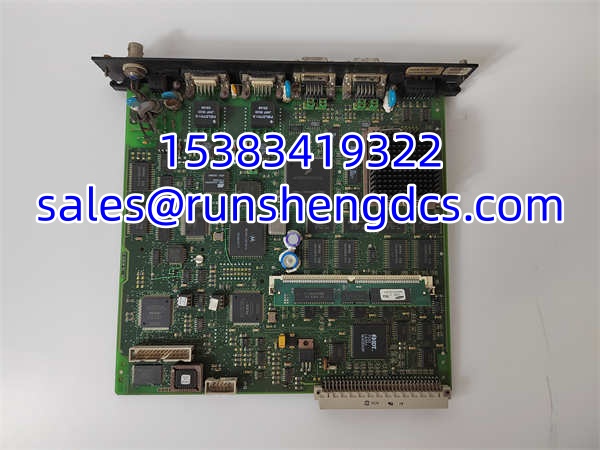

Description
Key Technical Specifications
| Parameter | Value |
|---|---|
| Product Model | ALSTOM UT150-1 |
| Manufacturer | ALSTOM (GE Vernova legacy) |
| Product Type | Control processor / WorldFIP network coupling module |
| Host System | CE2000 field controller |
| Network Protocol | WorldFIP (F8000 network) |
| Bus Speed | 1 Mbps |
| Media | Copper |
| I/O Management | Up to 16 I/O modules |
| Local Processing | TRX local control functions |
| Documented HW Revision | D |
| Documented Firmware | R13.00 (other revisions may exist) |
| Typical Application | Power generation, process control, substation automation |
Product Introduction
Legacy ALSTOM control systems do not fail gracefully when a coupling module is swapped without checking firmware. The ALSTOM UT150-1 sits between the CE2000 controller and the F8000 WorldFIP network, translating controller commands into 1 Mbps copper-bus traffic while managing up to 16 downstream I/O modules. It also handles local TRX control processing, so it is not just a passive network adapter.
This module matters in plants still running ALSTOM CE2000/F8000 architectures where OEM spares are scarce. Firmware R13.00 is documented as removing periodic static and dynamic memory parity checks that could trigger CPU crashes, which is a meaningful stability change if your existing fleet runs an older revision. Bottom line — confirm HW revision D and firmware before installing it into a live bay.
QA/QC Transparency SOP
Intake and origin verification: Record the full model ALSTOM UT150-1, hardware revision, firmware version, serial number, and any CE2000/F8000 system labels. Photos are taken before power-up.
Live functional testing: The module is powered on a compatible test bench and checked for normal boot, LED status, and WorldFIP bus activity. TRX local logic execution is verified where test fixtures allow.
Electrical parameter tests: Backplane contacts, bus termination, and I/O module interface pins are checked for continuity and insulation resistance. Power rails are measured under load.
Firmware and configuration verification: Hardware revision and firmware are read out. R13.00 is documented for improved memory handling; any other revision is flagged against the site baseline.
Final QC and anti-static packaging: After testing, the ALSTOM UT150-1 is sealed in anti-static packaging with test notes. Confirm the CE2000 project configuration before placing it in service.
Field Engineer Gotchas
Firmware revision mismatch: R13.00 removes periodic memory parity checks that could crash the CPU. Dropping an older-revision module into a system that expects R13.00 behavior — or vice versa — can cause intermittent faults that look like hardware failure. Read the firmware label before swapping.
WorldFIP bus termination: A 1 Mbps copper WorldFIP segment is sensitive to missing or incorrect terminators. An unterminated drop can cause cyclic communication loss across multiple I/O modules, not just the local one.
I/O module count mismatch: The UT150-1 manages up to 16 I/O modules. If the CE2000 configuration expects more than the installed module can address, some points will remain offline without a clear alarm.
TRX local logic conflicts: Since the module handles local TRX processing, uploading a new project without reconciling local logic can cause unexpected interlock behavior. Back up the existing configuration first.
Power and ESD handling: This is a legacy control processor, not a plug-and-play Ethernet card. Handle it with proper ESD precautions and verify auxiliary supply voltage before insertion.

ALSTOM UT150-1
Application Scenarios
controller replacement in a power plant: The UT150-1 restores WorldFIP coupling for an existing station where the original module has failed and OEM lead times are unacceptable.
F8000 network expansion: Adding a new I/O segment requires a verified coupling module that can manage 16 downstream modules without exceeding bus timing limits.
Legacy substation or process control retrofit: Plants still running ALSTOM /F8000 architectures use the to maintain WorldFIP communication while migrating higher-level monitoring systems.
Anonymized case note: A power plant replaced a failed coupling module with a surplus . The bus came up, but several I/O points remained offline. The root cause was a firmware mismatch — the replacement ran an older revision that handled memory parity differently from the site baseline. After loading the correct firmware and verifying the project, all 16 I/O modules returned to normal.
FAQ
What does the ALSTOM actually do?
It couples a controller to the WorldFIP network at 1 Mbps over copper, manages up to 16 I/O modules, and handles local TRX control processing.
Is this a relay or a controller?
Neither, exactly. It is a control processing and network coupling module within the ALSTOM / system.
Can I use any firmware revision?
Not safely. R13.00 is documented with specific memory handling changes. Match the firmware to your site baseline unless you have OEM approval to upgrade.
Does it support Ethernet or Modbus?
No. It uses WorldFIP at 1 Mbps over copper. Do not confuse it with an Ethernet gateway.
How many I/O modules can it manage?
Up to 16 I/O modules.
Is this still an OEM-supported product?
ALSTOM protection and control assets are now under GE Vernova. Availability is typically through surplus or refurbished channels. Verify hardware revision and firmware before purchase.
Will this work in a non-ALSTOM system?
No. It is designed for the / architecture. It is not a universal fieldbus adapter.