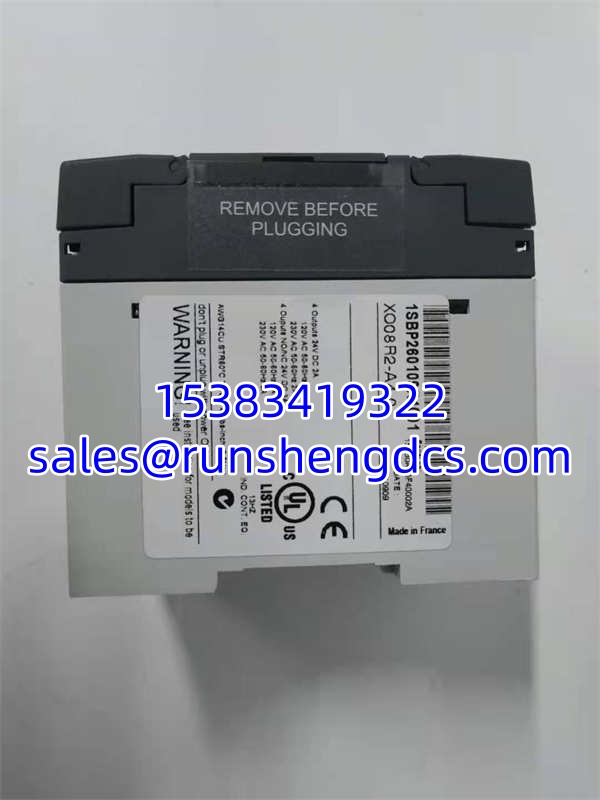

Description
Product Introduction
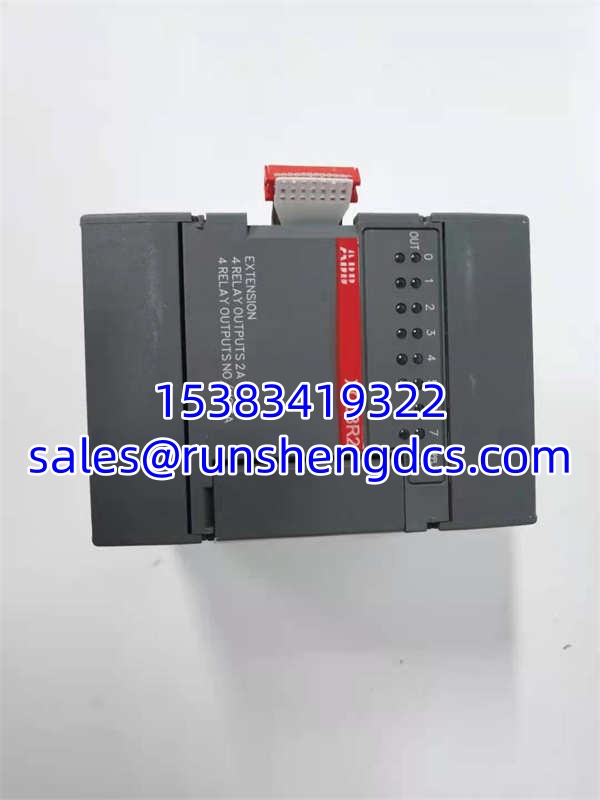
The ABB XO08R2 (1SBP260109R1001) is a high-performance relay output module designed for demanding industrial automation and process control applications. In plain terms, it acts as the muscle for your control logic, taking low-power signals from a PLC or controller and using its four independent relay channels to switch higher-power loads like motor starters, solenoid valves, or indicator lights.
What makes this module a reliable choice is its robust construction and versatility. Each of the four outputs provides both Normally Open (NO) and Normally Closed (NC) contacts, giving you maximum wiring flexibility. It’s rated for both 24V DC and 230V AC loads at 2A, making it a true universal output module. The modular design and optimized heat dissipation ensure it can run continuously in harsh plant environments without breaking a sweat.
Key Technical Specifications
| Parameter | Specification |
|---|---|
| Product Type | Relay Output Module |
| Part Number | 1SBP260109R1001 |
| Model Designation | XO08R2 |
| Number of Outputs | 4 Independent Relay Outputs |
| Contact Type | Form C (NO/NC) |
| DC Load Rating | 24V DC, 2A (or 3A per some specs) |
| AC Load Rating | 120V/230V AC, 60Hz, 2A (or 3A) |
| Wire Size | Up to AWG 14 CU |
| Terminal Torque | 4.6 lbs-Inch (0.6 Nm) |
| Protection Features | Over-current Protection |
| Communication | Supports EtherNet, Profibus (when integrated) |
| Safety Warning | Do not plug or unplug with power ON |
Compatibility & Replacement Matrix
- ABB XO08R2 (1SBP260109R1001) → ABB XO08R2 (1SBP260109R1001) : Direct Replacement — Identical part number, plug-and-play.
- ABB XO08R2 → ABB XO08R1 : Needs Adaptation — Likely a previous hardware revision. Functionally similar, but verify the exact contact ratings and physical dimensions before substituting.
- ABB XO08R2 → ABB Digital Output Module (e.g., DO810) : Incompatible — A standard digital output module uses transistors (solid-state) and cannot switch AC loads or handle the same inductive loads as a relay. They are not interchangeable.
- ABB XO08R2 → Third-Party 4-Channel Relay Module : Needs Adaptation — While functionally similar, the physical form factor, backplane connector, and communication protocol will not match. This is not a direct drop-in replacement.
Quality Inspection & SOP Transparency
Relay modules are mechanical and electrical components, so we test both aspects:
- Incoming Inspection: We verify the part number (1SBP260109R1001) and perform a visual inspection for any physical damage, especially to the relay sockets and the screw terminals. We also check for any signs of arcing or overheating on the contacts.
- Live Functional Test: We install the module into a compatible ABB control rack. Using the system’s configuration software, we force each of the four relay outputs to energize and de-energize.
- Contact Verification: We use a multimeter to verify continuity across the NO and NC contacts for each channel, ensuring the relay is switching correctly and that there is no welding or sticking.
- Load Test: We apply a test load (within the 2A/3A rating) to verify the relay can handle the specified voltage and current without excessive voltage drop or heating.
- Final QC & Packaging: After passing functional validation, we seal the module in an anti-static bag and pack it in a shock-absorbent carton to protect the relays and terminals during transit.
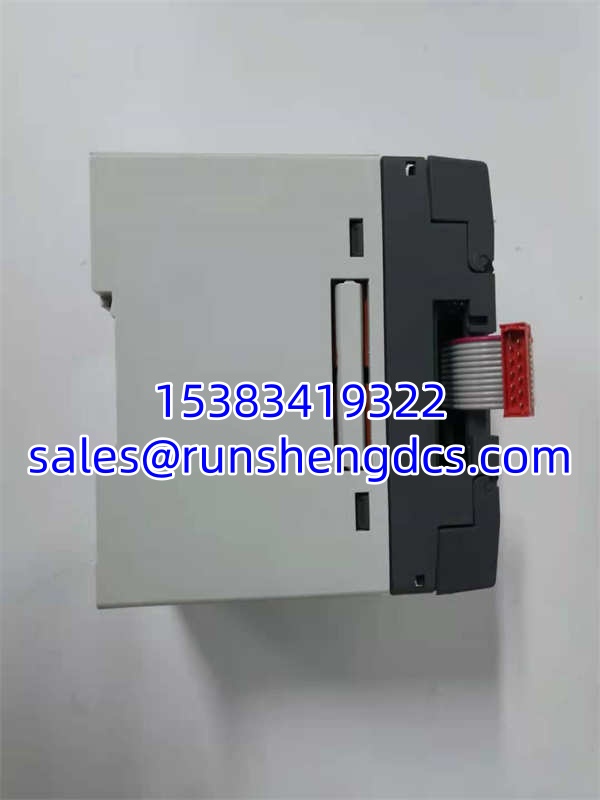
ABB 1SBP260109R1001 XO08R2
Common Replacement Pitfalls
- ❗ Hot-Swapping Danger: The module’s label explicitly warns: “Do not plug or unplug with power ON.” Unlike some solid-state I/O modules, this relay module is not designed for hot-swapping. Always power down the rack before replacing it to prevent arcing, which can damage the backplane or the new module.
- ❗ Inductive Load Suppression: If you are switching inductive loads (like motor contactors or solenoids), you must use appropriate suppression circuits (like RC snubbers or flyback diodes). Without them, the arcing will rapidly degrade the relay contacts and lead to premature failure.
- ❗ Terminal Torque: The specified terminal torque is 4.6 lbs-Inch (0.6 Nm). Overtightening can strip the threads or crack the terminal block, while undertightening can lead to high-resistance connections, overheating, and potential fire hazards. Always use a calibrated torque screwdriver.
- ❗ Total Current Load: While each relay is rated for 2A or 3A, always check the module’s total current rating. You cannot have all four relays switching a 3A load simultaneously if the module’s internal bus is only rated for, say, 8A total.
FAQ
Q: Can I hot-swap this relay module while the system is running?
A: No. The module carries a clear warning: “Do not plug or unplug with power ON.” You must perform a controlled shutdown of the I/O rack before replacing this module to avoid electrical arcing and damage.
Q: What is the difference between the 2A and 3A ratings I see?
A: The module’s label lists both 2A and 3A ratings for its DC and AC loads. This can depend on the specific safety certifications (like UL) and the type of load (resistive vs. inductive). For critical applications, always design your load to stay within the more conservative 2A rating to ensure maximum relay life and safety.
Q: Does this module have built-in protection?
A: Yes, the includes built-in over-current protection to enhance system safety and stability. This helps protect the module and the backplane in the event of a short circuit or overload on one of the output channels.
Q: Can this module communicate over Profibus?
A: The itself is an output module. When integrated into an ABB automation system, it communicates over the backplane. The Profibus or EtherNet communication is handled by the main controller or a dedicated communication adapter module in the same rack.
Q: How do I know if a relay is faulty?
A: Common signs include the output LED being on but the load not energizing (indicating welded or burnt contacts), a clicking sound without a state change (indicating a stuck armature), or the system reporting an output fault. You can also use a multimeter to check for continuity across the contacts when the relay is commanded on.