
Description
Key Technical Specifications
| Parameter | Value |
|---|---|
| Manufacturer | ABB |
| Product Line | Advant OCS / Control Systems |
| Module Type | Redundant 5V Regulator (SR511) |
| Part Number | 3BSE000863R1 |
| Input Voltage | 18-30V DC |
| Output Voltage | 5V DC (Regulated) |
| Output Current | 35A Max |
| Max Power | 310W |
| Architecture | Internal Redundancy (Parallel Operation) |
| Dimensions | 117mm x 243mm x 54mm |
| Weight | 1.6 kg |
| Mounting | Standard DIN Rail |
Product Introduction
When the 5V logic rail in a DCS or PLC rack drops, the entire chassis doesn’t just glitch; it dies. The ABB SR511 3BSE000863R1 is the “heart transplant” for Advant OCS systems, designed to keep the CPU and I/O modules alive even if one internal power path fails. It’s a redundant 5V regulator that runs two supplies in parallel, so if one burns out, the other takes the full load without the controller ever noticing.
We stock the ABB SR511 3BSE000863R1 because this is legacy gear, and OEM lead times for obsolete power modules can stretch into months or disappear entirely. This module is the difference between a 4-hour nuisance trip and a catastrophic plant shutdown. It’s heavy (1.6kg) for a reason: massive capacitors and heat sinking. Just verify your rack backplane pins before slamming it in; old Advant racks can have corrosion that mimics a bad power supply.
QA/QC Transparency SOP
- Intake & Origin Verification: We trace the ABB SR511 3BSE000863R1 to its decommissioned site. Visual inspection focuses on the output capacitors (checking for bulging/leakage) and the DIN rail locking mechanism integrity.
- Live Functional Testing: The module goes on a dedicated Advant test rack. We verify the 5V output stability under load and, crucially, test the redundancy switchover by simulating a primary path failure.
- Electrical Parameter Tests: Using a Fluke 115, we measure output ripple voltage and load regulation. Isolation resistance between input DC and output 5V is verified to ensure no ground loops.
- Firmware/Config Verification: While mostly analog, we check for any internal status LEDs or diagnostic flags that indicate internal fault history. Part number suffixes are cross-referenced with the label.
- Final QC & Anti-Static Packaging: After passing, it gets a test sheet, anti-static bag, and desiccant. If the redundancy test fails, it’s scrapped. No “as-is” sales on redundant power.
Field Engineer Gotchas
- Redundancy Switchover Shock: The ABB SR511 3BSE000863R1 is designed for takeover, but aged electrolytic capacitors can cause voltage dips during the transition. Risk: CPU reboot during the switchover test. Fix: Test the redundancy switchover during a planned maintenance window, not during a live fault simulation. I’ve seen a “perfect” bench test fail in the field because the caps couldn’t handle the transient load step.
- Backplane Pin Corrosion: Advant racks are old. Risk: Intermittent 5V loss or arcing. Fix: Inspect the backplane connector pins on the rack before installing the new ABB SR511 3BSE000863R1. If they look green or pitted, clean them or replace the backplane. A new power module won’t fix a corroded bus.
- DIP Switch/Jumper Settings: Some variants have jumpers for output voltage trim or redundancy enable/disable. Risk: Installing the module with factory defaults that don’t match your rack config. Fix: Photograph the jumper settings on the old board before removal. I once swapped a unit and forgot the “Redundancy Enable” jumper was removed on the old board (single supply config); the new board fought the existing supply and tripped the breaker.
- Thermal Paste/Heatsink: These run hot. Risk: Overheating in enclosed cabinets. Fix: Check the thermal interface between the regulator and the chassis/heatsink. If it’s dry or cracked, re-apply thermal compound. Don’t just bolt it down and hope.
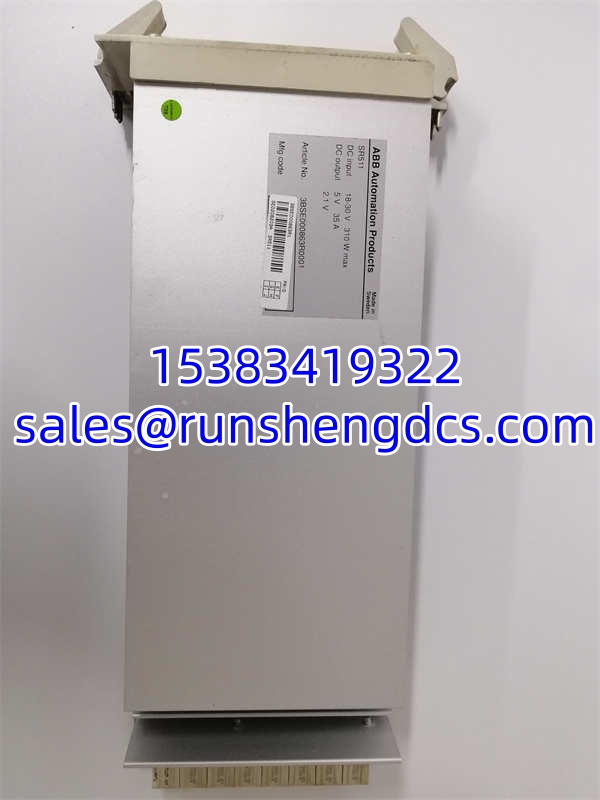
ABB SR511 3BSE000863R1
Application Scenarios
- Legacy DCS Racks: Powering CPU and I/O modules in 20+ year old Advant OCS installations in refineries and power plants.
- Critical Infrastructure: Water treatment and municipal control systems where 24/7 uptime is mandatory and upgrades are budget-prohibitive.
- Manufacturing Lines: Automotive assembly robots controlled by older ABB PLCs requiring stable 5V logic for motion control.
- Case Study: A chemical plant had intermittent CPU resets on a critical reactor controller. They replaced the CPU, then the I/O, then the backplane. Finally, they swapped the . The problem vanished. The old power supply had a failing internal diode that only dropped voltage during high-current transients. Bottom line — always suspect the power supply first in legacy systems.
FAQ
Is the 3BSE000863R1 compatible with P3BSE000863R1?
Yes. The is generally backward compatible with the P3BSE000863R1 and 3BSE000863R0001 variants. However, always verify the physical keying and jumper settings on your specific rack.
Does this support hot-swapping?
Mechanically, yes. Electrically, no. The is not designed to be pulled while the rack is live. Pulling it can arc the backplane pins or cause a voltage collapse. Plan a shutdown.
Why is my 5V rail reading 4.95V?
Check the load. If you’re near the max current rating (35A), voltage drop is normal. Also, check the backplane connections. A 50mV drop across a corroded pin is enough to cause logic errors. Measure at the CPU module, not just at the power supply.
Can I use a standard 5V PSU instead?
No. The has specific redundancy logic and form-factor connectors for the Advant backplane. A generic DIN-rail supply won’t fit or communicate the redundancy status.
How do I know if the redundancy is working?
Most Advant racks have a “Power Fail” or “Redundancy Fail” LED on the front panel or CPU. You can also monitor the status bit in the PLC logic. If you don’t have a way to verify, assume it’s not working until proven otherwise.
Is this obsolete?
Yes. The is a legacy part. Stock is finite. If you have a critical system running this, buy a spare now. Waiting for a failure is a gamble you will likely lose.
How do I know if it’s truly tested?
Ask for the redundancy test report. If the seller can’t show you a load step test or a switchover verification, walk away. Redundant power supplies are safety-critical. “Tested” is a marketing word; data is engineering.