
Description
Key Technical Specifications
- Product Type: 12SU Subrack (with BB510 backplane)
- System Compatibility: ABB Advant Controller 450 (AC450) / Industrial IT DCS
- Slot Count: 12 slots (12SU), accommodating CPU, AI/AO, DI/DO, communication cards, and other AC450 series modules
- Backplane Bus: Integrated BB510 high-speed parallel backplane bus for data, address, and control signal transmission between modules
- Power Supply: Compatible with AC450 system 24VDC power
- Operating Temperature: -40°C to +70°C
- Dimensions (W × H × D): Approximately 482 × 132 × 250 mm (19-inch standard rack size)
- Weight: Approximately 16 kg
- Enclosure Material: Metal housing with electromagnetic shielding capability
- Mounting Method: Supports DIN rail mounting or screw mounting
- Communication Protocol Compatibility: Integrates with ABB System 800xA; supports MODBUS, Profibus, MasterBus 300, and other protocols (depending on installed modules)
- Origin: Sweden (ABB Automation Products)
- Availability: Discontinued / Legacy product — surplus and secondary market only
Product Introduction
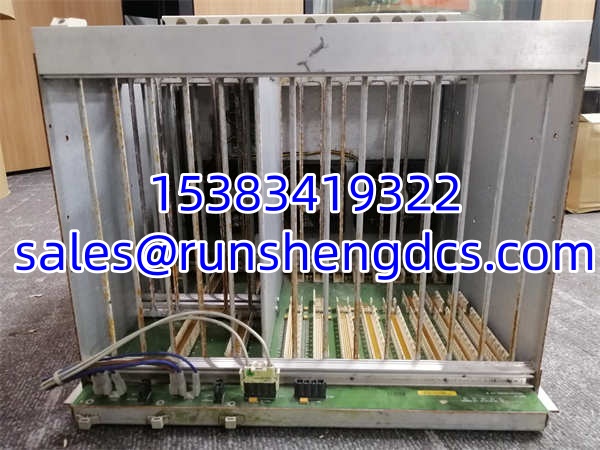
You are troubleshooting an AC450 control station fault. Every CPU and I/O module in the rack has lost communication. The problem might not be any individual card — it could be the subrack itself. The RF533 (3BSE014227R1) is ABB’s 12-slot subrack for the AC450 DCS system, with an integrated BB510 backplane bus. It provides physical mounting, backplane signal interconnection, and power distribution for all inserted modules.
It is not a PLC module. It is not an I/O card. The “RF” in the name has nothing to do with radio frequency — RF533 is purely a rack model designation. Think of it as the DCS system’s motherboard: 12 slots carry CPUs, analog/digital I/O, communication cards, and other modules. The BB510 backplane handles high-speed parallel data exchange between them, while distributing 24VDC system power to each slot. The metal enclosure provides electromagnetic shielding, and it fits a standard 19-inch rack. This product is discontinued. Supply depends entirely on surplus and secondary market channels. Since it is the physical foundation of the entire control station, a backplane bus failure or power distribution circuit fault affects the whole rack — making spare parts inventory critical for plants still running AC450 systems.
Troubleshooting Quick Reference
| Fault | Likely Cause | Quick Check | Fix |
|---|---|---|---|
| All modules in rack unresponsive | Backplane power distribution circuit failure or 24VDC input interruption | Measure backplane power terminal voltage with a multimeter; confirm 24VDC is present | Check upstream power supply and fuses; if voltage is present at backplane but modules remain unresponsive, backplane failure is likely |
| Modules in specific slots cannot communicate | Backplane bus contacts for those slots are oxidized or damaged | Swap a known-good module into the suspect slot; observe whether communication restores | Clean backplane contacts; if communication still fails, that slot may be permanently damaged |
| Modules dropping offline intermittently | Poor module-to-backplane contact or loose installation | Verify modules are fully inserted and locked; gently push modules and watch for communication recovery | Reseat modules and ensure locking mechanisms are engaged; inspect backplane connector pins for bending |
| Communication errors from electromagnetic interference | Poor enclosure grounding or shielding failure | Check that the rack ground wire connection is secure; measure ground resistance | Tighten ground connections; confirm metal enclosure is intact with no damage |
| Complete backplane bus failure | Internal PCB trace breakage or component aging on the backplane | Visually inspect backplane for burn marks or bulging components; measure continuity of key bus signals | Backplane-level faults are generally not field-repairable — full subrack replacement is required |
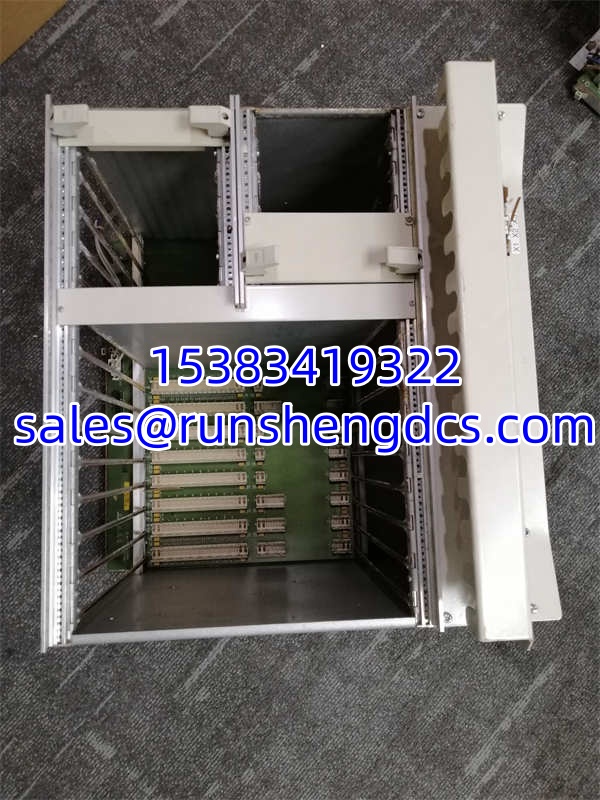
ABB RF533 3BSE014227R1
Application Scenarios & Pain Points
- Power plant DCS control stations: systems are widely deployed in thermal, hydro, and combined-cycle power plants for process control. The RF533 serves as the core mounting base for the control station, carrying controllers and I/O modules. A backplane failure means the entire control station goes dark — unacceptable downtime risk for an online unit.
- Oil, gas, and petrochemical process control: Refineries and chemical plants rely on control stations with RF533 subracks to carry safety interlock and process regulation modules. The pain point is sourcing — this product is discontinued, surplus inventory is thin, and lead times are unpredictable.
- Water treatment and metallurgy: These process industries also operate large installations. When an RF533 rack develops a backplane bus fault, all mounted modules go offline simultaneously — making diagnosis difficult. Engineers must determine whether the root cause is a single module failure or a backplane-level problem.
- System lifecycle management: Many plant systems have been running for over 15 years. Backplane connector aging and contact oxidation are gradual issues, often surfacing only during a maintenance window. Best practice is to perform visual inspection and cleaning of backplane contacts during every planned shutdown.