
Description
Key Technical Specifications
| Parameter Name | Parameter Value |
|---|---|
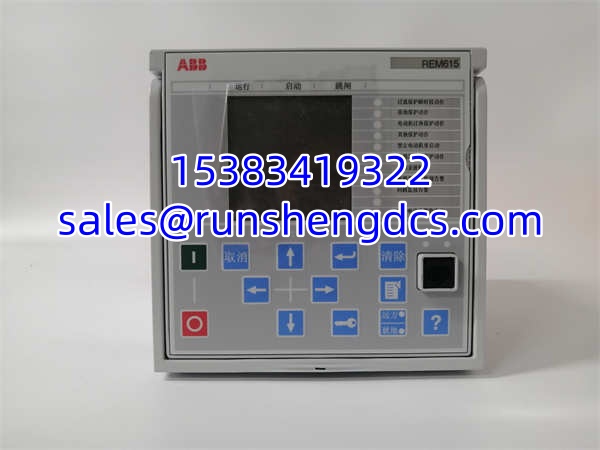
| Product Model | REM615 HCMJAEADABC2BNN11E |
| Manufacturer | ABB |
| Product Series | Relion® 615 |
| Communication Protocols | IEC 61850, Modbus, DNP3, IEC 60870-5-103 |
| Protection Functions | Thermal Overload, Stall, Unbalance, Ground Fault |
| Measurement | Voltage, Current, Power, Energy, Frequency |
| Operating Temp | -20°C to +60°C |
| Humidity | 5% – 95% (non-condensing) |
| Protection Class | IP54 (Front), IP20 (Rear) |
| Dimensions | 144mm x 144mm x 120mm (Flush Mount) |
| Power Supply | 24-250V DC/AC (Universal) |
| Certifications | UL, CSA, CE, IEC |
Product Introduction
Motor protection relays are the first line of defense against catastrophic winding failures, but legacy units often fail to communicate with modern SCADA systems. The ABB REM615 HCMJAEADABC2BNN11E solves this by integrating IEC 61850 and Modbus into a single, compact chassis, eliminating the need for external protocol gateways. It’s not just a trip unit; it’s a full motor management node that handles start-up supervision, thermal modeling, and real-time monitoring.
Engineers trust the Relion 615 platform because it actually delivers on the “integrated” promise without requiring a PhD in configuration. With a built-in web HMI and support for PRP/HSR redundancy, it maintains uptime even when the network hiccups. Bottom line: if your motor trips and you can’t see why on the SCADA screen, you’re flying blind. This relay gives you the data, the protection, and the comms in one box that still fits in the existing cutout.
QA/QC Transparency SOP
We don’t just flash the LEDs and ship. Every REM615 HCMJAEADABC2BNN11E undergoes a rigorous five-step validation to ensure it won’t fail during a motor start:
- Intake & Origin Verification: We trace the serial number against ABB production records to filter out high-quality counterfeits. Visual inspection checks for cracked display screens, corroded terminal blocks, or missing configuration stickers.
- Live Functional Testing: Module is mounted on a live Relion test bench. We inject secondary current/voltage to verify thermal overload curves, start-up supervision logic, and trip outputs.
- Electrical Parameter Tests: Fluke 115 verifies the universal power supply stability and checks for continuity on all CT/PT inputs. No open circuits or voltage drops under load.
- Firmware/Config Verification: We read the internal configuration to ensure no hidden fault flags or corrupted logic exist from previous deployments. Firmware version is logged and matched to your spec.
- Final QC & Anti-Static Packaging: Module is sealed in ESD-safe shielding with a printed test report. No bare PCBs in bubble wrap.
Field Engineer Gotchas
- Configuration Code Mismatch: The
HCMJAEADABC2BNN11Estring is a factory configuration code. Risk: Swapping a unit with a different code might load a default motor protection scheme that doesn’t match your CT ratios or thermal class, causing nuisance trips. Fix: Always photograph the full label and the “Configuration Code” sticker on the side. I’ve seen a tech swap a “BNN11E” for a “BNN12E” and spend 4 hours re-mapping CTs because the factory default was different. - CT Ratio Settings: The REM615 doesn’t auto-detect CTs. Risk: If the primary/secondary ratio in the settings doesn’t match the physical CTs, your current readings will be off by 10x, and thermal protection will fail. Fix: Verify the CT ratio in the “Measured Values” menu before putting the motor in service. Trust, but verify.
- Web HMI Access: The built-in web server is convenient but often misconfigured. Risk: Default IP settings or disabled HTTP ports will lock you out during a commissioning rush. Fix: Always set a static IP and enable HTTP/HTTPS in the “Communication” menu before racking the unit. I once had to factory reset a brand-new unit because the previous owner left the DHCP setting on and the network had no server.
- Arc Flash Protection: The front panel is IP54, but the rear terminals are IP20. Risk: Leaving the rear cover off during testing exposes live terminals. Fix: Always use the test block or proper test probes. Never stick a multimeter probe into the backplane while energized.
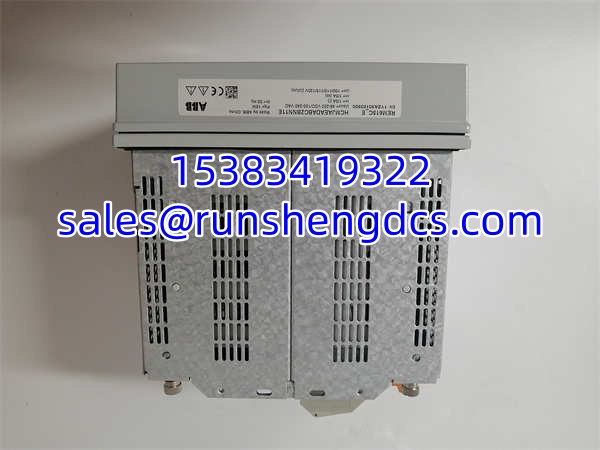
ABB REM615 HCMJAEADABC2BNN11E
Application Scenarios
- Mining Conveyor Drives: Protecting high-inertia motors from stall and unbalance conditions in dusty, high-vibration environments where the REM615’s ruggedized design shines.
- Water Treatment Pump Stations: Monitoring motor health and energy consumption for VFD-fed pumps, using the integrated Modbus to feed data to legacy PLCs without extra hardware.
- Cement Mill Fans: Providing thermal overload protection for motors that cycle frequently, using the accurate thermal model to prevent unnecessary restart delays.
FAQ
Is the HCMJAEADABC2BNN11E code critical?
Yes. It defines the factory-set protection functions, communication protocols, and hardware options. A different code might lack the specific IEC 61850 edition or have different CT inputs. Always match the full code or verify the configuration file.
Can I use this for VFD-fed motors?
Yes, but you must configure the “VFD Supply” setting and adjust the thermal model. VFDs introduce harmonic heating that standard thermal models don’t account for. The has specific settings for this; don’t ignore them.
Does it support IEC 61850 Edition 2?
Most units are Edition 1. Check the label or the “Product Information” menu. If your SCADA requires Edition 2, you may need a newer revision or a different model. Verify before ordering.
How do I reset the thermal image?
You can force a thermal reset via the HMI or a binary input, but only if the motor is actually cold. Forcing a reset on a hot motor bypasses protection and risks damage. Use the “Thermal Reset” function only after verifying the motor temperature.
Is the web HMI secure?
It has basic password protection, but it’s not enterprise-grade. For critical infrastructure, put the relay on a separate management VLAN or use the serial port for configuration. Don’t expose it directly to the corporate network.
What’s the max CT ratio?
Typically 1000:1 or 2000:1, depending on the hardware revision. Check the “Rated Current” setting in the menu. If your CT is 3000:1 and the relay maxes at 2000:1, you’ll need an external CT or a different relay model.