
Description
Key Technical Specifications
| Parameter | Value / Note |
|---|---|
| Product Type | AC 800M Processor Unit / CPU |
| Manufacturer | ABB |
| Model | PM866K01 |
| Order Code | 3BSE050198R1 |
| Processor | MPC866, 133 MHz |
| Memory | 64 MB RAM (approx. 51.4 MB available for application) |
| Firmware Storage | 4 MB Flash PROM |
| Power Supply | 24 VDC (19.2–30 VDC) |
| Power Consumption | Typ. 210 mA / Max. 360 mA at 24 VDC; approx. 5.1 W typ., 8.6 W max. |
| Redundancy | Supported (CPU, CEX-bus, communication, S800 I/O); switchover ≤ 10 ms |
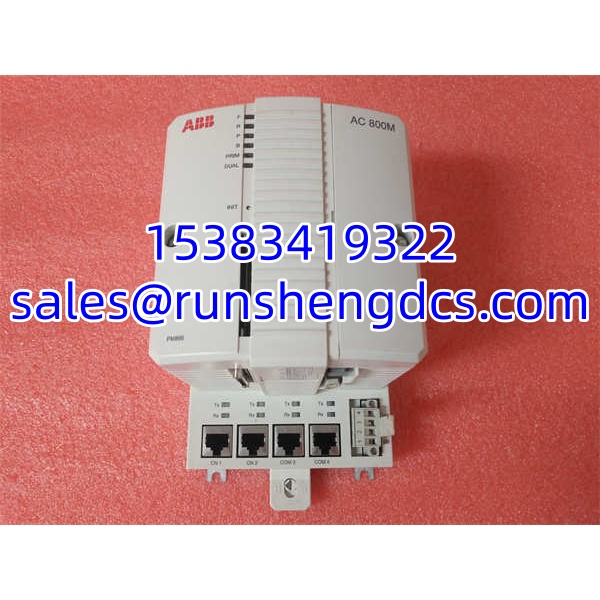
| Ethernet Ports | 2 × RJ45 (CN1, CN2) for control network |
| Serial Ports | COM3: RS-232C with modem signals; COM4: isolated, for configuration |
| I/O Bus | S800 I/O via ModuleBus; CEX-bus for communication modules |
| Baseplate | TP830 (required for mounting and external connections) |
| IP Rating | IP20 (panel/cabinet mounting) |
| Backup Battery | 3.6 V lithium battery for RAM retention |
| Documentation Status | No complete OEM datasheet confirmed in public sources; verify against ABB manual |
Product Introduction
The ABB PM866K01 3BSE050198R1 is a processor unit for the AC 800M controller family, used within ABB System 800xA and related process automation architectures. It serves as the central execution engine for control logic, sequence handling, communication management, and I/O supervision. The module mounts on a TP830 baseplate and connects to S800 I/O through the ModuleBus, while CEX-bus slots accommodate communication interfaces such as PROFIBUS DP, RS-232, and Ethernet-based links.
This unit is rated for redundant operation, meaning two PM866 processors can run in primary/backup configuration to reduce downtime during CPU or communication failures. Its 133 MHz MPC866 processor and 64 MB RAM place it in the mid-range segment of the AC 800M family—suitable for many process control loops, machine control tasks, and distributed I/O applications.
Some surplus listings label PM866K01 as a “tension controller” or “high-integrity” module. In practice, PM866K01 is a general-purpose AC 800M CPU; tension control, safety functions, or high-integrity behavior are achieved through application configuration, licensed function blocks, and system design rather than by the hardware alone.
QA/QC Transparency SOP
- Nameplate & Order Code Verification
Confirm ABB branding, PM866K01, 3BSE050198R1, serial number, hardware revision, and manufacturing date. Verify that the module is not a PM866A, PM866K02, or PM867 variant unless explicitly documented. - Baseplate & Connector Inspection
Inspect the TP830 baseplate, backplane contacts, Ethernet ports (CN1/CN2), serial ports (COM3/COM4), and CEX-bus connectors. Check for bent pins, corrosion, or damaged locking mechanisms. - Power-Up & LED Diagnostics
Apply 24 VDC within the 19.2–30 VDC range. Verify normal LED sequence, RUN/ERR status, and absence of persistent fault indicators. Confirm the backup battery is present and not depleted. - Redundancy & Communication Check
If configured redundant, verify primary/secondary synchronization, switchover behavior, and network address assignment. Test Ethernet connectivity and serial port access per plant procedure. - I/O Bus Validation
Confirm ModuleBus recognition of connected S800 I/O modules and CEX-bus communication modules. Check for bus faults, missing modules, or address conflicts. - Final Documentation & Packaging
Record revision, observed configuration, test results, and any missing accessories (battery, CF card, baseplate). Pack in anti-static packaging with moisture protection.
Field Engineer Gotchas
- PM866K01 vs. PM866A / PM866K02
Risk: Suffixes indicate different firmware, redundancy, or high-integrity capabilities.
Fix: Match the full order code 3BSE050198R1 exactly.
Warning: A PM866A or PM866K02 may not be a drop-in replacement without configuration review. - Requires TP830 baseplate
Risk: The CPU cannot operate without the correct baseplate.
Fix: Confirm the baseplate type and Ethernet address label.
Warning: Replacing the CPU without verifying the baseplate can cause network address conflicts. - Not a standalone “tension controller”
Risk: Aftermarket descriptions may oversimplify its role.
Fix: Treat it as an AC 800M CPU; tension or process behavior comes from the control application.
Warning: Swapping CPUs without restoring the correct application can disrupt the process. - Redundancy is not automatic
Risk: Installing a second PM866 does not create redundancy by itself.
Fix: Verify redundancy licensing, cabling (TK851V010/TB852), and Control Builder M configuration.
Warning: A mismatched redundant pair may fail over unpredictably. - Backup battery failure
Risk: A depleted 3.6 V battery can cause loss of RAM-retained data after power loss.
Fix: Replace the battery per ABB procedure before commissioning.
Warning: Do not remove power while replacing the battery unless the system allows it. - CEX-bus module compatibility
Risk: Not all CI85x/BC810/BC820 modules are compatible with every firmware revision.
Fix: Cross-check the CEX module part numbers against the controller firmware.
Warning: An incompatible communication module can prevent startup or cause bus faults.
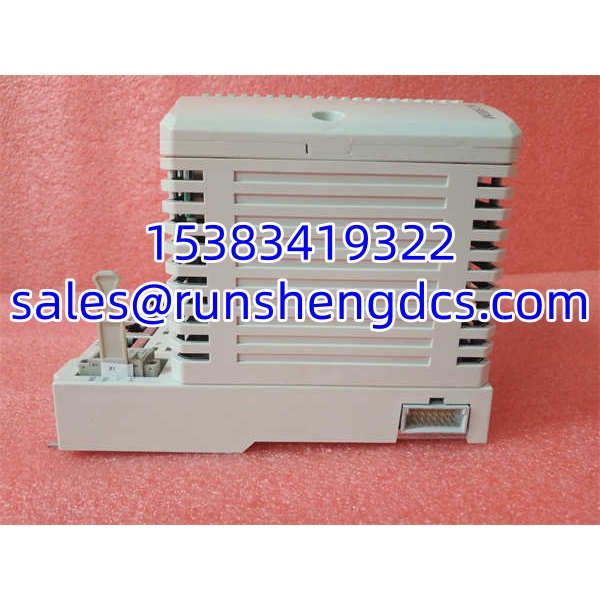
ABB PM866K01 3BSE050198R1
Application Scenarios
- Process control in chemical, oil & gas, and power
Executes PID loops, interlocks, and sequence control for continuous processes. - DCS replacement or expansion
Used when upgrading or maintaining an existing AC 800M controller rack. - Redundant CPU architecture
Deployed in primary/backup pairs to maintain availability during CPU or communication failures. - Machine and skid control
Suitable for packaged equipment requiring Ethernet connectivity, serial diagnostics, and S800 I/O.
FAQ
It is an AC 800M processor unit used as the CPU in ABB System 800xA and AC 800M control systems.
Is it a tension controller?
Not inherently. Some listings describe it that way, but is a general-purpose AC 800M CPU. Tension control depends on the application program and connected I/O.
Does it support redundancy?
Yes. supports CPU redundancy with appropriate baseplate, cabling, and configuration.
What baseplate does it need?
It typically mounts on a TP830 baseplate, which provides Ethernet, serial, and power interfaces.
Can it replace PM866A or PM866K02?
Not automatically. Suffix differences may affect redundancy, high-integrity features, or firmware compatibility. Always verify the full order code.
What programming software is used?
AC 800M controllers are configured using Control Builder M within the System 800xA environment.
Do you provide firmware loading?
For surplus units, firmware and application restoration must be confirmed separately. Do not assume the module contains a valid application.