
Description
Key Technical Specifications
| Parameter Name | Parameter Value |
|---|---|
| Product Model | PM511V16 3BSE011181R1 |
| Manufacturer | ABB |
| Product Series | PM500 / AC500 |
| Logic Supply Voltage | 24V DC |
| Mounting Style | DIN Rail |
| Processor Type | Integrated Microprocessor |
| I/O Expansion | Modular Backplane |
| Communication | Integrated Serial/Ethernet (Verify Rev) |
| Operating Temp | 0°C to 60°C |
| Humidity | 5% – 95% (non-condensing) |
| Protection Class | IP20 |
| Dimensions | ~100mm x 120mm x 70mm |
Product Introduction
Finding a clean, functional CPU for a legacy PM500 system is a race against time. The ABB PM511V16 3BSE011181R1 isn’t just a spare part; it’s the only thing keeping a 15-year-old water treatment plant from going manual. This module handles the dirty work of real-time logic execution and PID loops, sitting at the top of the rack while the I/O modules do the heavy lifting in the field.
Engineers keep these on the shelf because the replacement path isn’t always a simple drop-in. With a 0°C to 60°C operating range, it handles unconditioned electrical rooms better than modern office-grade controllers. Bottom line: if your 3BSE011181R1 is flashing red, you don’t have time for a migration project. You need this exact board, tested and ready to take the existing program.
QA/QC Transparency SOP
We don’t trust “New Old Stock” labels. Every PM511V16 3BSE011181R1 undergoes a rigorous five-step validation to ensure it won’t brick your process:
- Intake & Origin Verification: We trace the serial number against ABB production batches to filter out high-quality counterfeits. Visual inspection checks for cracked headers or bulging electrolytic capacitors.
- Live Functional Testing: Module is mounted on a live PM500 test rack. We load a verified test program and force I/O to confirm scan times and logic execution.
- Electrical Parameter Tests: Fluke 115 verifies the 24V DC rail stability and checks for continuity on all backplane pins. No open circuits or voltage drops.
- Firmware/Config Verification: We read the internal EEPROM to ensure no hidden fault flags or corrupted boot sectors exist from previous deployments.
- Final QC & Anti-Static Packaging: Module is sealed in ESD-safe shielding with a printed test report. No bare PCBs in bubble wrap.
Field Engineer Gotchas
- Firmware Revision Mismatch: The 3BSE011181R1 suffix is critical. Risk: A “V16” with a different internal revision might reject your existing program or fail to handshake with older I/O modules. Fix: Always photograph the full label, including the revision code, before pulling the old unit. I’ve seen a tech waste 6 hours because he matched the model but missed the “R1” vs “R2” difference.
- Backplane Pin Damage: These modular CPUs rely on gold-plated edge connectors. Risk: Forcing the module into a misaligned slot bends the pins, causing intermittent faults that look like software bugs. Fix: Always use the alignment guides. If it requires more than 5 lbs of force, stop. Inspect the backplane for debris.
- 24V DC Ripple: The internal switching regulator is aging. Risk: If your panel power supply has >5% ripple, the CPU will reset during high-load scans. Fix: Measure with an oscilloscope. A cheap multimeter won’t catch the spikes. Add a local 470µF capacitor if the run is long.
- ESD Sensitivity: The integrated comm ports have minimal protection. Risk: Touching the RJ45 or serial pins while ungrounded will kill the transceiver instantly. Fix: Wrist strap mandatory. Treat it like a bare CPU, not a light switch.
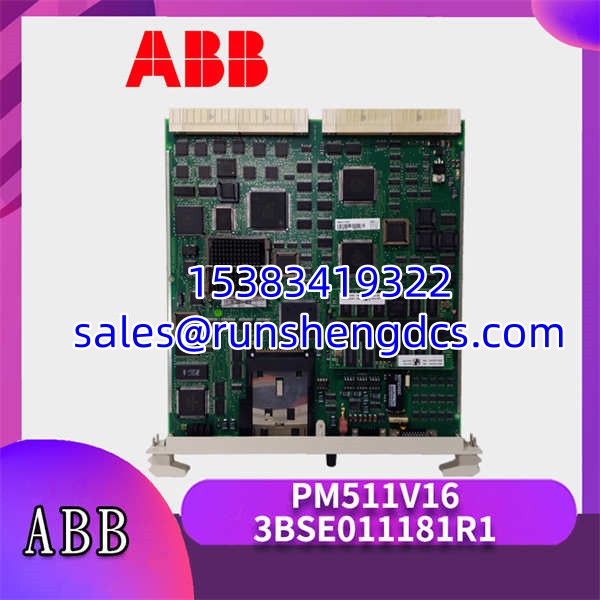
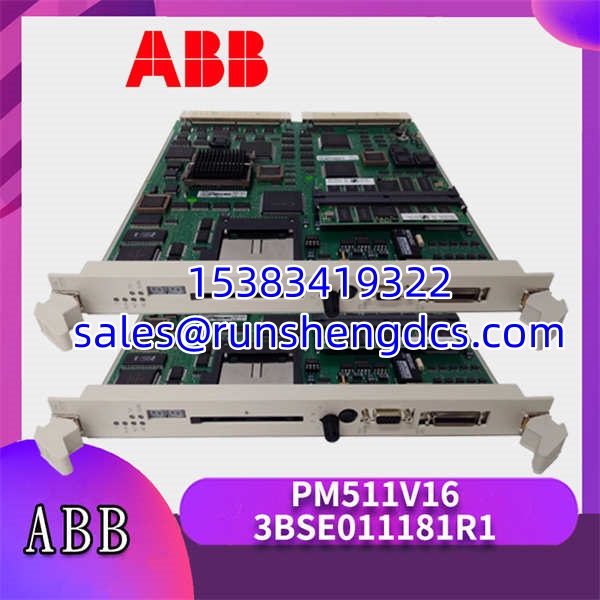
ABB PM511V16 3BSE011181R1
Application Scenarios
- Water/Wastewater Lift Stations: Maintaining legacy pump control logic in remote, unconditioned buildings where modern Ethernet-based systems fail due to heat and humidity.
- Food & Beverage Packaging Lines: Keeping 20-year-old filler controllers running during peak season when capital for a full retrofit isn’t available.
- Marine Ballast Water Systems: Replacing failed CPUs in tight, vibrating engine room cabinets where vibration-rated PM500 modules are still the standard.
FAQ
Is the PM511V16 still supported by ABB?
Officially, it’s in the “Classic” or “Legacy” phase. Support is limited to spare parts. For new projects, ABB pushes the AC500-eCo or PM5000 series. But for maintenance? This board is still the gold standard for reliability.
Can I use a PM511V08 instead?
Generally, no. The V08 has less memory and slower scan times. While physically compatible, your program might exceed the V08’s resource limits, causing “Program Too Large” errors. Stick to the V16 or higher.
Does this support hot-swapping?
No. The PM500 series does not support hot-swapping the CPU. You must power down the backplane. Attempting a hot-swap will likely corrupt the program memory and damage the backplane.
How do I verify the firmware version?
Connect via the serial port using ABB Automation Builder or the legacy PS501 software. The “Online > Module Info” dialog will show the exact firmware revision. Match this to your backup before swapping.
What’s the max program size?
The PM511V16 typically supports up to 256KB of program memory and 128KB of data. If you’re close to the limit, consider optimizing your code or upgrading to a PM513 before you hit a wall during a future expansion.
Is the 3BSE011181R1 the same as 3BSE011181R2?
Mechanically, yes. Electrically, usually. But firmware compatibility can vary. Always verify the exact suffix on your failed unit. We test for cross-revision compatibility, but your specific application might have unique constraints.