Description
Key Technical Specifications
- Input Signal Range: 0-20 mV/V (Optimized for bridge strain gauge sensors)
- Analog Outputs: Dual isolated outputs (4-20 mA and 0-10 V)
- Excitation Voltage: Built-in 5V DC or 10V DC for sensor power
- System Response Time: < 10 ms
- Measurement Accuracy: Typical non-linearity error ≤ ±0.05% F.S.
- Operating Temperature: 0°C to +55°C
- Protection Rating: IP20 (DIN Rail Mount)
- Power Supply: 24V DC
- Filtering: Adjustable low-pass filter (0-50 Hz)
- Calibration: Zero calibration (Tare) and gain adjustment supported
Product Introduction
Web handling processes live or die by tension stability. The ABB PFEA111-20 (3BSE050090R20) is engineered specifically for this task. It acts as a high-precision tension amplifier that takes the weak millivolt differential signals from load cells (like the PFTL series) and conditions them into robust, standard industrial analog signals. Instead of sending noisy raw signals across the plant, this module handles amplification, filtering, and linearization right at the source.
This module is a workhorse for continuous manufacturing lines. With a rapid response time of under 10 ms and an accuracy of ±0.05% F.S., it ensures that winding, unwinding, and web guiding systems maintain exact tension without stretching or wrinkling the material. The built-in adjustable low-pass filter (0-50 Hz) is a critical feature for ignoring mechanical vibrations from rollers while capturing true tension changes. Bottom line — it provides the clean, reliable signal your PLC or DCS needs to keep the web running smoothly.
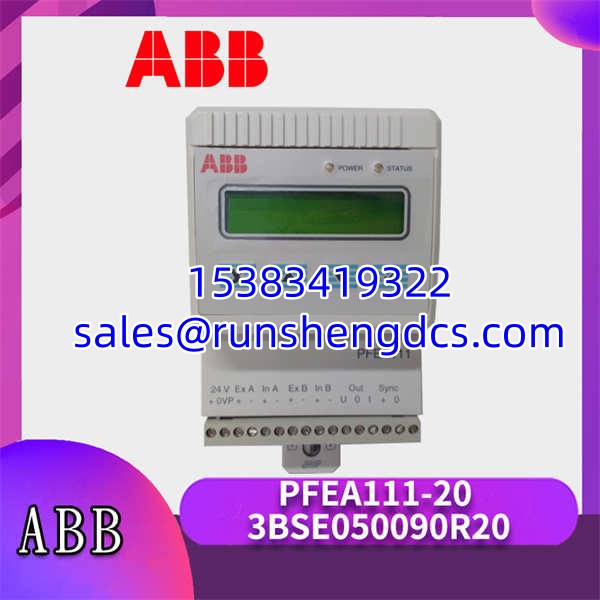
ABB-PFEA111-20-3BSE050090R20
QA/QC Transparency SOP
- Intake & Origin Verification: We trace every PFEA111-20 back to its source, rejecting units with physical damage or unknown history.
- Live Functional Testing: Modules are mounted on a test bench with a simulated tension load cell to verify signal amplification and dual analog outputs.
- Electrical Parameter Tests: We use calibrated multimeters to verify the 24V DC supply tolerance, excitation voltage stability, and output linearity.
- Firmware/Config Verification: Internal parameters are checked to ensure zero-calibration (Tare) and gain settings are intact and adjustable.
- Final QC & Anti-Static Packaging: Each module is sealed in ESD-safe shielding to prevent electrostatic damage during transit.
Field Engineer Gotchas
- Sensor Range Mismatch: The “-20” in PFEA111-20 means it is calibrated for a maximum 20mV/V input. Connecting a 65mV/V sensor (like those for the PFEA111-65) will cause immediate saturation and erratic readings. Always match the suffix to the sensor.
- Shield Grounding Errors: Tension signals are micro-volts. If your analog output is bouncing wildly, check the shield wire. It must be grounded at the controller end only, and kept away from VFD power cables.
- Mechanical Pre-load Ignored: Failing to perform a Zero Calibration (Tare) after installation means the controller will treat the mechanical weight of the roller as actual web tension. Always tare the system with the web completely removed.
- War Story: I once saw a tech swap a failed amplifier without checking the sensor cable. The new module worked perfectly for an hour, then started drifting wildly. Turns out, a forklift had nicked the shield wire in the cable tray, letting VFD noise straight into the mV lines. Always megger-test the sensor cable if the new module acts up.
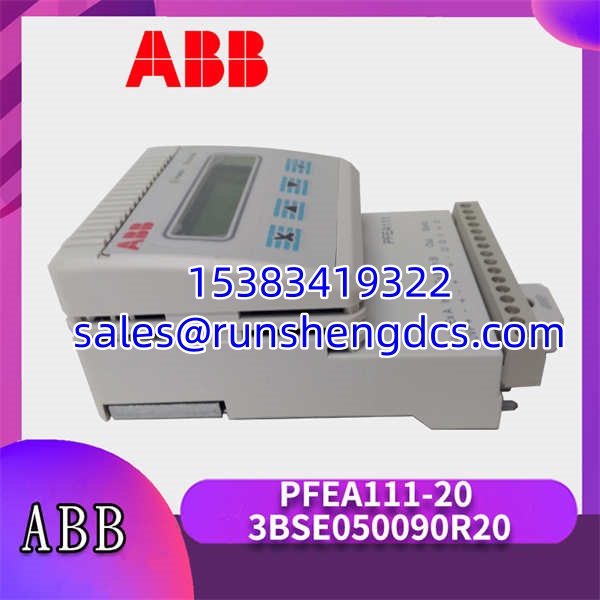
ABB-PFEA111-20-3BSE050090R20
Application Scenarios
- Paper & Pulp Manufacturing: Maintains precise web tension across drying cylinders to prevent paper breaks and reduce waste.
- Metal Foil Slitting: Requires ultra-fast response (<10ms) to handle high-speed metal foil without stretching or tearing.
- Textile & Film Winding: Uses dual-channel inputs to monitor left/right tension differences, preventing roll telescoping.
- Case Study: A BOPP film producer was experiencing a 37% variance in roll tightness due to slow tension response during speed changes. Upgrading to the PFEA111-20’s sub-10ms response time and tuning the internal PID loop eliminated the松紧度 (tightness/looseness) variance, significantly improving downstream converting quality.
FAQ
- Can I use this with a third-party PLC?
Yes. The 4-20mA and 0-10V outputs are isolated and standard. It will drop right into a Siemens S7, Allen-Bradley ControlLogix, or any standard analog input card. - My output is reading Err-05. What does that mean?
Err-05 indicates a sensor signal fault. This usually means the load cell is damaged, the cable is broken, or the configured range in the controller doesn’t match the actual sensor. Check the wiring with a multimeter first. - Is the PFEA111-20 interchangeable with the PFEA111-65?
No. The 111-20 is limited to 20mV/V sensors, while the 111-65 handles up to 65mV/V. Swapping them without changing the sensor will result in severe measurement errors. - Does this module have built-in PID control?
No. The PFEA111-20 is a signal conditioner and amplifier. It outputs a scaled analog signal to an external PLC, DCS, or dedicated drive for closed-loop PID control. - How do I calibrate this module?
You can perform a Zero (Tare) calibration using the front panel buttons when the roller is empty. Full span calibration requires applying a known physical weight or using ABB’s TensionTool software. - Can I hot-swap this module?
No. Pulling it while powered will disrupt the analog signal to the PLC and may cause process upsets. Schedule a brief stop to replace it safely.