Description
Key Technical Specifications
- Channel Count: 15 analog input signal paths
- Associated Module: SPFEC Analog Input Module
- System Architecture: ABB Symphony Plus / HR Series
- Signal Type: Supports standard industrial analog signals (e.g., 4-20mA, 0-10V)
- Mounting: Designed for 19″ rack-style cabinet installation
- Associated Base: NFTP01 Field Termination Panel (accommodates 2 units)
- Wiring Interface: Compatible with NKAS/NKHS/NKLS pre-wired cable assemblies
- Application Domain: Process control, power generation, water treatment
- Safety/Compliance: Industrial-grade signal isolation design
Product Introduction
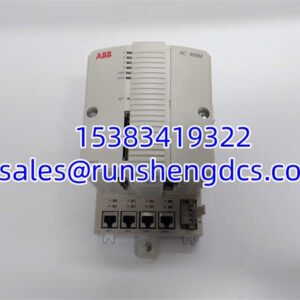
Intermittent sensor readings and signal drift in legacy DCS systems rarely point to a bad transmitter first — they usually point to a degraded termination board. The ABB NTAI05 is the physical bridge between your field wiring and the SPFEC analog input module. It provides 15 dedicated signal paths, ensuring that raw 4-20mA or voltage signals reach the processing module without degradation or cross-channel interference.
This termination unit is a foundational component in the ABB Symphony Plus and HR Series architectures, widely deployed in power generation and heavy process control. With 15 channels per board, it maximizes cabinet density while maintaining strict signal isolation. Bottom line — replacing a corroded or failing NTAI05 restores signal integrity instantly, and it is significantly cheaper than re-engineering your entire analog I/O architecture.
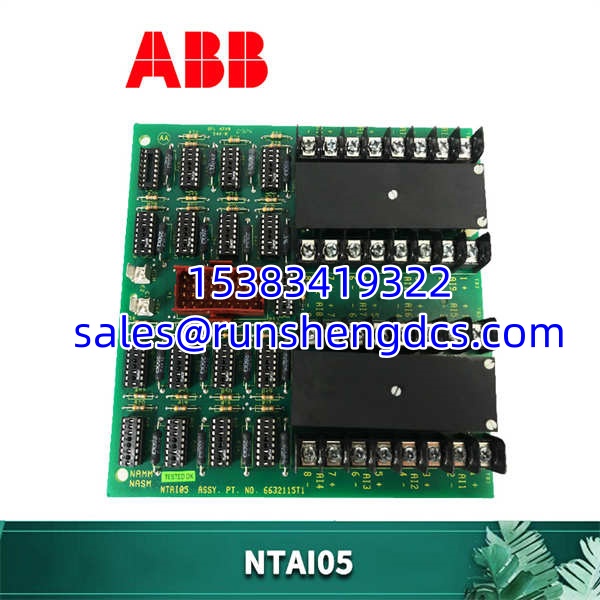
ABB-NTAI05
QA/QC Transparency SOP
Termination boards look simple, but internal trace corrosion causes nightmares. Here is how we verify them:
- Intake & Origin Verification: Inspect PCB traces, solder joints, and terminal blocks under magnification. Check for oxidation, lifted pads, or unauthorized rework.
- Continuity & Isolation Testing: Use Fluke multimeters to verify all 15 signal paths have proper continuity to the SPFEC interface pins. Megger test between channels to confirm isolation barriers are intact.
- Live Functional Testing: Mount on an NFTP01 base in a test rack. Inject calibrated 4-20mA signals and verify accurate passthrough to the SPFEC module via the DCS diagnostic interface.
- Terminal Block Inspection: Torque-test screw terminals and inspect for stripped threads or cold solder joints that cause intermittent field connections.
- Final QC & Anti-Static Packaging: Clean contact surfaces, seal in ESD-safe bags with desiccant, and pack with rigid edge protection to prevent PCB flex during shipping.
Field Engineer Gotchas
- Pre-Wired Cable Mismatch: The NTAI05 uses specific ABB pre-wired cables (NKAS, NKHS, NKLS series). Warning: I’ve seen techs force a non-spec cable into the connector, bending pins and creating intermittent shorts. Always verify the cable part number matches the NTAI05 pinout diagram.
- Single-Point Grounding: Analog termination boards are susceptible to ground loops. Reality check: If you’re seeing 60Hz hum on your 4-20mA signals, verify your shield grounding. Use shielded twisted-pair cable and ground the shield at ONE end only — typically the cabinet side.
- NFTP01 Base Compatibility: The NTAI05 mounts on the NFTP01 Field Termination Panel, which holds two units. Lesson learned: Don’t assume any old Bailey termination base will work. Verify the NFTP01 part number and check for bent socket pins before installing the new board.
- Channel Allocation Confusion: This board has 15 channels, not 16. Caution: When migrating from an NTAI06 (16-channel), your DCS configuration will have one unused channel. Document this explicitly in your as-built drawings to prevent future troubleshooting headaches.
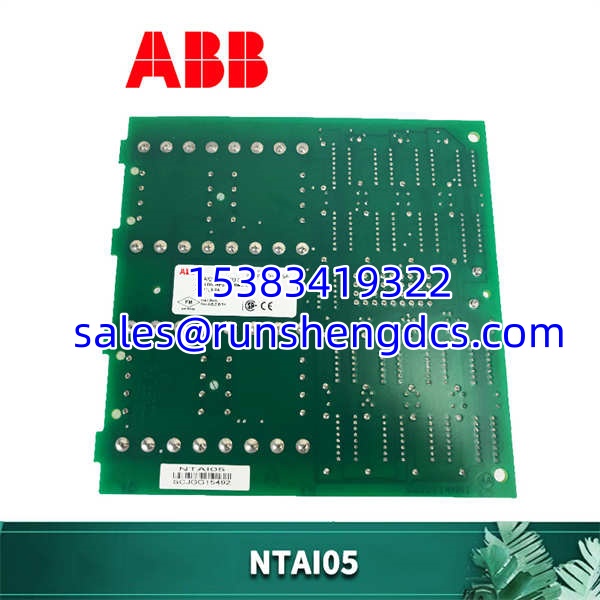
ABB-NTAI05
Application Scenarios
- Power Plant Boiler Control: High-temperature environments degrade PCB solder joints over decades. Replacing the NTAI05 restores accurate thermocouple and pressure transmitter readings for critical boiler safety loops.
- Chemical Reactor Temperature Monitoring: Precise analog signal routing prevents false trip conditions. The 15-channel density allows comprehensive reactor profiling without expanding cabinet footprint.
- Water Treatment pH/Flow Control: Harsh chemical environments corrode terminal blocks. Swapping a degraded eliminates erratic pH readings that cause improper chemical dosing.
- Legacy System Life Extension: Plants running 20+ year old Symphony systems face OEM obsolescence. The is often the first component to fail due to environmental stress, and replacing it extends system life by another decade.
FAQ
A: Physically, they mount on the same NFTP01 base. But the NTAI06 has 16 channels and interfaces with the SPASI module, while the has 15 channels and interfaces with SPFEC. The pinouts and module compatibility differ. Do not substitute without verifying your SPFEC module configuration.
Q: Does this board require any firmware or software configuration?
A: No. The is a passive termination unit — it has no firmware, no EPROM, and no configuration parameters. It is purely a signal routing and conditioning board. Plug it in and verify channel readings in your DCS.
Q: My old board has 2 channels that read zero. Is the whole board bad?
A: Likely yes. Individual channel failure on a termination board usually indicates internal trace corrosion or a damaged connector socket. Repairing individual channels is unreliable for safety-critical applications. Replace the entire unit.
Q: What pre-wired cable do I need for this board?
A: The typically uses NKAS01-15, NKHS03-15, or NKLS01-10 pre-wired cables depending on your cabinet layout and SPFEC module type. Pull the part number from your existing cable or consult your original as-built documentation.
Q: Can I hot-swap this termination board?
A: Absolutely not. This is a passive wiring interface connected directly to live field signals. Always de-energize field loops and remove power from the SPFEC module before replacing the . Hot-swapping will arc the terminals and damage both the board and the module.
A: Measure resistance across each channel at the terminal block and compare to the SPFEC module input. If the terminal block reads correctly but the DCS shows bad values, the board’s internal traces are degraded. Also inspect for visible corrosion, discoloration, or loose terminal screws.