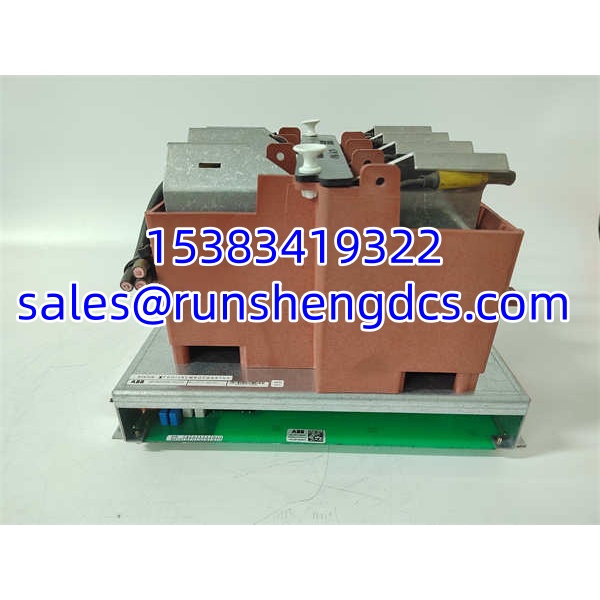

Description
Key Technical Specifications
| Parameter | Typical Value |
|---|---|
| Manufacturer | ABB |
| Order Code | 3BHB004661R0101 |
| Model Designation | KUC711AE101 / KU C711 AE |
| Product Type | Gate Unit Power Supply (GUSP) |
| Primary Application | MV drive gate power; excitation system gate supply |
| Compatible Systems | ABB ACS1000, ACS6000, SVC/STATCOM, excitation cabinets |
| Auxiliary Output | 24 V DC |
| Output Current | 4–10 A, version-dependent |
| Gate Output | Typically +15 V / −8 V for IGBT/IGCT drivers |
| Fiber-Optic Trigger Delay | ≤50 ns |
| High-Voltage Isolation | Several kV; verify against OEM nameplate |
| Operating Temperature | −20 °C to +60 °C (verify with label) |
| Protection Class | IP20 |
| Weight | Approx. 4.6 kg |
Product Introduction
Replacing a gate-unit supply in a live MV drive cabinet is not a “swap and pray” job. If the gate supply is marginal, the power semiconductors either refuse to turn on cleanly or trip on desaturation faults that look like IGBT failures. The KUC711AE101 sits exactly at that boundary between low-voltage control logic and medium-voltage power switching.
It is an ABB Gate Unit Power Supply used to feed isolated gate-driver boards and carry fiber-optic trigger signals in ACS1000/ACS6000-type converters and excitation systems. Its real value is electrical isolation plus deterministic trigger timing — the ≤50 ns fiber-optic delay matters when multiple series-connected devices must fire together. Do not treat it as a general-purpose 24 V DC power supply. It belongs to the power-conversion safety path.
QA/QC Transparency SOP
- Intake & Origin Verification: Confirm order code 3BHB004661R0101 and model KUC711AE101. Check for burnt resistors, swollen capacitors, cracked fiber-optic ports, and corrosion on high-voltage terminals.
- Live Functional Testing: Apply rated auxiliary input in a controlled test setup. Verify 24 V DC output stability, gate-output rails, and fiber-optic transmit/receive behavior with a known-good driver interface.
- Electrical Parameter Tests: Check output ripple, load regulation, fuse/PTC continuity, and isolation resistance between control-side and power-side circuits. Inspect connector pin tension.
- Firmware/Config Verification: Record any onboard firmware, calibration labels, jumper positions, or board revisions. Compare against the removed unit and the drive/excitation cabinet documentation.
- Final QC & Anti-Static Packaging: Bag in ESD packaging, photograph nameplate and test readings, and ship with a test summary. No internal calibration or isolation testing beyond safe limits is performed without OEM guidance.
Field Engineer Gotchas
- R0101 is not interchangeable with other R01xx revisions. ABB uses suffix revisions to change firmware, isolation ratings, or connector layouts. Installing the wrong revision can cause false gate faults or failed trigger signals. Match the exact order code.
- Fiber-optic connector contamination. Dust or oil on the fiber tip increases attenuation and can cause intermittent gate faults. Clean with proper fiber tools, not compressed air from a dirty shop line.
- Auxiliary 24 V DC instability. If the 24 V rail sags under load, the gate driver may misinterpret turn-on/turn-off states. Measure ripple and load regulation before blaming the IGBT/IGCT module.
- Isolation breakdown after moisture exposure. These modules live near high dv/dt nodes. A unit pulled from a humid cabinet may pass a cold test but fail under voltage stress. Treat any corrosion or white residue as a reject unless tested by OEM standards.
- Surplus description traps. Listings that call this a PLC CPU, robot controller, or Ethernet gateway are unreliable. The verified identity is a gate-unit power supply for MV drive/excitation applications.
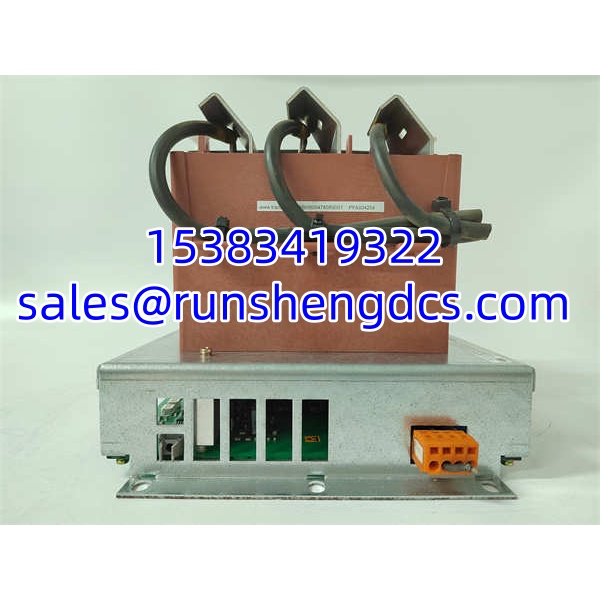
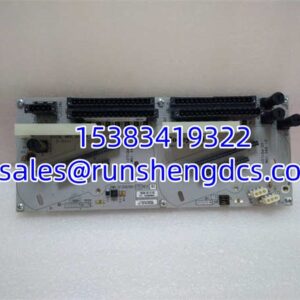
ABB KUC711AE101 3BHB004661R0101
Application Scenarios
- ACS1000 medium-voltage drive gate fault: One phase repeatedly reports IGBT desaturation. The gate resistors and power module check out, but the GUSP gate-output rail shows excess ripple under load. Replacing the KUC711AE101 stabilizes gate voltage and clears the fault.
- Excitation cabinet fiber-trigger loss: A generator excitation system loses trigger acknowledgment on one bridge arm. The fiber-optic receiver on the GUSP module has degraded sensitivity. Swapping the module restores synchronized firing.
- MV drive refurbishment project: During a planned outage, several aged gate-unit supplies are replaced. The new surplus units must match the original R0101 revision, fiber connector type, and gate-output polarity before the cabinet is re-energized.
FAQ
Is KUC711AE101 a PLC CPU module?
No. Despite some third-party listings, 3BHB004661R0101 is a Gate Unit Power Supply for MV drives and excitation systems, not an AC 800M or Symphony Plus CPU.
Can I substitute another KUC711 revision?
Not without OEM confirmation. R0101 may differ from R0001 or other R01xx versions in firmware, connectors, or isolation specs.
Does it provide the main converter power?
No. It supplies low-power gate-driver rails and auxiliary 24 V DC. The main DC link and AC supply come from the converter power stage.
What happens if the fiber-optic trigger fails?
The associated power device will not fire correctly, which can cause unbalanced voltages, desaturation trips, or excitation loss.
Is hot-swapping allowed?
Only if the cabinet design, interlocks, and OEM procedure explicitly allow it. Gate-unit supplies sit inside high-voltage equipment; treat them as energized until proven otherwise.
Where should I verify exact specs?
From the module nameplate, the ABB drive/excitation cabinet manual, and the site-specific configuration record. Surplus datasheets are often inconsistent.